
Why Is My Exterior Paint Peeling? Subsurface Moisture
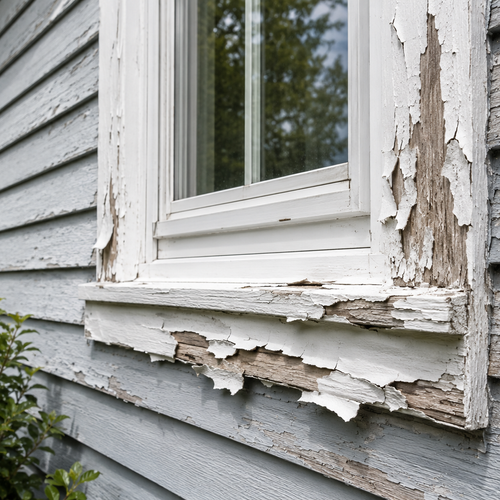
The paint on the back of your house is coming off in chips around the window trim — not crumbling, just curling up at the edges and letting go in sheets. You painted that side two summers ago. Maybe three.
But that curling edge is telling you something. Not about the paint. About what's happening in the wall behind it.
Blisters first, peeling second
The sequence almost always goes the same way. You get blisters first — raised bubbles where the paint film has separated from the wood underneath. Those bubbles are full of water vapor or liquid water, depending on how far along the failure is. They can sit there for a full season before they pop. Once they pop or crack from a freeze, the underlying wood is bare, and the surrounding paint starts lifting at the edges. That's the peeling you're looking at.
The blister is the symptom of active moisture. The peel is what happens after it.
This matters because treating peeling paint as a surface problem — scraping and repainting — doesn't fix anything. Six months later, the same spot peels again. The moisture is still there.
Where the moisture is actually coming from
Most people assume peeling paint means rain got in. Rain is one source. But on most older wood-sided homes, the primary driver is vapor coming from inside.
Here's the mechanism. Your home's interior in winter is warm and loaded with water vapor — from cooking, showering, running the dishwasher, breathing. That vapor moves toward cold surfaces, which means it pushes outward through porous wood siding. When the vapor hits the paint film on the cold exterior side, it condenses into liquid water right at the paint-wood interface. That thin film of water is under pressure. It pushes the paint away from the wood. That's a blister forming from the inside out.
Think of it like a plastic bag sealed over a wet cloth — even if the outside surface is bone dry, the moisture trapped inside has nowhere to go but against the barrier. The barrier eventually gives.
Interior vapor drive is worst on north-facing walls in winter, where the temperature differential between your heated interior and the exterior surface is the most extreme. It intensifies in January and February, when indoor humidity from daily household activity is highest while outdoor air is bone-dry. Humidity inside an older home in Minnesota can sit above 45% while the outdoor air is near zero relative humidity. The vapor pressure pushing outward is enormous.
Rain intrusion is the other path. If the caulk around your windows or door frames has cracked, water enters those gaps during rain and soaks into the wood. The same happens when gutters overflow or a downspout joint leaks and dumps water directly against the siding. Wood that stays consistently wet never lets paint bond cleanly to it — and any paint already on that surface lifts.
Reading the pattern before you repaint
Peeling in different locations points to different causes. The table below gives you a starting point before picking up a scraper.
| Where You See It | Most Likely Cause | Urgency |
|---|---|---|
| North-facing wall, spreading from lower boards upward | Interior vapor drive | Moderate — fix ventilation source before repainting |
| Narrow strip around windows and door frames | Failed caulk or flashing letting rain in | High — replace caulk before any painting |
| Near roofline and soffit on north or east side | Ice dam water traveling down behind fascia | High — identify ice dam source first |
| Low on wall, near foundation | Ground splash, poor drainage, or grade pitched toward house | Moderate — correct drainage before repainting |
| South-facing or west-facing walls, widespread | UV breakdown of old film + seasonal rain infiltration | Moderate — full surface prep required |
| Isolated to one area near a downspout | Gutter overflow or leaking gutter joint | Lower — fix gutter, then repaint section |
Ice dams deserve their own note here. When warm interior air escapes into the attic and heats the roof deck, snow melts and runs toward the cold eave, where it refreezes. That ice dam backs up liquid water that travels horizontally behind the soffit trim and down into the top of the wall cavity. It saturates the top courses of siding from the inside. The exterior paint blisters and peels starting at the roofline and works its way down a few boards.
On any wall where peeling starts near the top and works downward, check the attic insulation and air sealing above that wall before committing to a repaint. Fixing the surface without fixing the ice dam source puts you back in the same spot next spring.
UV breakdown on south- and west-facing walls follows a different path. Ultraviolet radiation breaks down the resin binders in paint — the film goes brittle, develops micro-cracks, and loses its ability to flex with seasonal wood movement. Once the film is cracked, rain gets in through those cracks during summer storms. Freeze-thaw cycles do the rest through fall and winter.
Why the damage spreads after it starts
A small peeling area doesn't stay small. Once the paint film has failed in one spot, bare wood is exposed to every rain, frost, and temperature cycle. Wood absorbs water fast and releases it slowly. In a freeze-thaw cycle, the absorbed water expands by about 9% as it freezes, physically prying open the wood grain. Each cycle opens the grain a little further, so the wood holds more water the next time around.
The paint at the edge of the bare area is now bonding to wood that's cycling between wet and dry. That bond gives way next. Then the paint on the adjacent board starts lifting. You can go from a six-inch blister to two square feet of bare, deteriorating wood in a single winter.
Mold follows quickly after the paint film breaks. Bare, wet wood is exactly the substrate mold needs — and once mold colonies establish in the wood grain, the surface is harder to prime and bond to even after the moisture source is resolved. You can't paint your way past established mold in wood. The wood needs treatment before any coating goes down.
What has to happen before you repaint
Scraping and repainting over an active moisture problem is the painting equivalent of patching a leaking pipe with tape. The surface looks fine for a few months, but the adhesion failure is already starting underneath.
Start with the moisture source. Use the location pattern from the table above as your guide. For interior vapor drive, the fix is typically better attic insulation and air sealing, or a bathroom exhaust fan that vents to the outside rather than dumping humid air into the attic. For exterior intrusion sources — failed caulk, gutter overflow, flashing gaps — those get corrected before any surface prep happens.
After that, the wood has to dry completely. Painting over damp wood is the most reliable way to guarantee the new paint will also peel. Wood moisture content should be below 15% before any coating goes down. On a wood-sided home after a wet spring, that typically means waiting two to three weeks of dry weather after fixing the moisture source — longer if the wood was saturated for an extended period.
Once the wood is dry, scrape and sand the damaged area back to sound material. The edge of the old paint needs to be feathered so the new coating blends at the surface rather than creating a raised ridge that traps water. Any wood that's soft, spongy, or shows gray or black mold staining needs treatment with a wood consolidant or replacement before priming.
Then prime. Bare wood gets spot-primed before any topcoat. Exterior wood primers penetrate the grain and seal it against moisture absorption in a way topcoats can't. A topcoat applied directly to raw wood won't bond correctly and will fail faster than the paint you just scraped off. This step gets skipped constantly on quick patch jobs — and it's exactly why those patch jobs last 18 months instead of 10 years.
Frequently Asked Questions
Peeling isolated to one wall almost always has a directional cause. The north wall stays cooler and wetter — it sees fewer freeze-thaw drying cycles and less sun to pull moisture out of the wood. South and west walls take intense afternoon UV that degrades the paint film faster than north-side paint. East walls see morning condensation and driving rain. If only one side is failing, start with the location pattern table rather than assuming the whole house needs repainting.
Scraping and repainting works — but only if the moisture source has been fixed first. If the same section peels again within a year, the moisture is still active. Each repaint over an unresolved moisture problem tends to hold for a shorter period than the one before, because the wood condition is worsening, and adhesion gets harder to achieve each cycle.
Location and timing give you the best clues. Vapor-driven blisters tend to appear after cold winters, develop first on the coldest wall, and often look uniform across the field of the siding boards rather than concentrated near joints. Rain-intrusion failures tend to start at joints, caulk lines, window corners, and anywhere water can enter from outside. A moisture meter held against the siding can confirm whether wood is holding water — readings above 17–20% indicate active moisture, not just old adhesion failure.
For bare or repaired wood siding, a high-quality 100% acrylic exterior latex over a penetrating oil-based or alkyd primer is the most durable combination in cold climates. Oil-based primers bond to raw wood better than latex primers and provide a more moisture-resistant base coat. For the topcoat, a satin sheen outperforms flat on walls that see rain and moisture — flat finishes absorb water rather than shedding it, which shortens paint life on exposed surfaces.
On properly prepped wood with a quality primer and topcoat, you should get 7–10 years before normal repainting is needed. Paint that peels inside three years is almost always a prep failure, an unresolved moisture problem, or a mismatched primer. Paint that starts failing between years four and six often points to UV breakdown on south- and west-facing exposures, where the film thins and micro-cracks before moisture resistance fails.
Yes — mold in the wood grain acts as a physical barrier between the wood surface and the primer. Even after the surface mold is cleaned, bleached, and appears gone, mold threads can remain in the grain and prevent proper adhesion. Any wood that shows active mold growth should be treated with a mold-inhibiting penetrating primer specifically before the topcoat. Standard exterior primers don't contain enough fungicide to seal wood that's had an active colony.
Peeling is a reading problem before it's a painting problem
The peel is the last event in a sequence that started weeks or months earlier. By the time paint is coming off in sheets, the wood underneath has already cycled through enough wet-dry and freeze-thaw stress to change its surface properties. Repainting over the symptom without working backward through that sequence produces paint that fails again in two years instead of ten.
Moisture source. Wood condition. Primer selection. All of that comes before a brush touches the surface.
Cesar's Painting handles exterior painting and surface prep across Woodbury, Maplewood, St. Paul, Minneapolis, Bloomington, and the Twin Cities metro. We identify moisture sources before repainting so the new coat doesn't repeat the same failure. Call (651) 650-4747 to schedule a free estimate.
