
Why Is My Deck Paint Peeling So Quickly?
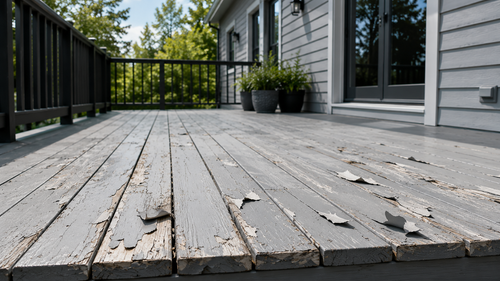
You painted the deck last spring — maybe two springs ago. Now there are patches where the paint is lifting at the board ends, curling back from the edges, and coming off in palm-sized sheets whenever you drag a chair across it. The boards underneath look dry and gray. You're standing there holding a chunk of paint the size of a business card, wondering what went wrong.
Chances are it wasn't the paint. Deck paint fails fast because of where it sits, what it's sitting on, and what happens to it between October and March. The causes are specific, they build on each other, and once you understand them, the fix is obvious — even if it's not the quick Saturday-morning project most people are hoping for.
Why decks destroy paint faster than any other surface
Your house walls shed water. Rain hits, runs down, and drains. The siding cycles through wet and dry, but it recovers between storms.
A deck is horizontal. Rain lands on it and stays. Snowmelt saturates the boards from above. Morning dew settles into the grain and sits there until afternoon. The wood gets soaked repeatedly — and each time, it swells. When it dries back out, it contracts. That expansion and contraction is constant. Not gradual.
Paint forms a film on the surface of the wood. When the wood beneath swells, the film stretches. When the wood contracts, the film compresses. Do that enough times and the film develops micro-cracks at the edges, the end grain, the seams — wherever wood movement is greatest. Once a crack opens, water gets in behind it. The next time that water freezes, it widens the crack. More water enters. More freezing. More widening.
None of that is a product defect. It's physics — and a Minnesota winter gives it everything it needs to run its full course.
The freeze-thaw mechanism that breaks coatings from the inside
In the Twin Cities, you're looking at somewhere between 60 and 80 freeze-thaw cycles every winter — days where temperatures cross 32°F in both directions. October through March. Sometimes multiple crossings in a single November or March day.
Water expands roughly 9 percent when it freezes. That sounds small. But inside a crack that's already working through a paint film, 9 percent is enormous — it's a wedge being driven into a split board. The crack widens. More water enters during the next thaw. The next freeze drives the wedge deeper.
This is why deck paint often looks fine in November but comes off in sheets the following May. The peeling didn't happen during winter. Winter spent five months prying it loose. You just didn't see it until the snow cleared.
South-facing and west-facing decks take the hardest UV hit in summer. Afternoon sun in July and August attacks the binders in paint — the chemical component that holds the film together and bonds it to the surface. UV breaks binders down. The film turns brittle. A brittle film is far more susceptible to the mechanical cracking that freeze-thaw cycling causes. On a southwest-facing deck with full afternoon exposure, you can see significant coating failure starting in as little as 18 months.
What moisture at application time does to bond strength
Here's a cause that doesn't get as much attention as it deserves: the wood was wet when the paint went on.
Wood stores moisture inside its fibers. After rain, deck boards may feel dry on the surface within a day. The interior of the board hasn't dried out. That moisture vapor still moves through the wood, and when the sun heats the surface, it tries to push outward — directly through the paint film sitting on top.
That outward pressure is called vapor drive. When moisture vapor pushes against a paint film from below, it creates blisters. Small raised bubbles appear first. The blisters rupture. Then the film lifts and peels.
Think of it like trying to seal a wet basement wall from the inside. The pressure behind the barrier has nowhere to go except through it.
Standard practice is to wait at least 48 hours after any rain before painting or staining a deck — longer after multiple consecutive rain days, or if the wood is dense and slow to dry. If the boards felt cool to the touch on a warm day, that's moisture still present in the wood. If you painted right after a stretch of wet weather, trapped moisture is almost certainly part of what you're seeing now.
The prep failure at the root of most peeling calls
Around 40 percent of deck peeling calls trace back to the same thing: the deck was painted over a failing old coat.
An old coat that's already losing adhesion doesn't become a stable base when you paint over it. It stays unstable. The new coat is only as good as what it's bonded to — if there's a weak layer in the middle, that's where it fails. And it will fail.
Proper prep means stripping all loose paint, not just the spots that are actively flaking. Anywhere the old finish sounds hollow when you tap it, the bond's already gone. Strip it now or strip it next year after the new coat peels too.
After stripping: power wash to remove algae, mildew, and gray oxidized wood fiber. This step matters more than most people account for. Algae and mildew look like weathered wood or gray staining. They're not. Fungal organisms grow into the wood fibers and push upward against whatever's coating the surface. Paint over active biological growth and those organisms keep growing, physically separating the new coating from the wood underneath — no matter how good the primer was.
After washing: sand with 80- to 100-grit to open the grain for mechanical adhesion. Then apply a deck brightener — typically an oxalic acid-based product — to restore the wood's pH and remove tannin staining. Then let it dry. Three to five days of dry weather, minimum.
It's not a fun weekend project. But it's the only thing that actually makes new paint stay down.
Paint films peel. Penetrating stains don't.
This distinction matters if you're deciding what to put back on the deck.
Solid deck stains and paints form a film on top of the wood. That film is what you see — and it's what cracks, blisters, and peels. Every product that sits on the surface is subject to the same freeze-thaw physics described above.
Penetrating oil-based stains work differently. They absorb into the wood fiber rather than building a layer on top. There's no film to crack. Nothing to peel. When they wear out, they fade away — the deck looks dull and gray, but it doesn't come off in sheets.
Solid stains do make sense on vertical surfaces like fence boards, deck skirting, or railing balusters. Vertical surfaces drain and dry faster, and the film holds up better there. But on a horizontal deck surface that sits under full Minnesota weather — snow load, spring melt, summer humidity, afternoon UV — a film product fights the conditions every single season.
If you've repainted the same deck twice and watched it peel both times, the problem may not be prep or product quality. It may be that a film-forming product is simply the wrong choice for that surface. Switching to a penetrating semi-transparent stain means accepting more visible wood grain. It also means not stripping and recoating every two years.
Before you repaint, do the water-bead test. Splash water on a clean, dry section of the deck. If it beads up, some film integrity remains. If it soaks in immediately, the coating has failed and the wood is bare — strip before recoating, not just repaint over it.
How to fix peeling deck paint the right way
Spot-patching peeling sections doesn't work long-term. The areas immediately surrounding the visible peeling are usually already compromised — the bond's going, you just can't see it yet. Patching buys one more season at best.
The right sequence: strip all loose material back to solid edges using a floor scraper and heat gun for large sections. Power wash at 1,500 to 2,000 PSI, then let everything dry — three to five days minimum after the last rain. Sand the full deck surface with 60- to 80-grit for heavy surface work, then 80- to 100-grit as a finish pass. Apply a deck brightener to restore pH and open the grain. Then apply the right product in the right conditions: temperature between 50°F and 85°F, humidity below 85 percent, no rain in the forecast for at least 24 hours after you finish.
Morning application is generally better than afternoon. The surface has had overnight to dry, and you avoid peak UV hours that can cause solvents to flash off before the coating cures properly.
And if you're switching from a solid stain or paint to an oil-based penetrating product, don't skip the stripping step. Penetrating stains won't absorb into wood that still has film residue on the surface. Put an oil product over an old film coat and you're right back to square one.
Frequently Asked Questions
One winter's worth of freeze-thaw cycles is enough to destroy a paint film that went on over damp wood, over an existing failing coat, or without thorough surface prep. If the bond wasn't solid from the start, 60-plus freeze cycles will exploit every weak point. Peeling after a single season almost always points to prep or application conditions — not a defective product.
A properly prepped and painted deck should hold for two to three years before showing any significant peeling. A penetrating stain on a well-prepped deck typically lasts three to four years before it needs recoating. If you're seeing peeling in the first season, prep or application conditions were the problem.
Apply deck paint or stain when air and surface temperatures are between 50°F and 85°F, humidity is below 85 percent, and no rain is forecast for at least 24 hours after you finish. Below 50°F, paint binders don't cure correctly — they just dry without developing the flexibility and adhesion they need. Above 85°F on a direct-sun deck, solvents can flash off before the product penetrates or cures properly.
Strip it. Paint applied over loose or failing old paint will fail at the same rate as the layer beneath it. The only time you can paint over existing deck coating is when it's uniformly adhered with no soft spots, no hollow sections when tapped, no peeling anywhere — clean, lightly sanded, and fully dry.
Penetrating stains don't peel because there's no film to crack. If you've had repeated peeling on a horizontal wood deck, switching from a solid stain or paint to an oil-based penetrating product is worth a serious look. You'll see more wood grain. You won't be stripping and recoating every two years.
Yes. South-facing and west-facing decks get more UV exposure, which degrades paint binders faster and makes the coating brittle before freeze-thaw cycling starts working on it. Under the same prep and product conditions, expect to recoat a southwest-facing deck one to two years earlier than a north-facing one.
Cesar's Painting handles deck painting and staining across Woodbury, Maplewood, St. Paul, Minneapolis, Bloomington, and the Twin Cities metro. We strip and prep decks properly before any coating goes down — no shortcuts on the step that actually determines how long the finish holds. Call (651) 650-4747 to schedule a free estimate.
