
Why Is My Ceiling Stained? Read the Marks to Find the Cause
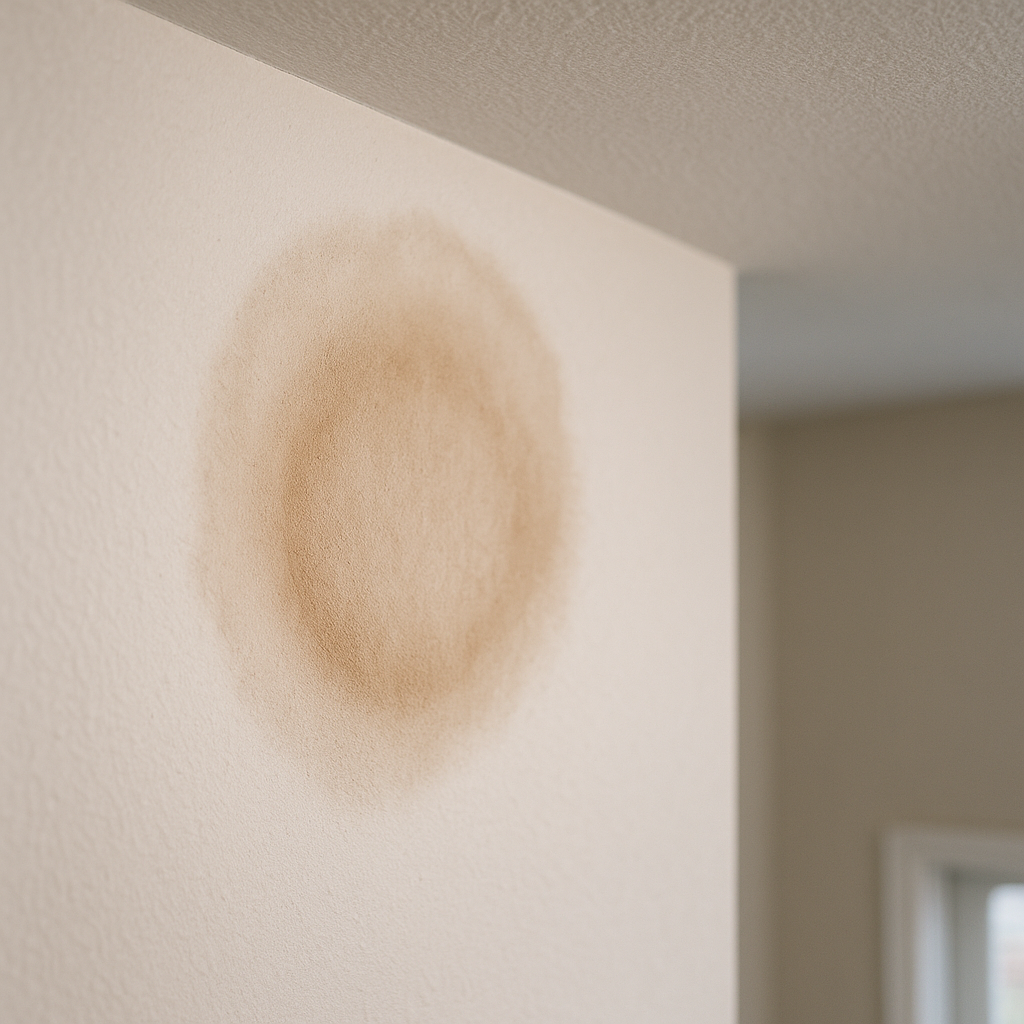
Quick Answer: A stained ceiling is a message, not just a blemish. A brown ring with a hard edge usually means a roof leak; a stain under a bathroom or kitchen points to plumbing; a soft gray haze in corners or near outside walls is condensation feeding mildew; dark lines tracing the framing are ghosting from dust and soot. Read the color, shape, and location first, fix that source, dry it, then prime with a stain blocker before repainting.
You look up, and something has changed. Maybe it is a coffee-colored ring spreading in one corner, a gray cloudiness creeping along an outside wall, or a set of shadowy stripes marching across the ceiling in neat rows. It is easy to reach for a can of paint and cover it, but a ceiling stain is really a symptom. The mark itself tells you what went wrong, and if you read it correctly, you can fix the actual cause instead of hiding it for a few weeks.
The good news is that ceiling stains fall into a handful of recognizable patterns. Each one has a look, a location, and a behavior that separates it from the others. Once you learn to tell them apart, you stop guessing.
A Stain Is Usually a Water Story
Most ceiling discoloration comes down to water traveling somewhere it should not. When water moves through building materials, it picks up tannins, rust, dust, and dissolved minerals, then leaves them behind as it dries at the surface. That residue is the stain. The color and edge of the mark record how the water arrived: a slow, repeated soak leaves a ringed brown blotch, while airborne moisture condensing on a cold surface leaves a softer, more even haze.
Think of it like a tide line on a beach. The water itself is gone by the time you look, but the darkened band shows exactly how far it reached and how many times it came back. Your ceiling works the same way. The shape of the mark records the water's path, which leads back to the source.
Not every stain is water, though. Some are soot and dust settling in patterns, some are age and smoke yellowing the whole surface, and some are a single rusting fastener bleeding through. So the first job is to read the mark and sort it into the right category.
Read the Mark: A Field Guide
Here is a quick way to match what you are seeing to the most likely cause. Use it as a starting point, then confirm with the tests further down.
| What the stain looks like | Where it shows up | Most likely cause |
|---|---|---|
| Brown or yellow ring with a defined edge | Near an outside wall, chimney, skylight, or roof penetration | Roof leak |
| Brown stain, sometimes without any rain | Directly under an upstairs bathroom, kitchen, or laundry | Plumbing leak |
| Soft gray or blotchy discoloration, no hard edge | Corners, along exterior walls, near a poorly vented bath | Condensation and mildew |
| Staining near the eaves, appearing in cold months | Along the outside edges of top-floor ceilings | Ice dam |
| Dark lines or shadows in a regular pattern | Following the joists or framing behind the drywall | Ghosting from soot and dust |
| Overall yellow or tan cast across the whole ceiling | Entire rooms, worse near where people smoked | Nicotine and aging |
| A single small brown dot that grows slightly | Anywhere a fastener sits | Rusting nail or screw bleeding through |
Roof Leaks Leave a Ring That Grows After Rain
A roof leak is the classic ceiling stain: a brown or yellow blotch with a fairly defined edge, often ringed like a target because the same spot has wetted and dried more than once. Each cycle deposits another faint line, the way a coffee cup leaves rings.
Location is a strong clue. Roof leaks tend to show up near the outside walls of the top floor or near something that penetrates the roof, such as a chimney, a plumbing vent, a skylight, or a bathroom fan cap. Water rarely drips straight down from the hole; it runs along the top of the drywall or down a rafter and appears a few feet away, so the stain marks where the water finally pooled, not always where it got in.
The defining test is rain. If the stain darkens, spreads, or reappears within a day or two after a storm and remains quiet during dry stretches, you are almost certainly looking at a roof or flashing problem.
Plumbing Leaks Track a Pipe and Ignore the Weather
A plumbing leak also leaves a brownish stain, but it behaves the opposite way. It does not care whether it has rained. A supply line under pressure can drip steadily; a drain leaks only when the fixture above is used, so the stain may grow a little every time someone showers or runs the dishwasher.
Location tells you a lot here, too. Look at what sits directly above the mark. A stain under an upstairs bathroom, kitchen, or laundry room, or one that runs in a line following where a pipe would travel between joists, points to plumbing rather than the roof. A long, narrow stain that runs in a straight line is often water running along a pipe before it drips.
The tell is timing: dry-weather constant, or tied to fixture use rather than to storms.
Condensation and Humidity Leave a Soft Gray Haze
Not all ceiling discoloration is a leak. When warm, moist indoor air meets a cold ceiling, usually one just below an under-insulated attic, the moisture condenses on the surface. Over time, that damp film feeds mildew, which shows up as a soft gray, greenish, or blotchy discoloration with no defined edge.
Condensation stains favor the coldest, least-ventilated spots: corners, the strip along an exterior wall, closets, and, above all, bathrooms with a weak or missing exhaust fan. Instead of one concentrated ring, you get a diffuse haze spread over a broad area. If you wipe a small test patch and the discoloration smears or lightens, you are probably dealing with surface mildew rather than a stain soaked in from above.
The fix is about airflow and moisture, not just paint: run the bath fan longer, confirm it vents outside rather than into the attic, and address insulation gaps that leave the ceiling cold. Cover the mildew without lowering the humidity, and it comes back.
Ice Dams Are the Cold-Season Version
In a cold winter, ice dams create an additional path for water. When attic heat melts the snow on the upper roof and that meltwater refreezes at the cold eaves, a ridge of ice builds up and backs water underneath the shingles. That water seeps in and stains the ceiling near the outer edges, typically along the eaves of a top-floor room.
Treat this as one seasonal cause among several, not the whole picture. An ice-dam stain looks a lot like an ordinary roof-leak ring, so the giveaway is timing and position: it shows up in cold, snowy stretches and sits close to the eaves. The rest of the year, the same ceiling can stain from roof, plumbing, or condensation instead, so do not assume every edge stain is an ice dam.
Ghosting Follows the Framing
If the marks are dark, sooty lines that run in an evenly spaced pattern, tracing straight bands across the ceiling, you are likely seeing ghosting rather than a leak. The framing behind the drywall, the joists, and any metal fasteners, stays slightly cooler than the insulated cavities between them. Airborne dust and soot particles drift to those cooler strips and stick, printing a shadow of the hidden framing onto the surface.
Ghosting is fed by fine particles in the air, so it is worse in homes with frequent candle burning, a fireplace or wood stove, or an unbalanced heating system that leaves cold spots. It is not water damage, and no amount of drying will change it. The real fixes are reducing the particle sources, sealing air leaks that create the cold framing lines, and cutting back on soot-heavy habits like burning many candles. Then the surface can be cleaned and repainted.
Two other non-leak stains round out the list. An overall yellow or tan cast across a whole ceiling, worse where people smoked, is nicotine and general aging rather than a single event. And a lone brown dot that slowly enlarges is usually a nail or screw rusting and bleeding its color through the paint.
A Few Tests to Confirm the Cause
Before you commit to a repair, run through a short checklist. It takes minutes and saves you from fixing the wrong thing.
- Note the shape. A defined ring means water arriving at a point, a leak. A soft, edgeless haze means condensation.
- Note the location. Is it under a wet room, near an outside wall, close to a roof penetration, along the eaves, or in a regular striped pattern?
- Watch the weather. Mark the edge of the stain with a pencil, then check after the next rain. Growth after rain says roof; no change suggests plumbing or condensation.
- Feel and measure. Press the spot. Cool and damp suggests active moisture. A moisture meter, or even a pinless one held to the drywall, can confirm whether the area still reads wet.
- Look above. Get into the attic or the room overhead if you can and trace the water back toward its entry point.
Why Painting Over a Stain Without Fixing It Fails
Here is the part people skip and regret. Water stains are loaded with dissolved tannins and soluble minerals. When you roll ordinary water-based latex over one, the wet paint reactivates that residue, and it wicks up into the fresh coat and telegraphs right back through, often within days. You end up with the same ghostly ring showing through brand-new paint.
Getting a lasting result takes three steps in order. First, find and fix the source, patch the roof, repair the pipe, and improve the ventilation so that no new water arrives. Second, let the area dry fully; sealing in trapped moisture invites mildew and more staining. Third, seal the old stain with a dedicated stain-blocking primer before you repaint. Shellac-based and oil-based stain-blocking primers are formulated to lock in those soluble marks so they cannot bleed into the topcoat, which is why painters reach for them on stubborn water and smoke stains. Skip any one of these steps, and the stain finds its way back.
Frequently Asked Questions
For a water or smoke stain, reach for a stain-blocking primer rather than a general wall primer. A pigmented shellac-based blocker is the strongest and dries fast, an oil-based blocker handles heavy water and tannin marks well, and water-based stain blockers exist but are the weakest of the three on a soaked ring. Prime the stained spot plus a few inches around it. Here is the catch, though: a single primed patch under fresh paint can flash, meaning it dries to a slightly different sheen and shows as a halo. On a ceiling that reads as one continuous surface, the cleaner result is to spot-block the stain and then repaint the whole ceiling corner to corner in one pass so the sheen stays uniform.
Water rarely drips straight down from where it got in. On a roof leak, it runs along the top of the drywall, down a rafter or a truss chord, or across the vapor barrier until it reaches a low point or a seam, then drops, so the real entry point is usually uphill and off to one side of the stain. Find it from the attic, not the ceiling: on a bright day, trace the wet or discolored path along the framing back to where it starts, and look first at the penetrations water loves, plumbing vents, the chimney, skylights, and valleys. If nothing shows on a dry day, a helper running a hose over one roof section at a time, working from the low side up, will reproduce the drip so you can pin the source before opening anything up.
That is filtration staining, and it comes from moving air, not water. Air leaking between the attic and the room is forced through small gaps around recessed lights, ceiling registers, and the attic hatch, and as it passes through, the drywall edge acts as a filter, catching dust and soot and leaving a dark halo right at the opening. It runs worse with forced-air heating, a dusty attic, or regular candle and fireplace use. Painting over it does nothing lasting; the fix is to air-seal and gasket those penetrations so the dirty air stops streaming through, then clean and repaint. It is a cousin of ghosting, but tied to airflow at a specific gap rather than the cold framing lines.
Sometimes. A brown water ring from a leak is deposited minerals, not mold. But a soft gray, greenish, or fuzzy discoloration in a corner or a damp bathroom is often mildew growing on condensation. A quick check: dampen a small area and see if the color smears or lightens, which points to surface mildew rather than a stain soaked in from above. If it is mildew, the real fix is to lower the humidity and improve ventilation. For a large or recurring patch, or if anyone in the home is sensitive to it, bring in a professional to assess it.
It depends on whether the gypsum is still sound. A dry, firm ceiling with only surface discoloration cleans up with a stain blocker and paint. But drywall that got thoroughly wet can lose its integrity: press on it, and if it feels soft or spongy, sags, shows a swollen or crumbling texture, or the paper face is peeling away from the core, that section has to be cut out and replaced, since primer will not restore strength, and mold can take hold inside a saturated panel. A workable rule is that a light, fully dried stain gets sealed and painted, while a sagging or soft patch gets replaced, and a moisture meter settles the borderline cases.
Long enough that the gypsum, not just the surface, has given up its moisture, which for a soaked ceiling means days rather than hours, and depends on how wet it got and how much air is moving. You can speed it up with a fan aimed at the spot and a dehumidifier running in the room. To confirm it is truly dry and not just dry to the touch, hold a pinless moisture meter against the spot and compare it to a known-dry area of the same ceiling; a low-tech version is to tape a square of plastic tightly over the area for a day and check whether moisture beads underneath. Priming or painting while the panel is still damp seals water in, which leads to peeling, blistering, and mildew a few weeks later.
Get the stain read and repaired at the source, not just painted over — so it stays gone for good. Cesar's Painting serves Minneapolis, St. Paul, Bloomington. Call (612) 203-5856.
