
Why Does My Paint Crack and Flake Over Time?
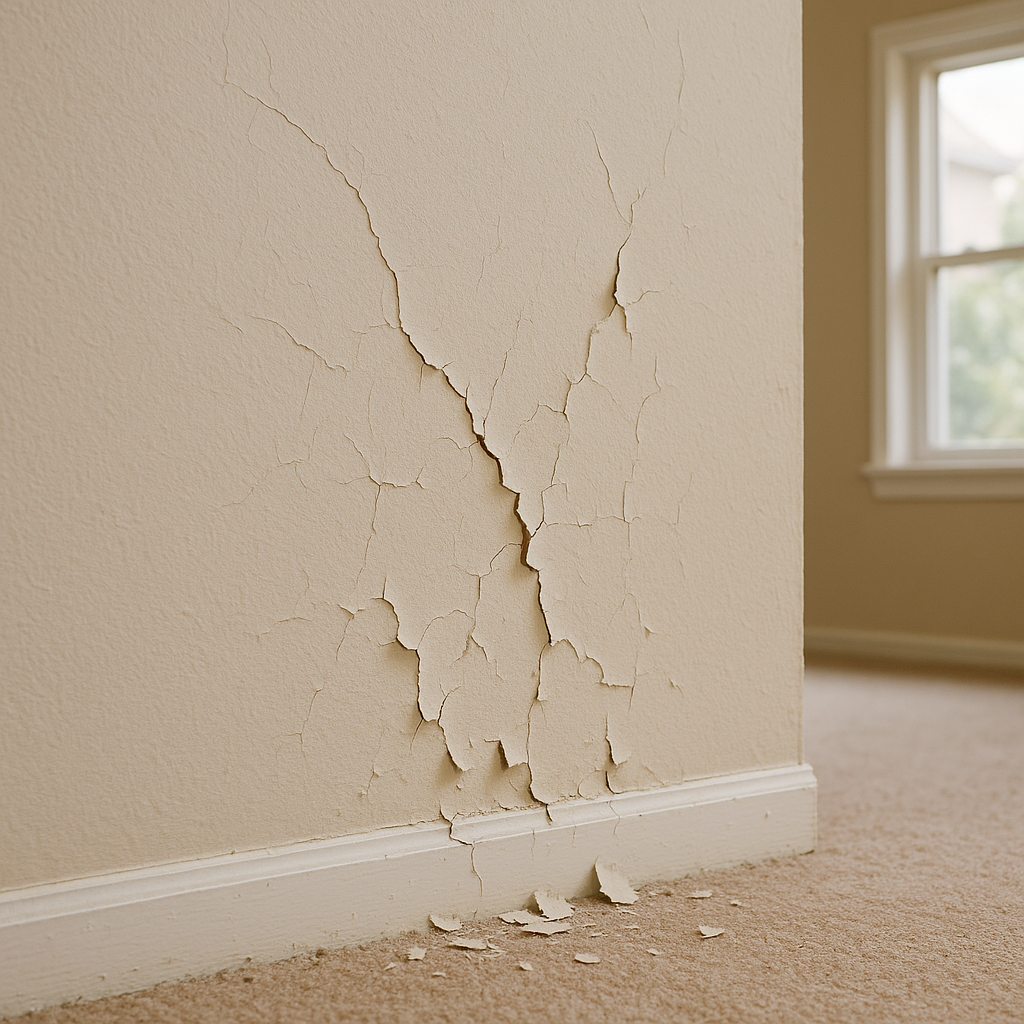
You notice it first as a spiderweb of hairline cracks on a wall or a piece of trim. Ignore it a while, and the cracks widen, the edges lift, and soon little flakes are letting go and landing on the floor. Paint that cracks and flakes always feels like the paint's fault, but it is almost never the paint by itself. It is a failure of the bond between the paint and whatever is underneath.
Once you understand what breaks that bond, the pattern makes sense, and so does the fix. Cracking and flaking are the visible end of a story that started before the brush ever touched the wall.
Cracking Is a Loss of Grip
Paint stays put by gripping the surface it was applied to and by staying flexible enough to move with that surface as it expands and contracts with temperature and humidity. Cracking begins when the paint film loses that flexibility or that grip. First, you get hairline cracks as the film splits. Then, as moisture and air work into those cracks and the film continues to lose adhesion, the cracked paint starts to lift and curl at the edges, which is flaking. Flaking is just cracking that has progressed to the point where the paint peels off its surface entirely. So the two are the same failure caught at different stages.
What Actually Breaks the Bond
A handful of causes account for most cracking, and they usually trace back to how the surface was prepared or how the paint was applied.
Poor surface preparation is the leading cause. Paint applied over a surface that is dirty, greasy, glossy, chalky, or unprimed never gets a real grip, so it lets go sooner. The wall may look fine when it is fresh, but the bond was compromised from the start.
How the paint went on matters too. Applied too thick, a coat dries unevenly and cracks as the outer skin sets before the layer beneath. Applied too thin, it becomes brittle and cannot handle the surface moving underneath it. Low-quality paint compounds this because cheaper formulas often contain less of the binder that keeps a film flexible and stuck down, so they become brittle and crack years before a quality paint would.
Then there is moisture and movement. Water getting behind the paint, from a leak, high humidity, or an unsealed exterior surface, pushes the film off from behind. And every surface expands and contracts as temperature and humidity swing, so a film that has lost its flexibility cracks along the stress lines as the substrate moves.
| What you see | Likely cause |
|---|---|
| Hairline cracks, then lifting edges | Lost adhesion, often poor prep |
| A pattern of cracks like reptile skin | Paint applied too thick or over a soft coat |
| Flaking near windows, bathrooms, rooflines | Moisture getting behind the film |
| Widespread brittle cracking on old paint | Age, UV, or a low-quality coat gone brittle |
Why the Climate Speeds It Up
A film that has to survive big swings in temperature and moisture is under more stress than one in a mild, stable climate, and that stress finds every weakness in the bond. Throughout the year, the surface expands in summer heat and sun and contracts hard in freezing winter, and the repeated expansion and contraction cause cracks to open at any spot where the paint has lost flexibility. Humidity swings between seasons add moisture stress on top of that. Exterior surfaces and areas that see sun, damp, or freeze-thaw show it first. None of it changes the root cause, but it does mean that here, cutting corners on prep or paint quality gets exposed more quickly than it would elsewhere.
Stopping It From Coming Back
The reason cracked paint so often reappears after a quick repaint is that the new coat inherits the same weak bond if the underlying cause is not fixed. A lasting repair means dealing with the cause: scraping and sanding back the failed, loose paint to a sound edge, cleaning and de-glossing the surface so the new paint can grip, priming bare or problem areas, fixing any moisture source feeding the failure, and applying a quality paint in proper coats. Paint over flaking paint without that prep, and you have simply added weight to a film that is already letting go. The prep is not the boring part before the real work; it is the work.
Frequently Asked Questions
Test the edges rather than guessing. After scraping the obviously loose flakes, press a strip of painter's tape firmly onto the bordering paint and pull it off fast: if paint lifts with the tape, that area is still letting go and needs to come off too. Feather-sand the boundary between the bare spot and the sound paint so there is no hard ridge, then run a fingernail or a putty knife under the edge. Anything that pops up is not staying. You strip back to where the film passes both the pull test and the edge test, which is often a few inches past the visible flaking, because the failure zone reaches under paint that still looks fine.
It matters as much as the topcoat, and the right one depends on what you are covering. A glossy or slick surface needs a bonding primer, formulated to grip a face that regular paint would otherwise slide off; scuff-sanding first, then priming, gives the new coat something to key into. Bare or patched drywall and fresh wood want a primer sealer so the porous spots do not suck binder out of the topcoat and leave it brittle. Water stains, tannin-heavy wood like cedar and redwood, or old oil-based paint call for a stain-blocking primer, often a shellac or oil-based one, so bleed-through does not undermine the finish. Using flat wall paint as a "primer," which people often do, skips all of that and is a common reason a repaint fails early.
That pattern is called alligatoring, and it points to a different cause than fine hairline cracks. Hairline cracks are usually a single coat that has lost flexibility or grip. Alligatoring, the wide, interconnected scales, results from a topcoat applied over a coat underneath that was incompatible or not dry, such as a hard finish laid over a softer or still-curing layer, or from too many coats built up over years of repaints. The top skin and the layer below move at different rates, and the surface splits into that scaled network. Because the trouble is buried in the layers, patching the surface will not hold; alligatored areas usually have to be scraped or sanded down to a stable base before recoating.
Yes. Elastomeric coatings are built for masonry, stucco, and concrete block, which crack and move more than wood or drywall. They go on much thicker than ordinary paint and stay rubbery when cured, so they stretch across hairline surface cracks instead of splitting along them, and they shed wind-driven rain while still letting the wall breathe. The catch is that they demand a clean, sound, fully cured surface and the right thickness; brushed on too thin or over a chalky, damp, or crumbling wall, they trap moisture and peel in sheets. They are not a fix for wood siding or interior walls, only for the mineral surfaces they are formulated to flex with.
They are stages of the same failure. Cracking is the first split in the paint film, flaking is when those cracks lift, and small pieces start coming off, and peeling is larger sheets releasing from the surface. Catching it at the hairline-crack stage means less to scrape than waiting until it peels.
It does, and it is easy to overlook. Latex paint needs to form its film within the right window: most exterior products require a surface and air temperature above roughly 50 degrees, and they want it to stay there for several hours afterward, since a coat that drops near freezing overnight before it cures can crack as it sets. Humidity and dew point matter just as much. Paint applied late in the day, when the surface is approaching the dew point, picks up condensation before it dries, weakening the bond. The practical habit is to start after any morning dampness has burned off, stop early enough that the last coat cures before evening moisture settles, and skip a surface in direct blazing sun, which flash-dries the skin before the layer beneath can set, inviting the same cracking as painting too thick.
The Bond Is the Whole Story
Paint cracks and flakes because it lost its grip, and it lost its grip because of what happened before and during the last paint job: a surface that was not properly prepared, a coat put on wrong, a product without enough flexibility, or moisture working from behind. Climate swings just speed the failure along. Fix the bond, not just the surface, by prepping thoroughly and painting with quality materials, and the cracks stop coming back.
If your paint keeps cracking and peeling no matter how often it is redone, the fix is in the prep and the product. Cesar's Painting serves Minneapolis, St. Paul, Bloomington. Call (612) 203-5856 for a free estimate.
