
When Is the Best Time to Paint a House Exterior in Minnesota?
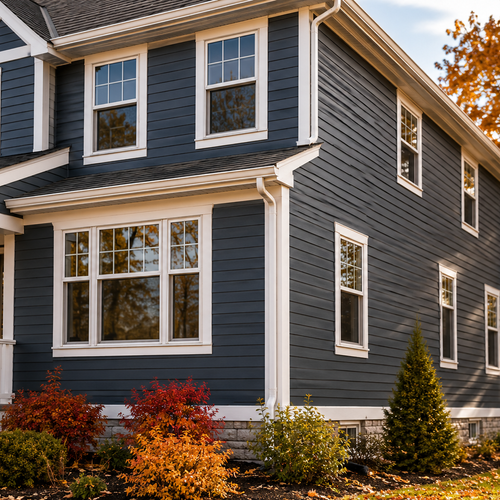
You walk the south side of your house in early May, and the paint looks worse than it did in October — chalk on your fingertip after touching it, a bubble forming near the corner where the gutter drips. Spring is finally here. The question is whether it's time to paint.
In most of the country, "spring" means you can start. In Minnesota, the answer is more specific than that.
Why the painting window here is shorter than you expect
The Twin Cities metro gets roughly five months of paintable weather per year. That sounds like enough — until you look at what each month actually delivers. April is still too cold and wet. Late June through August can run humid enough to stall curing. October closes faster than any forecast predicts. What you're actually working with is closer to six to eight weeks of genuinely reliable conditions, split across two seasons.
That window matters because exterior latex paint cures through polymer coalescence — paint particles fuse as water evaporates from the film. That fusion requires stable temperatures and moderate humidity. Too cold, and the water can't evaporate; the film never bonds. Too hot, and the outer skin hardens before the inner layer releases its moisture, trapping it underneath.
A coat applied at 40°F looks fine the first week. It's a little like a handshake through a thick glove — contact was made, but no real bond formed. The first hard freeze finds the gap. A coat applied under the right conditions lasts 10 to 12 years; a coat rushed into the wrong week lasts three or four.
The late spring window: mid-May to early June
This is the first reliable opening of the year, and in a typical season it's the busiest stretch for exterior painters across the metro. Overnight frost risk has passed, daytime temperatures are holding consistently between 55°F and 75°F, and humidity settles into the 45–55% range — the sweet spot for latex adhesion.
Surfaces have dried out after the last freeze-thaw cycles of April, which matters more than most homeowners realize. Wood siding, stucco, and fiber cement all absorb moisture when temperatures oscillate through 32°F repeatedly over six weeks. Apply paint over a substrate that still carries that winter moisture and you'll see bubbles within the first season, usually on the north-facing or east-facing walls where drying is slowest.
One practical thing to know about spring mornings: dew often lingers on siding surfaces until 9 or 10 a.m., even when the sky is clear. Painting into dew-damp siding causes the same adhesion failure as painting in the rain. Waiting until surfaces are fully dry — typically after 10 a.m. — is a discipline that most homeowners skip and most professional painters don't.
Why peak summer looks safer than it is
Early July feels like ideal painting weather. Long days, warm air, dry stretches. But midsummer brings two problems that don't show up on the basic temperature check.
The first is surface heat. Air temperature at 80°F is fine, but dark or medium-colored siding baking in July afternoon sun can hit 110–120°F at the surface itself. Latex applied at those temperatures flashes dry: the outer layer skins over while the film underneath is still wet. That trapped moisture lifts the paint from within. The result looks like bubbling or curling within the first season.
The second problem is humidity. July and August across the metro regularly push relative humidity to 70–75%. High humidity slows evaporation from the paint film, extends curing time, and raises the chance of a summer storm moving through before the coat has set.
Neither problem is insurmountable — painting shaded surfaces, starting early in the day, and picking windows where humidity stays below 65% all help. But summer requires active management that a quick weather check won't provide.
The fall window: often the better season
September through mid-October is the second window, and many experienced painters will tell you it's the more reliable of the two.
Temperatures run between 50°F and 70°F — stable and mild. There's less pollen and dust in the air than spring. Humidity settles into the 50–60% range after summer's heat. Surfaces are bone-dry from weeks of warm weather and have been fully exposed to UV all season, which actually improves adhesion by breaking down any residual chalking on the old coat.
The timing also works well from a protection standpoint. A coat applied in September has three to four weeks to cure before the first hard frost — enough time for primer bonds and topcoats to harden and develop the flexibility needed to survive freeze-thaw cycles.
One technique worth knowing: paint north-facing walls first. In spring, the north side is the last to dry after winter and the slowest to warm up. In fall, it's the first to lose afternoon heat. Starting there midday, when temperatures are most stable, prevents the rapid swings that stress a fresh coat before it sets.
The fall deadline is real. Once overnight lows start hitting 40°F consistently, the window is narrowing fast. Most quality exterior latex formulas need surface temperatures above 50°F for at least four hours after application, and overnight temperatures must hold above 35–40°F while the film is curing. A run of 38°F nights in mid-October can close the season without much warning.
When to stop entirely: November through April
This is the non-negotiable. Latex paint cannot cure below 35°F. Oil-based paints can go lower — down to about 40°F — but they require consistent warmth for the oxidation process that hardens the film, and a single cold night undoes that.
From November through April, surface temperatures in the Twin Cities regularly fall below the curing threshold, and that's not just air temperature. A south wall might register 50°F on a sunny February afternoon, but the underlying substrate — wood, stucco, or OSB sheathing — is far colder. Paint applied to a cold substrate won't bond regardless of what the air thermometer reads.
Beyond temperature, freeze-thaw cycles from October through March push moisture through siding. Any coat that hasn't fully cured absorbs that movement, flexes, and cracks. By spring, the new paint is already peeling. If fall slips away, save exterior work for the following May.
What to check before you start
The day-of conditions that actually matter, in order of importance:
- Surface temperature: Use a non-contact thermometer on the siding itself. Surface temp matters more than air temp on hot or cold days. Above 50°F, below 90°F.
- Air temperature: 50°F minimum, 85°F maximum at time of application.
- Humidity: Below 70%. Below 60% is ideal.
- Rain: No precipitation for at least 24–48 hours before and after painting. Surfaces must be bone-dry.
- Morning dew: Wait until after 10 a.m. before starting, even on clear days.
- Overnight low: Must stay above 35°F for at least 48 hours after application.
- Sun position: Avoid painting surfaces in direct afternoon sun. Follow the shade around the house — paint the side in shade, not the side baking.
A professional standard for any major exterior project is a 7-day stable weather window before starting. That's not always achievable here, but it's the target. If a thunderstorm is even hinted at in the 48-hour forecast, reschedule.
Watch overnight lows as closely as daytime highs. If nights are dropping below 40°F within 48 hours of application, the curing process will be compromised — even if the day felt warm enough to paint.
Frequently Asked Questions
Late spring (mid-May to early June) and early fall (September to mid-October) are the two reliable windows. Both deliver temperatures of 50°F to 75°F and humidity below 70% — the conditions latex paint needs to cure properly. Fall is often the more stable of the two, but spring works well if you catch a dry, settled stretch after the last frost.
Most exterior latex paints require surface temperatures above 50°F and overnight lows above 35–40°F for proper curing. Oil-based paints can tolerate surface temps down to about 40°F. Specialty low-temperature formulas like Sherwin-Williams Latitude® and Benjamin Moore Element Guard® extend the range slightly, but they still need overnight temperatures to stay above freezing. Once lows are consistently dipping below 40°F in fall, exterior painting is at or past its limit for the season.
Both windows work well. Spring gives more daylight and freshly dried surfaces after winter. Fall offers drier air and less humidity than spring, with surfaces that have had a full summer to dry out. The practical difference is often scheduling — fall tends to have more availability when spring was wet. Either way, look for a 7-day stretch of stable weather rather than a single good day.
Early October, yes — often. Mid- to late October, risky. Once overnight lows consistently hit 40°F, most latex formulas are at the edge of their curing range. Shaded walls cool faster than air temperature suggests. Most exterior painters wrap up by mid-October, though a warm fall can push that a week or two.
On a 90°F day with direct sun, dark or medium-colored siding can reach 110–120°F at the surface. Latex paint applied at those temperatures flash-dries — the outer layer skins over while the film underneath is still wet. The outer skin seals in moisture and solvents, and when they eventually push out, they lift the paint from the surface. The damage shows up as blistering or curling within the first season, even if the application looked fine the day of.
Paint dries to touch in two to four hours. Full cure — where the film reaches maximum hardness and flexibility — takes 30 to 90 days. A coat applied in late October hasn't developed the flexibility it needs before November's freeze-thaw cycles arrive. Spring and early fall give the paint its best chance at a full cure before temperatures drop.
Cesar's Painting handles exterior painting across Woodbury, Maplewood, St. Paul, Minneapolis, Bloomington, and the Twin Cities metro. We schedule projects around Minnesota's two reliable windows — spring and fall — to give every coat the curing time it needs before winter. Call (651) 650-4747 to schedule a free estimate.
