
Knockdown vs. Orange Peel vs. Smooth Ceiling Texture: Which Is Best?
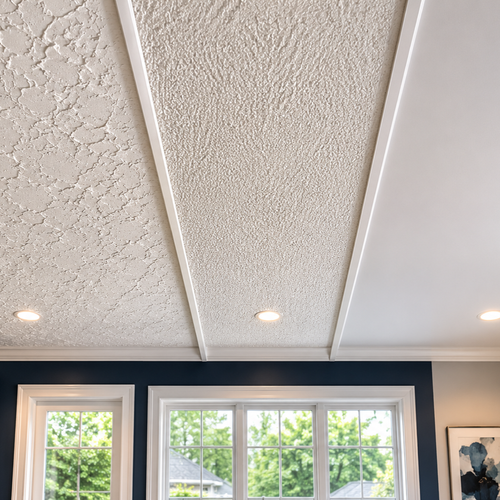
You're standing in the middle of a room looking up. There's a freshly patched section of ceiling — smooth white compound, perfectly flat, no imperfections at all. The problem is that the rest of the ceiling isn't like that. It has a pattern, a texture, a character. And now the patch stands out like a bandage on a forearm.
That moment is when most homeowners start asking questions they should have answered before the repair began: what texture is that, anyway? And if the ceiling is getting redone, what should it be?
Knockdown, orange peel, and smooth are the three most common ceiling finishes in homes around here. They look different, cost different amounts to apply and repair, and hold up differently in the humidity swings and temperature extremes from a hot, muggy July to a bone-dry January with the furnace going full tilt. Here's what each one actually is — and how to pick.
What ceiling texture actually does — and why it matters
Texture on a ceiling isn't decorative first. It's practical first.
Drywall seams, fastener dimples, minor ridges from tape compound — all of these show up under raking light. Early morning or late afternoon sun coming through a skylight or bedroom window can make a badly finished ceiling look like a topographic map. Texture breaks up that flat reflective surface. The small irregularities scatter the light instead of bouncing it straight at your eyes, and what was a visible ridge disappears.
Each texture type hides different sizes of imperfection. It responds differently to the humidity swings between a summer day pushing 80% relative humidity and a January interior with the furnace running non-stop, humidity dropping to 20% or below. And when you need a repair — a water stain fix, a drywall patch, a nail pop — the texture determines how hard that repair is to pull off.
Knockdown ceiling texture
Knockdown is the most common ceiling texture in homes built or remodeled from the late 1980s through today. If you have a newer house and you haven't looked closely, you probably have knockdown.
The process: joint compound gets loaded into a hopper gun and sprayed onto the ceiling in a random splatter. The compound sits for 10 to 15 minutes — long enough to firm up but not to set solid. Then a wide trowel gets dragged across the peaks. The knife flattens the high spots without smearing the whole pattern, leaving irregular flat islands with slight valleys between them. Think of dried mud that's been partially smoothed — not polished, just settled.
Knockdown creates shadow and dimension without looking busy. It reads as textured from across the room, subtle from farther back. The irregular pattern is forgiving of minor waves in the drywall surface, and paint settles into the valleys in a way that adds depth even to a flat color.
The weakness is repair. The knockdown pattern requires recreating specific timing — how long the compound sits before troweling, how much pressure the knife carries, how thick the splatter was sprayed. A bad patch shows immediately. You'll see a halo of slightly different texture around the repair, especially in natural light. That's not a catastrophe, but it's worth knowing before you assume any painter can match it in a 15-year-old ceiling.
For cleaning, knockdown is moderate. The surface isn't rough enough to be uncomfortable, but the valleys do catch dust. In a high-humidity kitchen or bathroom, the recesses can hold moisture slightly longer than a smoother surface.
Orange peel ceiling texture
Orange peel is what most people see and assume is smooth until they look close. The name is accurate: the surface has the same fine, uniform dimpling as an orange rind. Small bumps, random but even, no real variation in depth across the ceiling.
The process is simpler than knockdown. Joint compound gets sprayed through a hopper gun with a finer nozzle setting, creating a lighter, more uniform splatter. There's no trowel pass. The texture dries exactly as it was sprayed.
That simplicity is the main advantage. Orange peel is faster to apply, requires less skill in timing, and covers large areas consistently. For new construction, it's often the default — crews can texture a whole house in a day.
Orange peel doesn't trap dust and moisture the way a deeper knockdown pattern can, which matters in a kitchen. The fine texture helps diffuse light without adding much depth, so the ceiling reads as clean and neutral.
But orange peel hides smaller imperfections than knockdown does. A significant wave in the drywall, a prominent seam, a patch with a slightly different compound consistency — all more likely to show through orange peel than through a heavier knockdown pattern.
Repairs are actually easier with orange peel than with knockdown. The pattern is uniform and random, which makes it more straightforward to blend. A contractor can spray a patch area, feather the edges into the existing texture, and paint over it without a visible line. Not invisible, but close.
Smooth ceiling (Level 5 finish)
Smooth ceilings are exactly what they sound like. No texture at all. The drywall gets taped, mudded, sanded, and skim-coated until the surface is completely flat. Painters call this a Level 5 finish — the highest classification in the drywall finishing standard.
You see smooth ceilings in two contexts: high-end new construction where the homeowner specifically asked for it, and older homes built before spray texture became standard, where original plaster dried to a near-glass surface.
The appeal is real. A smooth ceiling in a room with clean trim and neutral walls looks precise and intentional. It bounces light in a way that makes the room feel brighter. Contemporary design favors smooth because it doesn't compete with anything else in the space.
But here's what a smooth ceiling costs you: nothing to hide behind.
Every fastener dimple, every tape seam, every slight wave in the drywall surface becomes visible. In a climate with freeze-thaw cycles running October through March, the framing in a home can shift fractionally as temperatures swing. Seams that are invisible in one season can open or show as ridges in another. Smooth ceilings in older homes often develop a fine web of hairline cracks — not structural, but persistent — because there's no texture to absorb the visual noise.
Repairs on a smooth ceiling are the most demanding of the three. The patch has to be flat, smooth, and matched to the sheen of the surrounding paint. Any variation in surface flatness or paint absorption shows. Most repairs end up requiring a full ceiling repaint to avoid a visible ghost.
Cost-wise, Level 5 finish is the most labor-intensive option on new work. Skim-coating to a true smooth finish takes more time, more coats, and more sanding than either spray texture. Budget accordingly.
How the three compare side by side
| Knockdown | Orange Peel | Smooth | |
|---|---|---|---|
| Visual impact | Moderate — adds depth | Subtle — nearly disappears | High — clean, precise |
| Hides imperfections | Well | Moderately | Poorly |
| Cost to apply | Moderate | Lower | Higher |
| Repair difficulty | Harder | Easier | Most demanding |
| Dust and cleaning | More surface variation | Easier | Easiest |
| Best for | Most rooms, versatile | New construction, rentals | High-end modern spaces |
Orange peel is the baseline for cost. Knockdown runs roughly 15–25% more because of the hand-finishing step. A true Level 5 smooth finish is the most expensive — skim-coating and sanding is slow work, and there's no shortcut that holds up.
Choosing the right texture for your ceiling
Start with what's already in the house.
If you have knockdown throughout and you're repairing or refinishing one ceiling, matching makes sense. Introducing orange peel on a single ceiling in a knockdown house reads as a cut corner. But if you're doing a whole-house repaint or a major remodel, it's a reasonable time to switch.
Light matters more than most people think. Skylights, floor-to-ceiling windows, and low sun angles are rough on smooth ceilings. In summer, the afternoon sun can come in low enough to turn a slightly uneven ceiling into a relief map. In a room that gets indirect diffused light, smooth is more forgiving. In a room with harsh angles of direct sunlight, texture protects you.
Room use narrows it further. A kitchen ceiling deals with humidity from cooking. A bathroom ceiling handles steam. A bedroom ceiling primarily just needs to look good. Orange peel holds up well in kitchens and bathrooms. Knockdown works in most rooms without issue. Smooth makes the most sense in a bedroom, formal living room, or dining room where aesthetics carry more weight than everyday durability.
And consider your repair tolerance. A smooth ceiling that's beautiful today requires more attention to stay that way. A small nail hole, a kid's ball hitting the ceiling, a patch from a plumbing leak — all require careful work to make invisible. If you want a ceiling that handles life without constant attention, knockdown and orange peel are both more forgiving.
In rooms where you're planning to add recessed lighting after the ceiling is textured, orange peel is significantly easier to patch around new cutouts than knockdown. The uniform spray pattern blends more cleanly around circular cuts than knockdown's hand-finished islands.
Should the walls and ceiling match?
Most homes run knockdown or orange peel on the ceiling with either matching or smooth on the walls. It's completely normal for ceilings and walls to share the same texture — it reads as intentional. It's equally normal for ceilings to carry a moderate knockdown while walls have a lighter orange peel or smooth finish. The ceiling is farther away, so it can carry a heavier texture without the room feeling rough.
One combination to avoid: heavy knockdown walls with a smooth ceiling. The ceiling ends up reading as unfinished by comparison. If you want smooth walls, a smooth or light orange peel ceiling is more coherent.
In kitchens and bathrooms where tile covers part of the wall, smooth drywall above the tile line creates a cleaner transition than textured drywall butting up against a tile edge. That's one case where mixing smooth walls with a textured ceiling actually makes practical sense.
Why texture matching after repairs is harder than it looks
The repair patch gets done, it looks fine when it's fresh, and then the paint goes on and suddenly there's a visible halo around it.
It's not bad workmanship, usually. It's the nature of ceiling texture matching.
Joint compound, once dry, absorbs primer and paint differently, depending on how it was mixed, how thick it was applied, and how long ago it was originally textured. An existing knockdown ceiling from 2005 has 20 years of paint coats on it. The surface is different than fresh compound. Even a perfectly matched texture pattern can look off under light because the paint soaks in at different rates.
The fix is proper priming before painting. A high-quality primer-sealer — not just drywall primer — gets the absorption rate close enough to the surrounding surface that the final coat looks consistent. Skipping the primer step, or going too thin, is what creates the ghost.
For repairs bigger than about six inches across, painting the entire ceiling after retexturing is the better call — the blending problem disappears when the whole surface gets a fresh coat.
Frequently Asked Questions
Knockdown is a spray-then-flatten ceiling finish that creates irregular flat shapes with visible depth. It's still one of the most common ceiling textures in the US — it's been the dominant style in new construction since the late 1980s and remains the default in most residential remodels. In production homes, knockdown is almost always the ceiling texture unless the homeowner specified otherwise.
Pricing varies by ceiling size, existing texture type, and whether the old texture needs to be removed first. For a straightforward retexture — skim coat plus new knockdown or orange peel — on a standard bedroom ceiling of around 150–200 square feet, expect a range of $300–$600, depending on prep required. Full removal of existing popcorn or damaged texture before retexturing adds cost.
Yes. The process involves applying one or more thin coats of joint compound over the existing texture, sanding between coats, and finishing to a Level 5 surface. It's more labor-intensive than applying new texture but generally faster and cleaner than replacing the drywall. The ceiling needs to be in structurally sound condition — loose, flaking, or severely water-damaged texture should be addressed first.
Knockdown. Its heavier pattern and variable depth do the most work of concealing surface variations after a water-damaged patch. A skim-coated repair on a smooth ceiling is significantly harder to make invisible. Orange peel lands in the middle — easier to repair than knockdown but less forgiving of surface irregularities.
Stand under a bright work light aimed low across the ceiling surface. Knockdown shows distinct flat islands with shadow in the valleys between them. Orange peel shows fine, even dimpling with very little depth variation — almost like a stippled surface. Smooth shows essentially nothing — maybe only seams or fastener dimples under direct light. Large irregular patterns with depth mean knockdown. Fine and even across the whole surface means orange peel.
Slightly, but not dramatically for the three options here. Popcorn texture had measurable acoustic properties because of its thick, foam-like composition. Knockdown and orange peel add minimal acoustic benefit compared to smooth. If sound control is a priority — reducing echo, minimizing noise transfer between floors — the ceiling's drywall mass and the insulation in the joist cavity matter far more than surface texture.
Cesar's Painting handles ceiling repair and retexturing across Woodbury, Maplewood, St. Paul, Minneapolis, Bloomington, and the Twin Cities metro. Whether you're matching an existing texture after a drywall repair or refinishing an entire ceiling, we handle the prep, texture application, and final paint coat as one job. Call (651) 650-4747 to schedule a free estimate.
