
Fence Paint vs. Fence Stain: Which Is Better for Wood Fences?
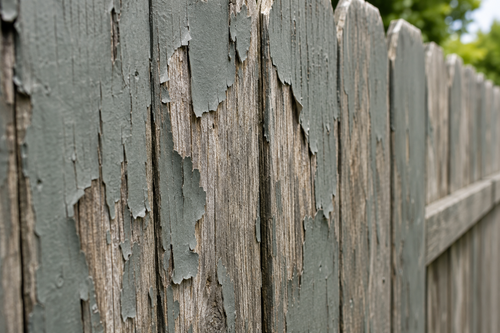
You repainted the fence three years ago. It looked good for about 18 months. Now there's a section on the south side — five or six boards — where the paint has cracked along the grain and the edges are lifting. You can slip a thumbnail under the flaking chips. The wood underneath has already gone gray.
Not a story about cheap paint. It's a story about film-forming coatings on wood that moves.
Stain is the better finish for most wood fences in most situations. But that's not absolute — paint has real use cases, and the wood species your fence is built from changes the math considerably. Here's how each finish actually works, where each one fails, and what re-treatment looks like five years down the road.
What stain does inside the wood
Stain doesn't build a layer on top of the wood. It soaks in. Think of how a coffee stain moves through a paper towel — the color becomes part of the fiber, not a coating sitting on its surface. The pigment and the carrier — oil-based or water-based — penetrate the grain, and the finish lives inside the wood rather than on top of it.
And that changes how it ages. There's no film to crack, no sealed layer for moisture to wedge behind, no paint edge to start lifting. When stain wears out, it fades. The wood gets paler. Power-wash the fence, let it dry for 48 hours, roll on a new coat.
That is the entire recoat job.
Stain comes in four transparency levels: clear (waterproofing only, no color), semi-transparent (shows full grain and texture), semi-solid (mutes the grain slightly with more color), and solid (opaque, looks similar to paint from a distance). Most residential fence work lands at semi-transparent or semi-solid — enough color to give the fence a consistent tone while keeping the wood texture visible.
Semi-transparent stains work best on smooth, sound wood. If your fence boards are rough-sawn, weathered, or already graying, a semi-solid or solid stain gives more even coverage with less blotching. For fences that have gone gray from UV, a commercial wood brightener applied after pressure-washing — and before stain — opens up the wood grain so the stain has something to absorb into rather than a closed, oxidized surface.
What paint does on the surface
Paint forms a film. It sits on top of the wood fiber and seals it completely — uniform color, smooth surface, no visible grain.
The film is also where the long-term problem starts. Wood moves. It swells in humid July air and contracts through a dry Minnesota January. Every humidity cycle stresses the paint film. Then add freeze-thaw cycling — October through March — and you add a second mechanical force: any moisture that gets under the film expands by roughly 9% when it freezes. That expansion wedges the paint away from the wood from below. Not all at once. Board by board, section by section, wherever moisture found an entry point. First a small bubble. Then a crack along the grain. Then the edge lifts and the whole patch peels away.
Painted fences look fine for about a year and a half, then fall apart in patches. The cause is moisture intrusion plus freeze-thaw expansion — not paint quality, not application error.
Once you're looking at bare wood and lifting edges, recoating is not a roll-and-go job. You scrape every loose section, sand the transition edges where old paint is still holding (to feather the lap lines), spot-prime all the bare wood, prime the full fence surface, then paint. On a 100-foot privacy fence, that is a full weekend's work before you open the topcoat.
Why cedar changes the calculation
Cedar is the most common wood in residential fencing in this region, and it behaves differently from pine or pressure-treated lumber in one specific way: cedar is naturally oily.
Cedar contains resins and oils that push outward as the wood breathes and heats. Paint films trap those gases between the coating and the wood surface. The result is bubbling — not from moisture, but from the wood itself off-gassing through the finish. On a cedar fence, paint can look clean in year one and start lifting in small blisters by year two or three. It's not a prep failure. It's chemistry. Stain doesn't seal over those oils — it moves with them. For cedar, stain isn't just a preference. It's the better match for the material.
Pressure-treated lumber is a different situation. The copper-based preservatives in treated wood also slow down stain penetration. Stain won't bond as deeply in treated wood as it does in raw cedar, so the first coat tends not to last as long. More critically, new pressure-treated fence boards need to dry out before any finish goes down — at minimum 6 to 12 weeks in warm weather. Finish applied to pressure-treated wood while it's still releasing preservative moisture won't bond properly, and you're looking at a re-do within a year.
Raw pine takes both finishes reasonably well, but it's more porous and absorbent than cedar. Rough-sawn pine can pull stain in unevenly — fast in the end grain, slow across the face — leaving a blotchy result if you use a thin semi-transparent coat. Semi-solid stain on rough pine gives more consistent color.
The sun-exposure problem
UV doesn't hit all sides of a fence equally. The south-facing section and the west-facing section take the most direct afternoon sun — especially in summer, when UV index in the Twin Cities reaches 8 or higher during peak hours.
Both finishes degrade under UV. Paint loses flexibility as the resin binders break down, which accelerates cracking and chalking. Stain fades — less destructive, but it still requires attention.
If your fence runs east-west with a full southern exposure, expect any finish to need recoating 20 to 30% sooner than a fence in partial shade. For stain, that means recoating every two to two-and-a-half years on the sun-exposed side instead of every three years. For paint, the south-facing boards may start chalking and developing microcracks by year four even if the shaded sections still look clean.
What recoating actually involves
Put the two side by side:
| Maintenance task | Stained fence | Painted fence |
|---|---|---|
| Prep before recoating | Power-wash, dry 48 hours | Scrape, sand edges, spot-prime bare wood, prime full fence |
| Products needed | One can of stain | Primer + paint (often two coats) |
| Application method | Pump sprayer or roller | Back-roll after spray, or brush only |
| Time for 100-ft fence | 3–5 hours | 8–14 hours over two days |
| What failure looks like | Even fading | Peeling patches, bare wood |
| Recoat frequency | Every 2–3 years | Every 5–6 years |
That 5-to-6-year interval for paint sounds like less maintenance until you account for what the prep actually involves. The stained fence at year three is an afternoon. The painted fence at year six is a two-day job of scraping, sanding, and priming before the topcoat goes down — and it gets harder each cycle as the paint accumulates more edges to feather and more bare spots to prime.
One-way doors: what you can and can't switch
Stain and paint aren't interchangeable, and the direction you go first matters.
If you've had a stained fence for years and want to switch to paint, you can — but the wood needs to be clean, dry, and fully stripped of any residual oil-based stain. Oil interferes with paint adhesion. A solid stain (which looks like paint but doesn't build a thick film) is often the better path if you want full color coverage without committing to paint's maintenance demands.
Going from paint to stain works the other direction: you cannot stain over existing paint. Stain has to absorb into bare wood fiber. It can't penetrate through a paint film. If your fence has been painted, your options are to keep painting or strip every bit of paint back to bare wood first — a substantial job on a large fence.
Worth thinking about before you put a first coat on a new fence. Stain keeps your options open. Paint closes some of them.
Paint vs. stain at a glance
| Stain | Paint | |
|---|---|---|
| How it works | Penetrates wood fiber | Builds film on surface |
| How it fails | Fades gradually | Peels, cracks, blisters |
| Recoat cycle | 2–3 years | 5–6 years |
| Prep at recoat | Minimal | Extensive |
| Color range | Limited; no true brights | Full spectrum |
| Cedar fences | Best choice | Bubbling risk from cedar oils |
| Pressure-treated | Works; penetrates less deeply | Works; wood must dry first |
| Freeze-thaw resistance | Strong; no film to delaminate | Risk of moisture-driven lifting |
| Application | Pump sprayer; forgiving | Requires sanding, priming |
| Switch-back flexibility |
Frequently Asked Questions
Most semi-transparent and semi-solid stains last 2 to 3 years on a wood fence with normal sun exposure. South-facing and west-facing sections may need attention closer to the 2-year mark due to UV load. Solid stains can last 3 to 4 years before the color fades noticeably.
Stain. Cedar contains natural oils that push outward as the wood breathes and heats. Paint traps those gases at the surface, which causes bubbling and early delamination that has nothing to do with how well the paint was applied. Stain moves with the wood rather than sealing over it. Oil-based or alkyd-modified stains bond particularly well to cedar.
For raw cedar or pine, typically 2 to 4 weeks once the boards have dried and any mill glaze has weathered off. For pressure-treated lumber, wait 6 to 12 weeks minimum. The preservative chemicals need to cure and the moisture content needs to drop before any finish will absorb properly. Staining or painting wet treated wood is one of the more common re-do calls contractors get.
Not without stripping all the existing paint first. Stain needs to penetrate bare wood fiber to bond. It can't absorb through a paint film. If your fence has been painted, you either keep painting it or strip everything back to bare wood before switching. There's no shortcut between the two.
50°F is the floor for most exterior stains. Below that, the solvent doesn't evaporate correctly and the stain can't bond into the wood fiber. You also need no rain in the forecast for at least 48 hours after application. In Minnesota, that leaves a reliable working window from late May through early September for most years.
Professional fence staining typically runs $1.50 to $3.50 per linear foot for a standard 6-foot privacy fence, including labor and materials. Professional painting generally runs $2.50 to $5.00 per linear foot, due to additional prep — washing, priming, and two coats of paint. Re-staining an existing fence lands at the lower end of the stain range. Re-painting a fence with peeling sections can run above the paint range once scraping and prep labor is factored in.
Cesar's Painting handles fence staining and fence painting across Woodbury, Maplewood, St. Paul, Minneapolis, Bloomington, and the Twin Cities metro. We assess wood species and existing finish condition before recommending a product and coat schedule. Call (651) 650-4747 to schedule a free estimate.
