
What Factors Drive Up a Professional Painting Estimate?
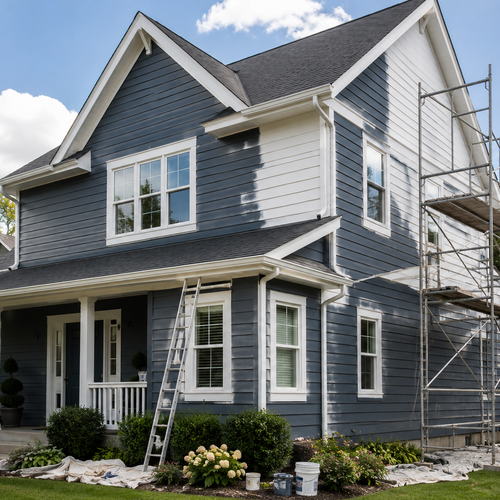
You asked for an estimate on the exterior. The number came back higher than you thought it would — maybe higher than what your neighbor paid a couple of years ago. Before you start shopping around for a lower bid, it helps to know what painters are actually counting when they calculate the price.
A painting estimate isn't just paint plus labor. It's a risk assessment. The contractor is looking at every surface that needs coating, every surface that needs prep before it can be coated, and every condition that could turn a two-day job into a four-day job if something goes sideways. That's what the number reflects.
Here's what moves the price — and why.
Surface area: the floor, not the ceiling
The most obvious driver is how much surface needs to be painted. But "square footage" in a painting estimate doesn't mean the same thing it means on your floor plan. Painters calculate paintable surface — wall faces, trim, soffits, fascia, door and window casings, and detail elements like shutters or columns. A 1,800-square-foot house footprint can produce 3,000 square feet of paintable exterior surface once you count everything that gets coated.
Every square foot of coverage takes primer, paint, and labor. Add a second story, dormers, or a wraparound porch, and that number climbs fast.
Surface condition: prep is half the job
Surface condition is where estimates diverge most sharply between identical-looking houses. Two houses the same size, same age, same siding type — different prep situations can produce a 40% to 60% difference in total price. That's the gap most homeowners don't see coming.
Here's what painters evaluate during a walkthrough:
| Surface condition | What it requires | Price impact |
|---|---|---|
| Clean, intact paint, minimal cracking | Power wash, light sand, prime bare spots | Baseline |
| Moderate peeling or chalking | Hand or mechanical scraping, more priming | Moderate increase |
| Heavy peeling or bare wood | Full scrape, spot repairs, full-surface primer | Significant increase |
| Caulk failures at windows and doors | Remove old caulk, recaulk all penetrations | Moderate increase |
| Rotted wood or failed siding sections | Board replacement before painting | Major increase |
Peeling paint on wood siding is a symptom, not the problem. The real cause is moisture pushing out from inside the wall — vapor working through the substrate as interior humidity meets cold exterior temperatures in a freeze-thaw cycle. That moisture has to be dealt with, and the prep has to go far enough to remove every adhesion failure, before new paint can bond. A painter who skips that work gets a new coat that peels in the same spots within a season. A thorough painter prices in what prevents that.
Siding type and material
Not every surface paints the same way. Smooth cedar takes paint differently than rough-sawn pine. Stucco needs a masonry-specific primer and a two-coat strategy that smooth siding doesn't. Fiber cement like HardiePlank behaves differently from hardboard products like LP SmartSide. Brick and masonry need a bonding primer and a masonry-formulated topcoat to keep efflorescence from pushing through as moisture moves in and out of the wall.
The material drives the product selection, the number of coats required, and how long each coat needs to cure before the next one goes on. A stucco wall on a July afternoon — south-facing, soaking up direct UV — changes how a crew paces their work to avoid lap marks and premature drying. That pacing is labor. And labor is cost.
Paint quality: the one place price visibly changes
Paint isn't paint. There's roughly a $25 to $40 per gallon spread between a builder-grade exterior latex and a premium product like Sherwin-Williams Emerald or Benjamin Moore Aura. On a large exterior that needs 8 to 12 gallons per coat, that spread adds up.
Budget 8–12 gallons per coat for a standard single-story 2,000-square-foot house — more if trim, outbuildings, or detached garages are included. Premium exterior products run $60–$85 per gallon as of 2026.
Premium paints carry more resin. More resin means better adhesion, better film integrity over repeated freeze-thaw cycles, and a longer useful life before the next repaint. In a climate where the temperature swings 100°F between a January cold snap and a July afternoon, coating flexibility matters. A thin or brittle film cracks when the substrate contracts in cold. A premium paint follows the substrate. The paint costs more upfront. The savings show up when the next repaint cycle is three years later than it would've been.
Accessibility and height
Getting paint on a wall isn't the hard part. Getting paint on a wall that's 25 feet off the ground, behind mature landscaping, or above a concrete garage apron where ladders can't be positioned safely — that's a different job.
A full two-story house requires equipment: extension ladders at minimum, scaffolding for some configurations, boom lifts for certain gable ends and peak heights. Each piece of equipment takes time to stage, move, and work safely from. A ranch house with clear perimeter access prices out lower per square foot than an equivalent house with a steep pitch, a high gable, or tight vegetation against the foundation on all four sides. The painting work is the same. Getting to it safely is what changes the math.
Number of colors and trim complexity
A two-color exterior — body and trim — is a different job than a three-color scheme with multiple accent tones, decorative woodwork, and a contrasting porch ceiling. More colors mean more masking, more careful cut lines, more time per linear foot of trim.
Detail work — window casings, door frames, columns, corbels, spindles — can't be sprayed without extensive masking, and on intricate millwork, it's often hand-brushed entirely. A house with a simple roofline and standard windows quotes lower than an equivalent-sized house with architectural details, even if total square footage is identical. That's not a markup. That's time.
Number of coats
Standard exterior repaints are typically two coats over a spot-primed substrate. But some situations call for a full-surface prime coat, which adds a complete pass over every surface before the finish coats go on.
Full priming is warranted when:
- The existing color is very dark and the repaint is going lighter
- Large sections of bare wood are exposed after scraping
- The existing surface is severely chalked or has compromised adhesion
- The substrate is new or unpainted wood
Each additional coat multiplies material cost and labor. It's not padding — a full prime coat on a chalked surface is what makes the finish coat bond and hold. Skip it, and the same peeling problem comes back in two or three years.
Older homes and lead paint
Any house built before 1978 is a real candidate for lead paint somewhere in the coating layers — and that changes how the job has to be handled. Painters working on these homes follow specific containment and cleanup procedures under federal Renovation, Repair, and Painting (RRP) rules. Certified contractors use drop cloths, wet scraping methods, and contained disposal. All of that adds time and labor to the quote.
A painter who comes in substantially lower on an older home may not be pricing those requirements at all. That matters for proper disposal and for the health of everyone on the property while the work is happening.
Timing and the painting season
Think of exterior paint like sunscreen on skin. It works when it's given time to actually bond to the surface. Put it on when the surface is too cold or too damp, and it doesn't adhere — it just sits there until the first rain pulls it off.
Exterior latex needs the substrate at or above 50°F at application and through the initial cure window. That compresses the viable exterior painting season in the Twin Cities to roughly May through October. Popular crews fill their calendars by late spring. If you need work done in late September, expect tighter scheduling — and crews working around rain events in a shorter window. Interior painting, cabinet refinishing, and epoxy floor coating don't have the same seasonal pressure. Those estimates are more flexible year-round.
What a high estimate usually means
A higher estimate doesn't always mean the painter is expensive. More often, it means they actually looked at the job. A complete estimate prices the prep work — not just the painting. It accounts for the surface condition as it actually is, not the best-case version of it.
The painter who comes in 30% lower may have measured only the wall faces and skipped the trim. Or priced builder-grade paint. Or assumed minimal preparation. Or planned to skip the primer on bare wood that needs a dedicated prime coat to bond correctly. Any one of those omissions produces a job that fails faster than it should.
Here's where the spread between low and high bids usually lives:
| What low bids often skip | What that means |
|---|---|
| Full prep scope | Peeling returns within 2–3 seasons |
| Dedicated prime coat | Poor adhesion on bare or chalked areas |
| Premium paint grade | Earlier next repaint cycle |
| Caulking at penetrations | Water intrusion behind new coating |
| Accurate trim measurement | Surprise change orders when work starts |
| Equipment rental for two-story access | Billed as an add-on once work is underway |
| Lead abatement on pre-1978 surfaces | Undisclosed additional cost if not itemized upfront |
Getting competitive quotes is reasonable. But comparison only works when you understand what each quote actually includes — paint grade, coat count, prep scope, and whether caulking and minor repairs are line items or buried somewhere else.
Frequently Asked Questions
A thorough estimate specifies the surface area measured (not guessed from the street), prep scope, paint product names and grades, coat count, whether primer is a full-surface coat or spot-only, and what's excluded. If the estimate is a single total with no breakdown, ask for a line-item version. Prep scope is usually where the real difference between bids lives.
Yes. Premium exterior paints — those with higher resin content and UV-resistant pigments — typically deliver 8 to 12 years on a properly prepped surface. Builder-grade products in a climate with real temperature swings might deliver 5 to 7 years. The initial cost difference on a mid-size exterior is often $200 to $400. A full repaint two to three years earlier easily outpaces that.
Two-story work requires ladders, scaffolding, or lift equipment. It takes more time to stage, reposition, and work safely from elevated heights. The paint coverage per square foot is identical — the access cost isn't. Some painters charge a flat premium for second-story work; others roll it into the per-square-foot rate. Either way, the time is real.
On an exterior with significant peeling or adhesion failures, prep can run 30% to 50% of total labor. On a house in good shape, it may be under 20%. The spread between "light prep" and "full scrape and prime" represents two completely different scopes at very different price points. Ask specifically what prep is included and what triggers additional prep charges once work starts.
Two to three estimates is a solid range. More tends to create comparison paralysis rather than clarity. Focus your comparison on what each estimate includes rather than the total number alone. A detailed estimate that comes in 15% higher than a one-page quote may be pricing the actual job. The lower quote may be setting up for change orders once the painter sees the real surface condition on day one.
Exterior pricing generally holds steady through the season, but scheduling availability compresses hard in peak periods — particularly late spring through early summer. The bigger timing risk is rushing an exterior job into cold weather. Paint applied below 50°F and cured in 35°F temperatures won't form a proper film. The failure shows up the following spring. Not immediately — which is exactly why it's easy to miss until it's too late.
Read the prep line carefully
The prep scope is what you're actually buying. Look at what paint products are specified. Ask how many coats are included. Ask whether primer is a separate coat or spot-only. Compare what's in each bid before you decide the lower number is the better deal.
And remember: a paint job that peels in three years on an eight-year repaint cycle isn't a savings. It's just two paint jobs.
Cesar's Painting handles exterior painting, interior painting, and cabinet refinishing across Woodbury, Maplewood, St. Paul, Minneapolis, Bloomington, and the Twin Cities metro. Every estimate is walked in person — prep scope, product grade, and coat count specified in writing before any work starts. Call (651) 650-4747 to schedule a free estimate.
