
Polyaspartic vs. Epoxy Floor Coating: Which Is Better for a Minnesota Garage?
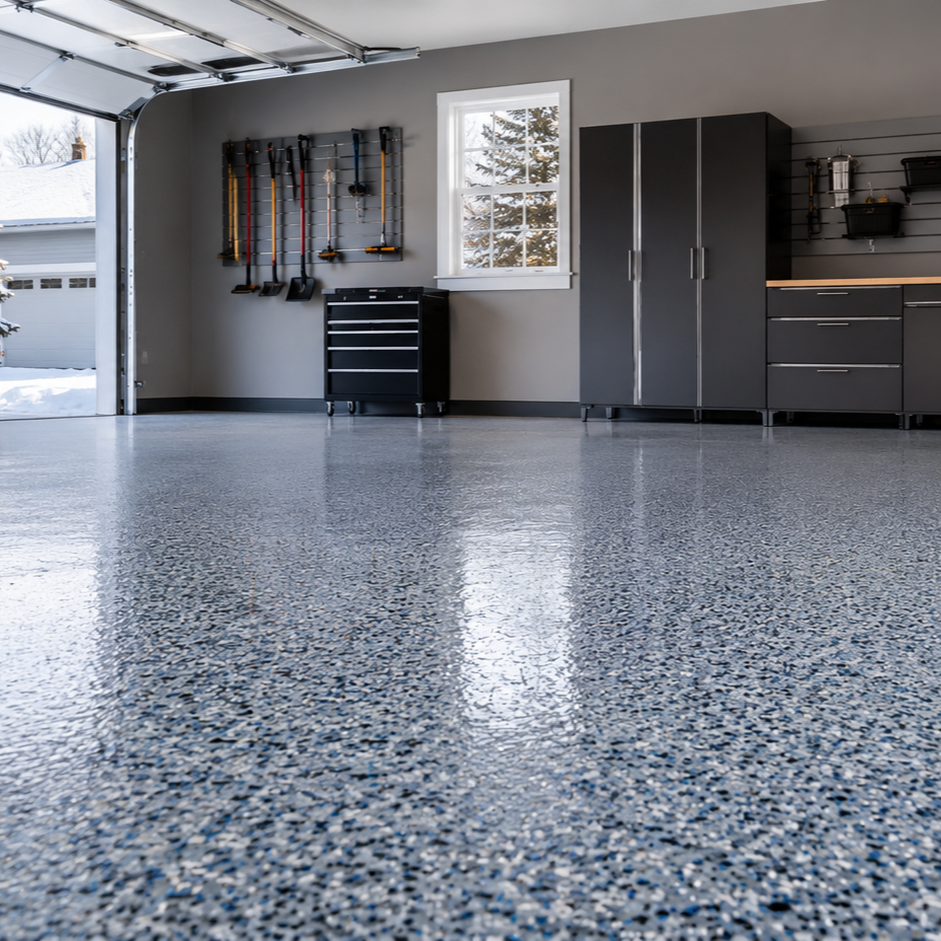
The floor in your detached garage has that yellowish tinge in the center — where the afternoon sun hits through the door — and a chalky, soft patch in the corner where the car drips slush all winter. You had it coated three years ago. It looked good for about eight months.
That's not a product problem, exactly. It's a compatibility problem. Polyaspartic and epoxy coatings behave differently in ways that matter here, and the climate in this part of the country exposes those differences fast.
What epoxy floor coating is and how it works
Epoxy is a two-part system: a resin and a hardener that you mix before applying. The chemical reaction between them creates a hard, plastic-like film that bonds to concrete. When that reaction runs its course — typically 5 to 7 days for full cure — you get a surface that's tough, chemical-resistant, and easy to clean.
That bond depends heavily on two conditions: temperature and moisture. Epoxy needs the concrete and air temperature to stay above 50–55°F throughout application and the entire cure window. Below that threshold, the chemical reaction slows enough that the coating never fully cross-links. You get a film that looks cured but isn't — soft, porous, and prone to peeling.
Moisture creates a parallel problem. Concrete releases vapor after freeze-thaw cycles push water up through its pores. If the slab is off-gassing during the cure window, epoxy can't form a proper mechanical bond. The coating adheres to the surface, but there's a vapor layer working underneath it — and eventually that layer wins.
One more limitation: UV. Epoxy resins use aromatic chemistry that breaks down under direct sunlight. The surface doesn't weaken dramatically, but it turns yellow — starting where afternoon sun hits and spreading inward from there.
What polyaspartic floor coating is and how it works
Polyaspartic is an aliphatic polyurea coating — a different chemical family entirely. It's still a two-part system, but the reaction chemistry is faster, more flexible, and UV-stable.
Think of the difference this way. Epoxy sets like concrete: rigid, thorough, unforgiving under flex. Polyaspartic sets more like a dense rubber membrane — flexible enough to move with the slab as temperatures swing, without cracking at the bond line. A concrete garage floor in a cold-climate home can shift several millimeters between January and August just from thermal expansion. That movement is invisible to you. A rigid coating feels it.
Polyaspartic coatings are also substantially stronger. Industry testing on high-grade systems shows polyaspartic performing four times the tensile strength of standard epoxy, with far greater flexibility — the combination that explains why professional coatings contractors use polyaspartic as a topcoat rather than epoxy in most climate-exposed garages.
The cure rate is another differentiator. Polyaspartic coatings cure in 20 to 60 minutes per coat, depending on the product and temperature. Light foot traffic is typically possible within 12 hours. Vehicle traffic clears by 24 to 48 hours after the final topcoat.
For a household that uses the garage every day, that's the difference between a 48-hour inconvenience and a 5-to-7-day project.
The application window problem
This is where Minnesota reshapes the entire comparison.
Epoxy can only be applied when the concrete surface is above 50–55°F. In a detached, unheated garage — which is the typical setup in older Twin Cities neighborhoods — that window is roughly late May through September. Apply it in April when the slab is still cold from the winter, and the coating appears fine for a few weeks, then starts lifting in sheets from a bond that never properly formed.
Polyaspartic has no such restriction. Professional-grade polyaspartic formulations can be applied in temperatures as low as -40°F and as high as 104°F. A contractor can coat a garage floor in March, October, or on a hot August afternoon when standard epoxy would flash too quickly and leave fisheyes in the surface.
The freeze-thaw cycle creates a secondary problem. Every time water infiltrates the pores of your slab and freezes, it expands and opens those pores slightly. By spring, the slab is releasing vapor. An epoxy coating applied to a slab with elevated moisture vapor emission will delaminate — not gradually, but in sheets. Polyaspartic coatings are more moisture-tolerant by chemistry and handle the vapor emission levels typical of a post-winter concrete slab in a way that most epoxy systems can't.
Before any coating — epoxy or polyaspartic — test the slab for moisture. Tape a 16" × 16" piece of plastic sheeting to the concrete and seal all four edges. Leave it 24 hours. Condensation under the plastic means the slab is releasing vapor and needs more dry time before coating proceeds.
UV stability: where the two coatings look different five years out
Epoxy yellows. That's not a sign of a defective product — it's a structural property of aromatic resin chemistry. UV radiation breaks down the molecular chains, and the degradation products are yellowish compounds that migrate to the surface.
In a garage where sunlight reaches the floor — particularly through a south-facing or west-facing door — discoloration can appear within 12 to 18 months. It starts at the exposed edge and works inward. The discoloration doesn't compromise the coating's chemical resistance, but it makes a light-gray or white floor look stained and uneven within a few years.
Polyaspartic uses aliphatic chemistry. The molecular structure doesn't degrade the same way under UV exposure. The color holds. A white or light-chip floor stays consistent from year three to year fifteen in a way that epoxy alone won't.
Where standard epoxy still has a role
Epoxy isn't obsolete for garage floors — it's just not the right sole topcoat in a cold-climate, UV-exposed environment.
As a base coat, it's effective. High-solids epoxy bonds well to properly prepared concrete and provides a dense, chemical-resistant foundation. The volume-solids number matters here: inexpensive box-store epoxy kits typically run 40% volume solids or lower, meaning more than half the product evaporates during cure and what's left is a thin film. Professional-grade systems — epoxy and polyaspartic alike — run 85–100% volume solids, so the film thickness you apply is close to the film thickness you keep.
In a heated, attached garage where temperatures stay above 55°F year-round and UV exposure is low, a quality high-solids epoxy performs well and costs less per square foot than a polyaspartic system. The performance gap narrows significantly when cold temperatures and direct sunlight aren't factors.
The hybrid system most contractors actually install
Here's what gets left out of the standard comparison: most professional coatings contractors in cold climates don't use one or the other. They use both.
The typical installation sequence is as follows. First, the slab gets mechanically prepared — diamond grinding or shot blasting to open the surface and remove any contamination. Then a base coat of high-solids epoxy or polyurea goes down. If using a decorative chip system, the flakes get broadcast across the base coat while it's still wet. Then one to two topcoats of polyaspartic go over everything.
The base coat provides depth and a strong mechanical bond to the concrete. The polyaspartic topcoat gives you UV stability, rapid cure, and the flexibility to handle thermal movement. Full-flake systems — where chips cover the entire floor surface before the topcoat — add a grip texture that matters when you're walking in from wet snow with winter boots. The result is a system thicker and harder than either material alone, and one built to handle road-salt runoff, deicer tracking, and the freeze-thaw stress that a Minnesota garage floor absorbs from October through April.
How the costs compare
| System | Typical Installed Cost (per sq ft) | Lifespan | DIY feasible? |
|---|---|---|---|
| Box-store epoxy kit | $1–3 (DIY materials) | 2–4 years | Yes, but high failure rate |
| Professional high-solids epoxy | $6–10 | 7–12 years | Not recommended |
| Professional polyaspartic (full system) | $8–15 | 15–20 years | Not practical |
| Hybrid (epoxy base + polyaspartic topcoat) | $9–14 | 15–20+ years | Not practical |
The upfront difference between a basic epoxy and a full polyaspartic system is real. But on a per-year basis, polyaspartic frequently costs less — because a properly installed system lasting 15 to 20 years doesn't need recoating in between.
A DIY epoxy kit on a 400 sq ft garage floor runs $400–1,200 in materials. If that coating fails in two to three years because the slab was too cold or releasing vapor during cure, you're paying to strip the failed film before starting over. That's a cost that rarely gets included in the initial math.
Which system fits your garage
A few questions narrow this down quickly.
Is the garage heated year-round, and is UV exposure minimal? A high-quality epoxy system performs well in those conditions and costs less.
Is it a detached, unheated garage in a climate that goes below freezing from October through April? Polyaspartic or a hybrid system is the appropriate choice. Epoxy cannot be properly installed or cured at the temperatures that garage sees for six to seven months of the year.
How long do you plan to stay in the house? A short-term horizon may justify a lower upfront investment. A 10-to-15-year hold makes the cost math lean toward polyaspartic.
Do you want a consistent color long-term? Light floors, chip systems, and colors that show yellowing all hold better under a polyaspartic or hybrid topcoat.
What does the floor absorb daily? Road salt from tires and boots, gas drips, and standing water from melting snow all favor polyaspartic's chemical resistance and moisture tolerance over a standard epoxy alone.
Frequently Asked Questions
A professionally installed polyaspartic system typically lasts 15 to 20 years with normal use. That assumes proper slab prep — diamond grinding and moisture testing — before coating begins. A floor prepped poorly or applied over a vapor-active slab can fail in 2 to 3 years regardless of what coating product was used.
Epoxy kits are available for DIY use and can produce acceptable results in controlled conditions. Polyaspartic is significantly harder to apply without professional equipment — the cure time is fast enough that mixing and spreading by hand often leads to uneven film before the product starts setting. For either system, the prep work is where most DIY attempts fail, not the coating itself.
Yes. Epoxy resins yellow under UV exposure. In a garage where sunlight reaches the floor — through a south-facing or west-facing overhead door — discoloration typically appears within 12 to 18 months. Polyaspartic topcoats don't yellow the same way because the aliphatic resin chemistry is UV-stable.
Standard epoxy needs the concrete and air temperature above 50–55°F throughout application and the full cure period. Applying below that threshold results in a coating that never fully cross-links and will peel. Professional polyaspartic formulations rated for cold climates can go down at temperatures as low as -40°F.
A two-car garage floor is typically 400–500 square feet. Professional epoxy installation generally runs $6–10 per square foot, or $2,400–5,000 for the project. A full polyaspartic system runs $8–15 per square foot, or $3,200–7,500. Actual costs vary based on slab condition, how much prep the concrete requires, and the specific coating system selected.
For a detached, unheated garage in a state with freeze-thaw winters, yes. The application window alone is a meaningful argument — epoxy can only go down in a narrow 4-month window when garage temps cooperate, which limits when the work can be scheduled and raises the risk if temperatures drop during cure. The durability and UV stability differences add to that case over a 10-to-20-year ownership horizon.
Cesar's Painting handles epoxy and polyaspartic floor coatings across Woodbury, Maplewood, St. Paul, Minneapolis, Bloomington, and the Twin Cities metro. We install full polyaspartic and hybrid systems with professional slab prep — the step that determines whether a coating holds for two years or twenty. Call (651) 650-4747 to schedule a free estimate.
