
When Is It Too Cold to Paint a House Exterior?
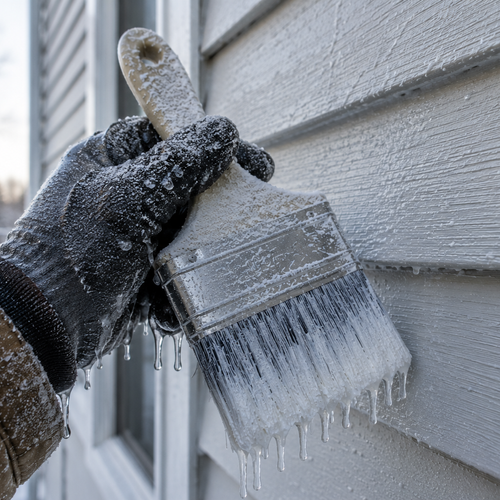
The paint is on-site, the scaffolding is up, and the forecast shows 55°F by 10 a.m. Tomorrow it drops to 40. The week after, nothing's above 45. You are looking at what might be the last real window of the season, and you are trying to decide whether to push through or pull the plug.
That decision matters more than most people expect. Painting an exterior in cold weather doesn't just produce a rougher finish — it can build in failure from the first coat, and the damage won't announce itself until spring thaw.
What happens to latex paint when it gets cold
Latex paint forms a film through a process called coalescence. After you brush or roll it onto siding, the water in the paint evaporates. As it evaporates, tiny acrylic resin particles get drawn together — and then, if the temperature is right, those particles fuse into a continuous, flexible, sealed coating. That's the film that keeps water out and holds color for years.
Think of those resin particles like small wax pellets. At the right temperature, they soften, touch, and melt together into a single continuous sheet. Below 40°F, they stay hard. They sit next to each other on the siding but never fuse. The film looks smooth from ten feet away. It won't survive the first hard winter.
When the air or surface drops below roughly 40°F, the particles harden before they can meld. The water evaporates, the paint looks dry — but you've got a powder bed of disconnected particles on the siding instead of a bonded coating. What follows: poor adhesion that shows up as flaking or peeling the first time the wall goes through a freeze-thaw cycle. A chalky surface where the pigment has no binder holding it together. Color that looks uneven or washed out compared to the chip. A paint job that should have lasted eight years, due for a redo in two.
The daytime-fine, nighttime-disaster trap
Most exterior latex paints have a minimum application temperature of 50°F. Some newer formulas — Sherwin-Williams Resilience, Emerald, Duration, and SuperPaint among them — are engineered to coalesce down to 35°F. But that lower floor comes with a condition that matters a lot in Minnesota fall weather.
The resin particles need to stay warm enough to fuse through the entire curing process, not just at the moment the brush goes on. Sherwin-Williams' own product guidance flags the trap directly: if daytime temperatures are above 50°F but overnight temperatures drop below 35°F, the paint can stop coalescing when the temperature drops. You painted at 52°F at noon. By 10 p.m. it's 33°F. Coalescence stops mid-process, and what's on the wall is a half-formed film.
There's a second problem that kicks in at evening temperature drops: dew. As soon as the sun sets on a clear fall night and the temperature approaches the dew point, moisture condenses on nearly every outdoor surface — including freshly painted siding that hasn't finished curing. That moisture seeps into the uncured film. When it evaporates the next morning, it pulls water-soluble ingredients up to the surface. The result is staining, uneven sheen, and adhesion gaps that aren't visible right away but open up the following spring.
Both air and surface temperature need to stay at or above 35–40°F for at least 48 hours after paint is applied — that means overnight lows, not just daytime highs. A 55°F afternoon with a 28°F overnight forecast is not a green light, regardless of which product is on the wall.
Surface temperature isn't what the weather app says
The thermometer on your phone gives you ambient air temperature, measured in the shade at five feet off the ground. The siding you are painting can be at a very different temperature — sometimes warmer, sometimes much colder.
On a sunny October afternoon, a south-facing wall in direct sun can run 20–30°F hotter than the air. You check the forecast, see 48°F, and think it's borderline. That south wall may actually be sitting at 70°F and is fine to work on. Meanwhile, the north-facing wall in full shade is at 38°F with morning frost still working out of the wood grain. That wall isn't.
This gap is why experienced painters use an infrared thermometer on the actual surface before starting, not just the app. A north wall in October doesn't warm up until 11 a.m. or noon, and by 3 p.m. it's already cooling back down. On some days, the usable window for a shaded elevation is two hours wide. On some days it doesn't open at all.
There's also the moisture angle. October mornings in the Twin Cities regularly drop below freezing. Frost forms on wood siding overnight. Even after the air warms up, that frost sits in the end grain and surface pores of the wood until the sun has been on it for a while. Paint applied over a surface that's releasing moisture from beneath fails at the bond — not from cold air, but from vapor pressure pushing the new film up from below.
When the window closes in Minnesota
Late May through mid-October is the realistic exterior painting season in the Twin Cities. Within that window, late August through early October is often the best stretch — daytime temperatures in the 60s and 70s, humidity lower than July, and the sun angle dropping enough to reduce lap marks from paint drying too fast on hot siding.
The window starts tightening in mid-September. Not because every day is too cold, but because overnight lows start consistently approaching 40°F, and forecasts get less predictable. A 48-hour window of dry weather above 50°F is harder to find. By mid-October, most nights in the metro are hitting 30–35°F. Freeze events can happen any week from October through April at this latitude.
October jobs can work, but they require watching three variables at once: daytime high, overnight low, and a dry window for 48 hours after each coat. November exterior painting in Minnesota is almost never defensible with standard latex products. The freeze-thaw cycles that run through winter — temperatures bouncing above and below 32°F every few days from October through March — will work over a paint film that didn't fully coalesce. By April, you've got peeling siding and the same job to do over.
Low-temperature paint products and their actual limits
The industry has made real progress on cold-weather formulas. Products engineered for 35°F application exist, using modified coalescing agents that stay active at lower temperatures than standard latex binders. For a late-season job in October, these products extend what's possible.
But they're not a workaround for winter painting, and they don't change the overnight-temperature rule. Even with 35°F-rated products, overnight lows still need to stay above 35°F for 48 hours after application. A 35°F-rated paint doesn't help if it's going to be 22°F overnight. It also doesn't help if the surface is wet from frost or if the substrate is saturated from recent rain.
What these products do is give crews a legitimate mid-October window they wouldn't otherwise have. They buy time. They don't eliminate the fundamental chemistry of what a paint film needs to cure.
What to watch for if you painted on the edge
If a paint job went on in borderline fall temperatures, spring is the report card. Check the north and east walls — the shaded elevations that were coldest during application — first.
| What you see in spring | What it likely means |
|---|---|
| Peeling or flaking on north and shaded walls | Incomplete coalescence — film never fully formed |
| Chalky powder rubbing off on your hand | Binder breakdown from failed curing |
| Color looks uneven or washed out in patches | Dew infiltration pulled surfactants up during curing |
| Paint lifting in strips near trim joints and end grain | Substrate moisture at time of application |
| Fine hairline cracks across the surface | Film has no flexibility — freeze-thaw cycles broke it up |
Any of these in the first spring after a repaint is a sign that the temperature window was too narrow. The fix is stripping the failed areas back to substrate, repriming, and recoating — the same scope as the original job, for work you already paid for.
Frequently Asked Questions
With standard exterior latex, both air and surface temperature need to be at or above 50°F during application and for 48 hours after. With low-temperature products like Sherwin-Williams Resilience, Emerald, or Duration, the floor drops to 35°F — but overnight lows still need to hold above 35°F throughout the curing window. Below that, proper film formation doesn't happen regardless of which product is on the wall.
Early October, yes — many years produce good painting days in the first two weeks of the month. Mid to late October gets unreliable. The overnight low is the constraint. You need a 48-hour window where it won't drop below 35–40°F, and by the third week of October those windows are rare in the Twin Cities metro. Check the overnight forecast, not just the daytime high.
Fresh exterior latex needs at least two to four hours before rain resistance kicks in, depending on the product. Paint that gets rained on before it's cured can show streaking, blush, or adhesion loss. Cold rain is harder on the film than warm rain because it drops the surface temperature while adding moisture — two problems landing at once on a coating that's still forming.
Oil-based exterior paints have a slightly lower application floor — some products are usable down to 40°F. The bigger concern with oil in cold weather is dry time. At 45°F, an oil-based topcoat can take 24–48 hours between coats instead of the standard 6–8 hours. That extended window in October weather creates the same dew and frost exposure risks as cold-applied latex — just stretched out over more days.
Walk the perimeter in early spring before the weather warms. Run your palm across the siding on the north and east walls. Powder that smears onto your hand means the binder didn't coalesce. Try to lift a loose edge near trim or end grain. Check for a fine grid of hairline cracks across the surface. These signs concentrate on the walls that were coldest during application — the ones that got the least sun and the most overnight frost.
Yes, and it's the right move. Interior spaces hold temperature steadily year-round, so cabinets, trim, ceilings, and walls all go forward regardless of what October is doing outside. Most painting crews that handle interior and exterior work will sequence fall that way — finish up exterior while the weather allows, shift interior work through winter, and pick back up outside in May.
Cesar's Painting handles exterior painting across Woodbury, Maplewood, St. Paul, Minneapolis, Bloomington, and the Twin Cities metro. We schedule exterior jobs inside the temperature window — and when fall has closed that window, we'll tell you straight and book your project for spring. Call (651) 650-4747 to schedule a free estimate.
