
What Happens to Exterior Paint If You Skip the Primer?
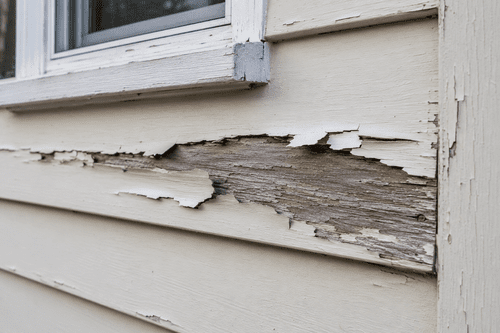
The paint went on in August and looked great. Covered evenly, dried to a nice sheen, and matched the chip almost perfectly. By the following May, the north edge of one of the window casings had lifted, and you could see a thin gap between the paint and the wood. By October — sixteen months after the job — a six-inch strip peeled off a corner board and took a sliver of wood fiber with it.
That's the primer skip, playing out on schedule.
What primer actually does to wood
Most people think of primer as a first coat of watered-down paint. That's not what it is.
Bare wood is a collection of open cells. Those cells absorb moisture from the air, swell in summer, and dry back down in winter. They contain natural oils, resins, and tannins that migrate outward whenever moisture moves through the wood. A topcoat of exterior latex applied directly to bare wood bonds to the surface of those cells — but the substrate underneath is moving, releasing chemicals, and pushing moisture outward. The topcoat has nothing stable to grip.
Primer's job is to penetrate into the wood fibers and cure, creating a rigid bonding layer between the wood and the topcoat. It closes off the cells so they stop absorbing. It encapsulates the tannins so they can't migrate. It gives the topcoat a flat, sealed surface with mechanical tooth — something it can grip rather than just rest on.
Paint on an unprimed surface behaves like tape on a dusty wall. It sticks. Until it doesn't.
Four things that go wrong when you skip it
Adhesion fails at the wood-paint interface
Without a primer to close the cells, exterior latex soaks into the grain unevenly during application. Some areas drink up most of the first coat; others hold it at the surface. The result is uneven film thickness — heavy in the flat-grain sections, thin across the end grain and at the edges of boards.
End grain is the worst case. It's essentially a bundle of open tubes pointing straight out. Paint floods into them on application, then pulls back as it dries. Film builds at the center of boards and stays thin where it's most exposed — right at the edges and joints where water enters first.
Rain runs down the face of every piece of siding and finds the edge of every horizontal board. If the film is thin enough, it doesn't block the water. Once water gets behind the paint at the edge, the rest of the bond degrades from below.
The freeze-thaw cycle accelerates everything
Minnesota's freeze-thaw window runs October through March — a long stretch where temperatures cross the freezing point multiple times in a single week, sometimes in a single day. Any moisture that worked its way behind the paint film freezes, expands, and mechanically pushes the film away from the substrate.
On a properly primed wall, the primer keeps water from getting behind the topcoat in the first place. On an unprimed wall, the water is already there. The first hard freeze lifts whatever hadn't bonded. The second and third cycles finish the job. What takes two years to fail in a mild climate happens in one winter here.
Tannin bleed stains through
Cedar siding, redwood, and some pine species contain water-soluble tannins — the same compounds that make tea brown and autumn leaves rust-colored. When moisture moves through the wood (and it always does, as humidity swings between July's 80-percent-plus and January's bone-dry air), the tannins travel with it. They migrate to the surface and push through any coating that isn't formulated to block them.
Without primer, tannin bleed shows up as brown, tan, or rust-colored staining that bleeds through the topcoat. On a white or pale exterior, it looks like random watermarks or coffee-colored smudges that appear on calm, dry days with no obvious water source. The staining doesn't wash off — it came from inside the wood, not from outside the house.
Stain-blocking primer — oil-based or shellac-based on high-tannin species like cedar — seals the tannin pathway before the topcoat goes on. Skip it, and the topcoat spends its life absorbing a steady supply of extractives from below.
The topcoat uses more paint and still looks patchy
This one is visible during the job, not months later. Bare wood drinks paint. A gallon that covers 400 square feet on a properly primed wall might cover 250 square feet on bare wood — and still look thin. Painters who skip primer spend more material and more labor trying to build a film that the substrate keeps absorbing before it can set.
The coverage looks patchy in raking light: glossy where the surface finally sealed itself, matte where the wood kept absorbing. Applying a second topcoat over that base doesn't fully correct it. The sheen variation is baked into the surface profile of the wood, and topcoats conform to whatever is underneath them.
How fast it actually fails
The timeline depends on the substrate and what the weather does.
| Substrate | Condition | Typical failure without primer |
|---|---|---|
| New bare wood (lap siding, trim) | Clean, dry | Peeling at edges within 1–2 winters |
| Cedar or redwood | Any | Tannin bleed within the first wet season; adhesion failure by winter 2 |
| Previously painted wood (chalky) | Topcoat over chalk layer | Film releases in sheets by spring after the first freeze |
| Fiber cement (Hardie) | Factory-primed but cut ends unprimed | End-grain swelling and paint lifting within 1 year |
| Glossy old paint | No bonding primer | Delayed failure, usually winters 2–3, then large-section peeling |
The fiber cement detail is worth calling out on its own. Hardie board ships from the factory with primer on the face and back. Every cut creates a raw end — at window and door trim, at corners, at the bottom of every piece — that is absorbent and unprotected. Field-cut ends need to be spot-primed before installation. Skip that step, and the trim swells at the cut ends, the paint cracks and lifts at the joint, and water wicks into the core.
The floor for exterior latex application is 40°F — below that, the binder doesn't cure, it just dries. Even on a properly primed wall, painting below this threshold means the film forms without bonding fully to the primer. Check both the air temperature and the siding's surface temperature before you start.
What a proper exterior primer job looks like
The scope of priming depends on the condition of the wood going into the job.
New bare wood or recently stripped sections get a full prime coat across the entire surface. On high-tannin species like cedar, oil-based primer is the standard choice — it penetrates deeply, seals the tannin pathway, and dries to a hard base that the topcoat can grip. On fiber cement, most manufacturers specify a water-based acrylic primer because the surface chemistry is different.
Previously painted wood that's still in sound condition usually needs only spot priming on areas where old paint was scraped or sanded down to bare wood. The key is identifying where "bare" actually is — sometimes it's obvious at a chip or crack; sometimes it's subtle at the end grain of a horizontal board or the back edge of trim.
Entire walls being repainted over old chalk need a full prime coat, not spot work. Chalk is a release layer. Even when you can't see it from twenty feet, it's there on any sun-facing wall that hasn't been washed and tested. A chalk test takes three seconds: wipe a dark cloth across the wall. White powder on the cloth means chalk. Prime the whole wall.
The prep step most often skipped isn't the primer — it's cleaning. Primer bonds to a clean substrate. Mold, mildew, chalky dust, and surface contamination each break that bond. A proper exterior prep washes until the runoff runs clear, lets the wood dry to below 15 percent moisture content, and then primes.
Frequently Asked Questions
No. Additional topcoats don't replicate what primer does at the substrate level. Topcoats aren't formulated to penetrate wood cells, seal tannin pathways, or build adhesion to a bare surface. They sit on top of whatever is underneath them. An extra coat on bare wood gives you a thicker paint film that still isn't bonded — more material to fall when the failure eventually starts.
Self-priming paints have a higher solids content than standard topcoats, which lets them build film faster and cover in fewer coats. On a previously painted wall in good condition, they work well. On bare wood, they don't substitute for a dedicated primer. The solids fill pores faster but don't penetrate as deeply as primer, and they don't block tannins. Most manufacturers include a disclaimer about bare or porous substrates. Read it before skipping the primer on new wood.
Pull a fresh chip from a peeling area and look at the back. If you see bare wood fiber or raw grain, the topcoat never bonded to a stable substrate — no primer, or the wrong primer. If the back of the chip has a layer of powdery residue matching the old paint color, it was rolled over a chalky surface without a bonding prime. If the back is smooth and shiny with old paint visible underneath, the issue is paint-over-paint chemistry — usually latex over oil without proper surface prep.
Not much, relative to the cost of a failed job. Primer runs $25 to $55 a gallon, and a crew applying it as part of a full job uses the same staging they're already set up for. On a typical 1,800-square-foot exterior in the Twin Cities, primer adds roughly $300 to $700 to the job. Repainting two years early because the paint failed without it runs four to five times that number.
Not a full prime, usually — but look carefully before making that call. Any area where old paint was sanded or scraped, any cut end on trim, any spot that fails the chalk wipe test, and any surface where moisture has been getting behind the paint all need primer. Sound, clean, lightly abraded old paint can take a topcoat directly. The problem is that most repaints include a dozen spots that don't qualify as "sound, clean, lightly abraded." Walk the house first.
Most premium exterior paint warranties require application according to the manufacturer's instructions, which specify priming on bare or porous surfaces. If a paint fails prematurely and the manufacturer investigates, missing primer on bare wood is one of the first things the inspection surfaces. The warranty typically excludes failures caused by incorrect surface prep — which is exactly what skipping primer is.
Cesar's Painting handles exterior painting across Woodbury, Maplewood, St. Paul, Minneapolis, Bloomington, and the Twin Cities metro. Every estimate includes a walk of all four elevations and a frank assessment of what prep the wall actually needs before any paint goes on. Call (651) 650-4747 to schedule a free estimate.
