
What Happens to an Unstained Wood Deck Over a Single Winter?
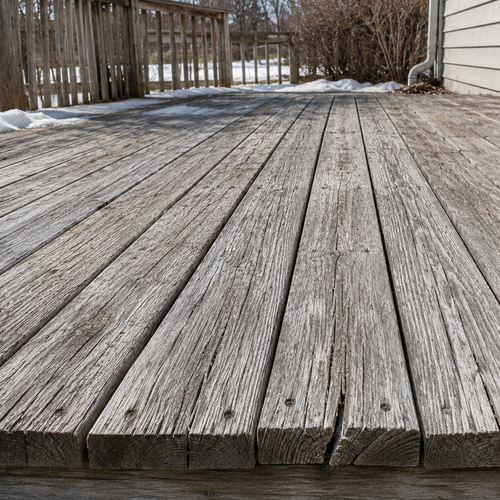
You come out the back door in April, first dry day after the thaw. The boards look like driftwood — gray where they were brown last fall, grain lifted up in little ridges you can feel through your shoe. One board end has split open a quarter inch along the center. Over by the downspout, there's a dark patch where the snow sat longest.
None of that was there in October. One winter on unprotected wood did all of it.
Here's what actually happened.
What stain does — and what skipping it leaves open
Deck stain isn't color on wood. It's a resin barrier that soaks into the top layer of the boards — somewhere between a sixteenth and an eighth of an inch — and slows how fast they take on water and release it. It also carries UV blockers that absorb the sun's damage before it reaches the wood surface itself.
Without stain, you've got raw boards sitting outdoors. And raw wood in a freeze-thaw climate works against itself from October through March.
The damage timeline: October through March
The damage doesn't happen all at once. It builds in stages.
October–November: The first water load
Unstained pressure-treated lumber and cedar are hygroscopic — they pull moisture from their surroundings. A rain in mid-October soaks straight in. The boards swell as water moves through the fibers, then dry back out some as temps drop. Every wet-dry swing puts stress on the wood at a cellular level — the fibers expand and pull back, and that movement starts working tiny checks open along the grain.
End grain takes the worst of it. The cut end of each board is essentially hundreds of open tubes running the length of the wood. Water moves into those tubes in minutes, not hours. Without a sealer, board ends absorb water faster than the faces, swell more, and crack more aggressively as that stress difference plays out through fall.
December–January: Freeze-thaw
Here's where the damage really piles up. The boards are loaded with moisture, and then it freezes. Water expands about nine percent when it turns to ice — and inside the wood cells, that expansion has nowhere to go. The fibers split apart microscopically. You can't see it happening, but you see the result in spring.
This isn't one freeze. A Twin Cities winter runs dozens of cycles: a week of zero-degree nights, then a January thaw pushing temps to 42°F for three days, then back below zero. Each cycle loads more water into already-stressed wood and expands it again. A board that started October in fine shape can have visible surface checks by February, and any checks that existed in November are wider.
February–March: UV and gray
Winter sun sits lower in the sky but still hits south- and west-facing surfaces. On an unstained deck, that UV hits the lignin — the organic binder that holds wood fibers together — directly. Lignin breaks down faster under UV than almost anything else. That bleached, gray color you see in spring? It's oxidized, lignin-depleted wood. Not just a color change. The gray surface fibers are softer and more fragile, and they'll splinter under foot traffic sooner than the healthy wood beneath them.
A stained deck grays eventually too. But there, the pigment takes the UV hit instead of the wood — the color fades because the stain breaks down, not the boards.
What you find when the snow melts
By April, an unstained deck that went into October in decent shape will typically show most or all of these:
| What you see | What caused it | Still fixable? |
|---|---|---|
| Gray surface across most boards | UV degraded the lignin | Yes — deck wash and brightener restore the color |
| Raised grain on board faces | Repeated wet-dry swelling | Yes — light sanding before stain |
| Checks along the board faces | Freeze-thaw expansion in the wood fibers | Yes if shallow; check depth with an awl |
| Cracking or splitting at board ends | End grain absorbed water and froze | Yes if cosmetic; replace if the end is soft |
| Dark patches near low-drainage spots | Water stood too long; mold in the pores | Yes — deck cleaner removes it; check for soft spots underneath |
| Spongy or soft boards underfoot | Rot has started inside the wood | No — those boards need replacing |
Most of what one winter does to an unstained deck is fixable. Gray wood, raised grain, surface checks — those are all prep problems. What isn't fixable is rot. If water sat under snow all winter in a spot that doesn't drain, you can end up with lumber decaying from the inside. The awl test tells you the truth: push it into a soft-looking spot with light thumb pressure. Sinks more than a quarter inch without resistance? That board's gone.
When one winter turns into a real repair job
A deck that came through one bad winter is still stainable. The prep is more involved than it would've been — you're cleaning, brightening, probably sanding — but the deck comes back.
Two or three winters without stain is a different problem. The checks from year one are splits now. The raised grain is fuzzy and splintering underfoot. The dark patches from year one are soft when you push on them. Getting that deck back to a stainable surface means a full wash, a brightener, and enough sanding to cut through the damaged layer — and even then, some boards may absorb stain so unevenly the result looks blotchy.
Unstained wood in a wet-freeze climate is like a sponge left on the sidewalk through winter. Once it's through enough cycles of wet-expand-freeze-crack, the material itself has changed. You can clean the outside of that sponge. You can't make it as dense as it was.
End grain at board cuts absorbs water roughly 10 times faster than face grain. An end-grain sealer — a separate product from deck stain — applied to board ends after installation noticeably reduces checking and splitting at the board tips. Even on a freshly stained deck, this step is worth doing on exposed board ends.
What to do when the snow melts
Sequence matters as much as product selection.
Start with a sodium percarbonate–based deck wash. This removes mold, mildew, and the gray oxidation layer without stripping wood fibers the way bleach does. Let the deck dry for at least 48 hours — stain applied to wet wood bonds to the water, not the wood. Follow with a wood brightener to bring the pH back toward neutral, where deck stain is designed to bond.
Then sand. An 80-grit pass on the raised grain, careful work around any checks. For board ends with visible cracking, an epoxy wood filler stabilizes the crack before stain goes on. It won't make the board invisible, but it keeps water out of that same crack next winter.
For pressure-treated lumber that's been through a rough winter, a semi-solid stain covers more of the surface variation and penetrates better than a transparent or semi-transparent formula. For cedar that cleaned up well after the wash, a semi-transparent stain still lets the grain show. The application window here runs late April through early June — overnight lows need to be reliably above 50°F, and the wood needs 48 to 72 hours of dry weather after the stain goes on to cure correctly. Stain applied below 50°F won't cross-link. The binder stays soft, and the first rain turns it tacky.
Frequently Asked Questions
Maybe — depends on what the boards actually feel like. Gray color, raised grain, and surface checking are all prep problems: clean, sand, stain. What you're really checking for is soft wood. Walk the deck and press an awl into any board that looks darker, sits lower than its neighbors, or flexes when you step on it. If the awl goes in with light pressure, that board needs replacing before stain goes on. Staining over soft wood seals moisture in and speeds up the decay instead of slowing it.
End grain is where the wood opens up — each board is a bundle of longitudinal fibers, and the cut end exposes every one of them. Water enters end grain much faster than the face grain. When that absorbed water freezes, the expansion runs along the fiber direction and splits the board end. It's normal and expected on any unstained wood through a freeze-thaw winter; it's usually one of the first things you'll see after a single unprotected season.
No, and it won't hold. The gray layer is oxidized and chemically different from healthy wood. Stain applied to it bonds to the dead surface material, not to the wood fibers underneath, and it peels off in months. The deck wash and brightener strip that oxidized layer and open the wood back up to receive stain. Those aren't optional steps.
One summer and one winter handles most of it. South- and west-facing boards can gray inside a single summer from UV alone. Shaded or north-facing boards tend to stay their original color a season longer but develop mildew faster because they dry slowly after rain. By the end of year two, most unstained wood in a freeze-thaw climate is fully gray and checking at the board ends.
Yes, noticeably. Cedar has natural oils that slow water absorption compared to pressure-treated pine. An unstained cedar deck typically comes through the first winter with less grain-raising and fewer checks than pressure-treated pine in the same conditions. But the freeze-thaw mechanism works on every species eventually — every wood absorbs water, every wood cracks when that water freezes inside the fibers. Cedar buys you time. It doesn't exempt the deck from the process.
Fall makes an argument: stain going into winter means the boards start the wet months with protection already in place. The risk is timing — fall windows are narrow, and stain applied when overnight lows are dropping toward 40°F won't cure before the cold sets in. Spring gives more reliable temperatures and a longer curing window. Either season works when the timing is right. A deck that went unstained through winter just needs spring attention as soon as the boards are dry.
The cost of skipping a season
One winter on unprotected wood is mostly a prep problem. You'll spend more time cleaning and sanding than you would've if stain had gone on last fall, but the deck comes back. Three winters without stain is a different job — you're assessing boards, replacing some, and working with a surface that may never hold stain as evenly as it did when the wood was healthy.
The window to fix this with a cleaning and a stain coat is now, before the next October. After that, the prep gets longer and the board count goes up.
Cesar's Painting handles deck staining and restoration across Woodbury, Maplewood, St. Paul, Minneapolis, Bloomington, and the Twin Cities metro. We check board condition before quoting — pushing the awl test on any soft or dark spots and noting which ends need sealing — so you know exactly what the deck needs before any stain comes out of the can. Call (651) 650-4747 to schedule a free estimate.
