
What Exterior Paint Finish Lasts Longest on Wood Siding?
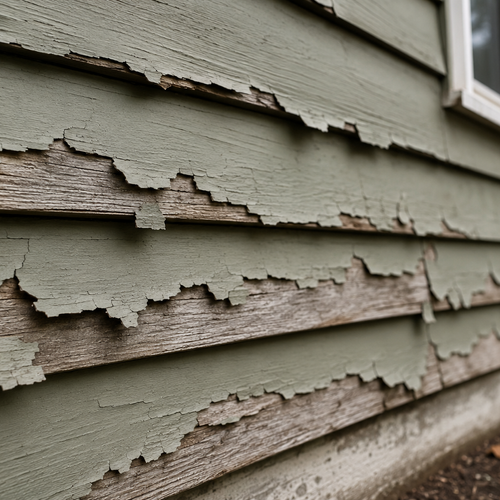
The south wall of your house peels first. You painted it four years ago and you can already see the blistering starting near the bottom course — the boards cupping slightly, the film breaking at the seams. You picked a quality paint. You paid for two coats. Something still went wrong.
Finish choice is often the culprit nobody talks about.
Most homeowners pick a paint color, confirm it's "exterior grade," and trust that the finish — flat, satin, semi-gloss — is a matter of preference. It isn't. On wood siding, finish type directly affects how long the paint film survives, and the wrong one starts failing within three to five years regardless of brand or coat count.
Why wood siding demands more from a paint finish than any other exterior surface
Wood moves. That's the starting point for every decision about finish type.
A cedar lap board at 85°F in July carries very different moisture content than the same board at -15°F in January. Wood expands as it absorbs humidity; it contracts as it releases moisture. Across a full Minnesota year, that dimensional swing can reach 5–10% of the board's cross-section width — enough movement that a paint film applied in June is being stretched and compressed repeatedly by October.
The paint film has to survive that movement without cracking. Once a crack opens — even a hairline — water enters the seam, migrates behind the film, and begins the cycle that produces blistering. In winter, any water that reached the wood during fall doesn't just sit there. It freezes, expands, and pushes the film away from the surface from below. That's the blister you see in spring. The paint didn't fail at the surface. It failed at the bond underneath.
Finish type determines how much the film flexes. That's it. The whole selection process comes down to flexibility versus moisture resistance — and those two properties pull in opposite directions as sheen increases.
The finish spectrum: what each sheen level actually means
Sheen comes from binder-to-pigment ratio. A flat finish has a high pigment volume concentration — lots of pigment held in place with relatively little binder. More pigment, less film integrity. A semi-gloss reverses that: more binder, less pigment, denser film, harder surface.
The binder is what creates flexibility. More binder means the film can stretch and recover. Less binder means a more brittle film — one that cracks when the wood under it shifts.
Here's how the main exterior finish options stack up on wood siding:
| Finish | Sheen Level | Film Flexibility | Moisture Resistance | Recommended Use on Wood |
|---|---|---|---|---|
| Flat/Matte | None | Poor | Poor | Not appropriate for siding |
| Eggshell/Low Lustre | Very low | Good | Fair | Acceptable on protected/north-facing siding |
| Satin | Low-medium | Excellent | Good | Primary siding — best all-around choice |
| Semi-gloss | Medium | Moderate | Very good | Trim boards, window casings, doors |
| High-gloss | High | Low | Excellent | Doors, accent details only |
One finish that often gets skipped in these conversations is eggshell — called "low luster" in exterior paint terminology. It sits between flat and satin: slightly more film density than flat, not quite as much as satin. On a north-facing or heavily shaded elevation that doesn't catch direct UV or concentrated rain, low luster holds reasonably well. On any exposed side of the house, it's a trade-off. If you're repainting the whole house and want a consistent answer across all four sides, satin is the simpler and more durable choice.
Flat exterior paint has its place — on masonry, concrete block, rough stucco where any glossier finish would catch unevenly on texture. On wood siding, flat fails because the porous film doesn't shed water. Rain hits a flat-painted board and sits. The finish absorbs it. When that moisture pushes back out as the board dries and contracts, the weak film lifts with it.
And semi-gloss? Harder, denser film than satin — which sounds like it should be better on siding. But on the wide boards that make up the field of the siding, that hardness becomes a problem. The film doesn't flex through freeze-thaw cycling the way satin does. It cracks at the seams where boards butt together, and peeling starts at those cracks within a few winters.
Satin is the answer for wood siding — here's the mechanism
Satin finish hits the balance point. Enough binder to create a film that flexes through wood's seasonal movement. Enough pigment density to resist moisture penetration. It's not porous like flat, and it's not brittle like high-gloss.
Think of the paint film as a rubber glove over a hand that's constantly swelling and shrinking with the temperature. A thick, rigid glove cracks at the knuckles during the stretch. A thin, flexible glove moves with the hand. The physics here is the same: film flexibility is what separates a paint job that lasts eight years from one that starts lifting at year four.
Satin's slight sheen also does real work on south-facing and west-facing walls. Afternoon UV in summer hits those exposures harder than any other surface on the house. UV breaks down binders — the film chalks, fades, and eventually goes brittle. Satin's denser binder content handles UV better than flat does, and the color hold on southern and western elevations is noticeably better at the five-year mark.
One note on 100% acrylic latex satin versus oil-based: alkyd (oil-based) satin penetrates bare wood deeply and bonds aggressively, which is why it was the exterior standard for decades. But alkyd cures to a rigid film. As the binder oxidizes over the years, it gets increasingly brittle. A 100% acrylic latex satin film stays flexible throughout its life. On a properly primed surface — alkyd primer or acrylic, either works — acrylic latex satin is the current standard for longevity on wood siding.
Where semi-gloss belongs on a wood-sided house
Semi-gloss isn't wrong. It's just used in the right places.
Exterior trim takes more abuse than field siding. Fascia boards catch drip-edge runoff. Window casings sit directly against caulked joints where heat concentrates. Door casings get hands on them constantly. The harder, more washable film that semi-gloss produces earns its keep on those surfaces.
Trim also doesn't move as dramatically as wide siding boards do. A 1×4 piece of finger-jointed pine trim is thinner, more stable, and moves far less than a 6-inch cedar lap board. Reduced movement means reduced liability — semi-gloss's lower flexibility matters less when the substrate isn't asking much of the film.
The visual contrast matters too. Satin siding with semi-gloss trim holds up well and looks intentional — the slight sheen difference between field and trim gives a repaint its three-dimensional quality. Match both at the same sheen and the house reads flat. Not in the finish sense. Just flat.
Why the south wall almost always fails first
If your paint is peeling unevenly — one side much worse than the others — it's almost never a primer failure across the whole house. It's usually UV and moisture working together on a specific exposure.
South-facing walls get direct sun from late morning through mid-afternoon, every day, all year. In summer, surface temperatures on a dark-colored south wall can hit 160–180°F in the afternoon. That drives moisture vapor from inside the wall cavity toward the exterior surface at high velocity. The vapor pushes against the paint film from behind. If the film is already UV-fatigued and losing flexibility, the bond breaks and the blister forms.
West-facing walls get the same UV load in the afternoon hours, combined with thunderstorm rain — wet surface immediately followed by blazing sun, over and over all summer. The film dries fast but the substrate behind it stays wet longer.
On a house with failing paint on one side, finish choice usually made the failure worse. Flat on south siding won't survive the UV and vapor combination. Semi-gloss on south siding cracks at the board joints when the wood contracts hard in January. Satin, with a quality acrylic binder, gives both exposures the best chance at a full service life.
On south-facing and west-facing siding, a quality acrylic satin with a light reflective value (LRV) above 25 will hold up noticeably better than a deep color at the same sheen. Darker colors absorb more heat, which drives more vapor movement through the wall. If you're set on a dark color for these exposures, plan on a 5–7-year repaint cycle instead of 8–10.
How prep interacts with finish choice
Finish type can't rescue a bad prep job. But the right finish does forgive minor surface imperfections better than semi-gloss.
Semi-gloss on siding amplifies every wave, dent, and lap-joint edge. On older wood siding with some weathering texture or slight board waviness, semi-gloss makes the surface read rougher, not smoother. Satin's lower sheen level evens out across an imperfect substrate.
Flat hides imperfections even better — but the durability trade-off isn't worth it on siding. The only scenario where flat on exterior wood siding makes sense is texture so rough and irregular that any sheen would look wrong. Rough-sawn board-and-batten sometimes falls there. Even then, a low-sheen satin is usually a better call.
A note on bare wood: when stain is the better starting point
Everything above assumes previously painted siding — a surface with a bondable base already on it.
Bare wood is different. A paint film applied directly to bare siding sits on top of the wood rather than penetrating it. Wood movement, tannin bleed-through from cedar and redwood, and moisture cycling from behind the board can all lift that film faster than on a primed surface. Penetrating stains — semi-solid or solid-color formulas — absorb into the wood and move with it rather than forming a surface film that's fighting against the board underneath. For bare wood siding, stain is often the more durable first treatment.
The finish question comes back into play when the siding is previously painted. Once a paint or stain film exists on the surface, you're applying over an existing system. That's where finish selection matters most — and where satin earns its place.
Frequently Asked Questions
Very rarely. Rough-sawn cedar or heavily textured board-and-batten are the exceptions where flat or low-sheen finishes occasionally make sense visually. For smooth or semi-smooth lap siding, flat should be avoided — the porous film absorbs moisture instead of shedding it, and the lack of binder density means the film cracks and chalks faster than satin under direct UV and freeze-thaw cycling.
On properly primed and prepared wood siding, a quality 100% acrylic satin should hold for 7–10 years on north and east exposures and 5–8 years on south and west exposures. Those ranges assume normal weather, one coat of primer plus two coats of finish paint, and no significant moisture problems in the wall cavity driving vapor through the siding.
Both matter, but finish type matters more than brand. A satin finish from a mid-grade manufacturer will outlast a flat finish from the best manufacturer on the market. Within satin, quality does matter — products like Sherwin-Williams Duration and Benjamin Moore Aura Exterior are formulated with higher acrylic binder content and better UV inhibitors than contractor-grade satin options. Those products typically run $65–$90 per gallon but hold color and flexibility longer on exposed elevations.
On most homes, yes. Satin siding with semi-gloss trim holds up well and reads correctly. The slight sheen difference creates visual definition between the field and the trim without making the transition jarring. Matching sheen on both flattens the appearance and reduces the performance advantage of using semi-gloss where it actually earns its keep — trim boards that take concentrated moisture and UV.
Yes, but adhesion matters. If the existing flat paint is chalking heavily — a condition where the surface rubs off on your hand — that chalk layer has to come off before applying satin over it. Satin applied directly over a chalky flat surface bonds to the chalk, not the wood, and the entire film eventually lifts with it. A thorough pressure wash (or soft wash followed by hand-scrubbing on loose areas) removes chalk and gives the new coat a bondable surface.
Cedar is a resinous wood that bleeds tannins through paint films, especially on unprimed or underprimed surfaces. For cedar, an oil-based or stain-blocking alkyd primer is worth using before the satin topcoat — it seals the tannins and prevents the brown bleed-through streaking that shows up on cedar painted with a straight acrylic system. The topcoat is still satin acrylic. The primer is where cedar gets its special treatment.
What finish choice actually predicts about your paint job's lifespan
Get the finish right and a quality paint job becomes a planning problem rather than a repair problem. You know roughly when the south wall will need attention. You know when you can let the north side go another season. Get it wrong and the timeline collapses — you're patching and touching up long before any repaint was in the budget.
Satin on field siding. Semi-gloss on trim. 100% acrylic latex throughout. That combination gives wood siding the best shot at a real service life in a climate that tests paint from both ends — frozen dry winters and humid, UV-loaded summers.
Cesar's Painting handles exterior painting across Woodbury, Maplewood, St. Paul, Minneapolis, Bloomington, and the Twin Cities metro. Our crews work with wood siding regularly and can assess your current paint condition, prep requirements, and finish selection before any work starts. Call (651) 650-4747 to schedule a free estimate.
