
Interior vs Exterior Paint: Why You Can't Swap Them
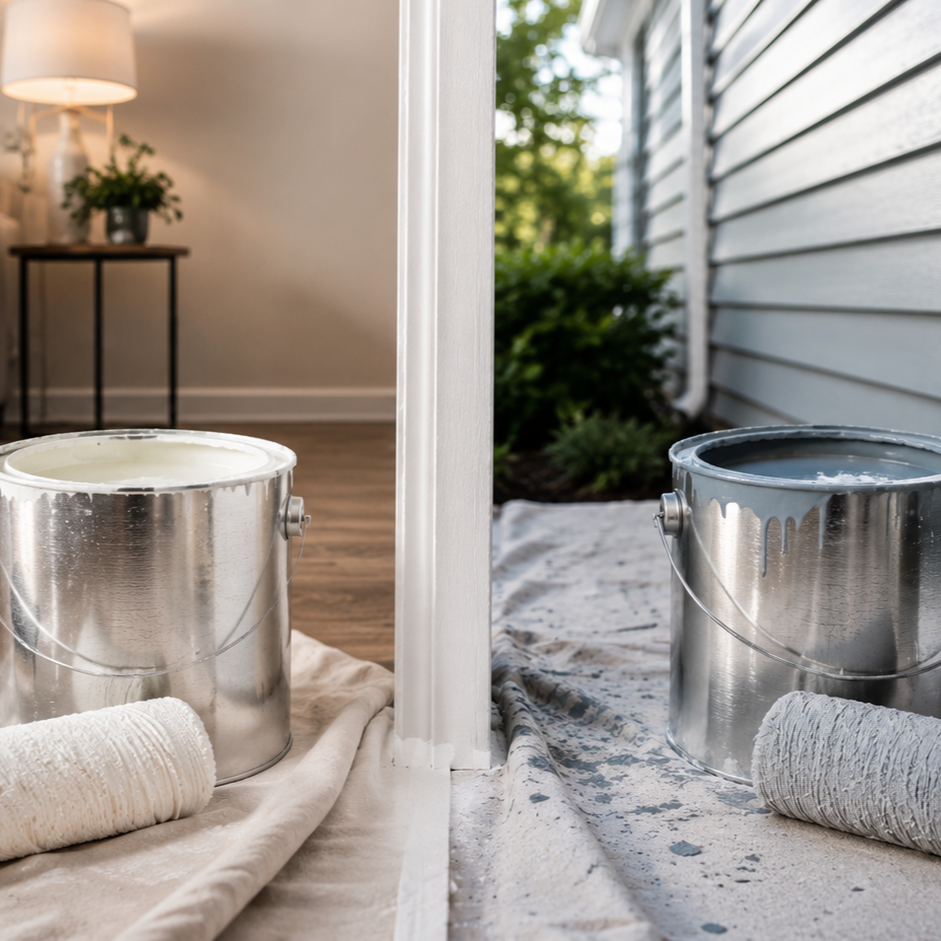
Quick Answer: Interior and exterior paints are built for different jobs. Exterior paint uses tougher, more flexible resins and additives to survive sun, rain, temperature swings, mildew, and fading — so it expands and contracts without cracking and resists weather. Interior paint is formulated for washability, smooth coverage, low odor, and easy cleanup, since it doesn't face weather. You can't safely swap them: exterior paint indoors can release more fumes and isn't made for scrubbing, and interior paint outdoors fails fast against weather. Use each where it belongs for safety and durability.
There's a half-can of exterior paint in the garage and a room that needs freshening up — or the other way around. It's tempting to figure paint is paint and use whatever's on hand. It isn't, and the difference goes deeper than the label. Interior and exterior paints are engineered for completely different environments, with different ingredients to match, and using one in the wrong place gets you a poor result at best and an air-quality problem at worst. Knowing what sets them apart explains why you can't just swap them.
Same Idea, Different Engineering
Both paints do the same basic job — color and protect a surface — but they're built for opposite worlds. Exterior paint has to survive whatever the weather throws at it: blazing summer sun, driving rain, snow, and Minnesota's swing from heat to deep freeze. Interior paint lives in a controlled, climate-stable space, where it has to look smooth, clean up easily, withstand scrubbing, and keep indoor air pleasant. Those different demands mean different resins, additives, and trade-offs baked into each can. So the difference isn't marketing — it's chemistry built for the conditions each one faces.
What Makes Exterior Paint Different
Tougher, More Flexible Resins
Exterior paint uses resins — the binders that hold the paint together and stick it to the surface — designed to stay flexible. That flexibility matters enormously in a climate with big temperature swings, because siding and trim expand and contract with the heat and cold. Flexible exterior paint moves with the material instead of cracking, which is exactly what it takes to survive freeze-thaw winters.
Weather and UV Protection
Exterior paint is loaded with additives to fight what the outdoors does to a finish: UV-resistant pigments to keep the sun from fading it, mildewcides to fight mold and mildew in damp conditions, and water resistance to shed rain and snow. Those additives are what let exterior paint hold its color and integrity through years of weather that would chew through interior paint in no time.
What Makes Interior Paint Different
Built for Washability and Looks
Interior paint is made to go on smoothly, cover evenly, and give a clean, attractive finish, since you see it up close every day. It's also built to be washable and scrub-resistant, so you can wipe off fingerprints, scuffs, and marks without wrecking the finish — which matters on walls in busy living spaces. It doesn't need the weather-fighting additives, so it's tuned instead for appearance and cleanability.
Lower Odor and Easy Cleanup
Because interior paint goes on in enclosed spaces, it's formulated for lower odor and lower emissions, and many interior paints are low- or zero-VOC for better indoor air quality. It's made for comfortable application indoors and easy cleanup. Those are qualities exterior paint isn't built around, since it's applied out in the open air.
| Feature | Exterior Paint | Interior Paint |
|---|---|---|
| Built to handle | Sun, rain, snow, temperature swings | Stable indoor conditions |
| Resins | Tougher and more flexible | Optimized for smooth finish |
| Key additives | UV blockers, mildewcides, water resistance | Washability, scrub resistance |
| Air quality focus | Less of a concern (open air) | Low odor, low/zero VOC |
| Strength | Weather durability and adhesion | Appearance and cleanability |
Why You Can't Just Swap Them
The differences mean each paint fails — or causes problems — when it's used in the wrong place.
Using exterior paint indoors is the riskier mistake. Exterior paints can contain additives and release more fumes and VOCs than are appropriate in an enclosed space, raising indoor air-quality concerns, and they aren't made for the washable, smooth finish that interior walls need. The tougher outdoor chemistry just isn't built for living spaces.
Using interior paint outdoors fails the other way. Interior paint doesn't have the flexibility, UV protection, mildew resistance, or water resistance to withstand weather, so it fades, cracks, peels, and grows mildew quickly once it's out in the sun, rain, and freeze-thaw cycles. It simply isn't made to be outside, and a Minnesota winter destroys it quickly. What looks like a money-saving shortcut — using up leftover paint in the wrong place — ends up costing more, because you pay again to redo the job right. Matching the paint to the environment the first time is what spares you that double cost.
Don't use leftover exterior paint on interior walls to "use it up." Beyond the poor finish and lack of washability, the higher fumes aren't worth it in an enclosed room. Keep exterior paint for outdoor touch-ups and choose a proper low-VOC interior paint for living spaces.
Frequently Asked Questions
It's not a good idea. Exterior paints are formulated with additives and chemistry meant for the outdoors, and they can release more fumes and VOCs than is appropriate for an enclosed space, which raises indoor air-quality concerns. They're also not made for the smooth, washable finish that interior walls need. For indoor projects, a proper interior paint — ideally low- or zero-VOC — is the safer and better-performing choice.
It fails quickly. Interior paint lacks the flexible resins and weather-fighting additives — UV protection, mildew resistance, water resistance — that exterior paint relies on. Exposed to sun, rain, snow, and freeze-thaw cycles, it fades, cracks, peels, and grows mildew far sooner than exterior paint would. In a climate like Minnesota's, interior paint used outdoors can deteriorate within a season, making it a waste of time and money.
Because outdoor surfaces move. Siding and trim expand and contract with temperature changes, and in a climate with wide swings between hot summers and cold winters, that movement is significant. Exterior paint uses flexible resins so it can expand and contract with the material rather than crack. Interior walls remain stable and don't move much, so interior paint is optimized for finish and washability rather than flexibility.
Interior paint is formulated for use in enclosed spaces, so it's generally made for lower odor and lower emissions, with many options being low- or zero-VOC for better indoor air quality. That makes it the appropriate choice for living spaces. Exterior paint isn't designed around indoor air quality since it's applied in open air, which is one reason it shouldn't be used inside. For any indoor project, choosing a quality low-VOC interior paint is best.
It genuinely matters. Interior and exterior paints are engineered with different resins and additives for different environments, and using the wrong one can lead to poor durability, a poor finish, or air-quality concerns. Exterior paint won't provide a washable indoor finish and creates unnecessary fumes inside; interior paint can't withstand weather. Matching the paint to where it's used is what delivers a result that looks good and lasts.
Use Each Where It Belongs
Interior and exterior paints aren't interchangeable — they're engineered for opposite environments. Exterior paint uses flexible resins and weather-resistant additives to withstand sun, rain, and freeze-thaw cycles, while interior paint is formulated for a smooth, washable, low-odor finish in stable indoor conditions. Swap them, and you get poor durability outdoors or a poor, fume-heavy finish indoors. Match each paint to its place, and you get the safety, finish, and longevity each one was designed to deliver.
Planning an interior or exterior painting project? — Get the right products and a quality, long-lasting finish from Twin Cities painting pros. Cesar's Painting serves Minneapolis, St. Paul, Bloomington. Call (612) 203-5856.
