
Popcorn Ceiling: Remove It or Skim Coat Over It?
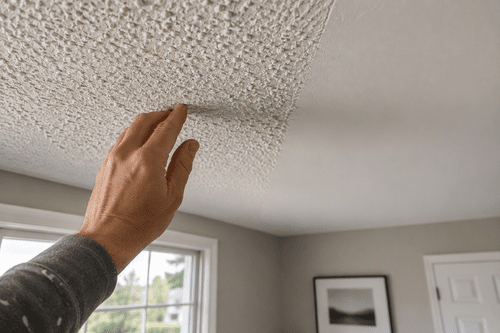
The ceiling in the upstairs bedroom has been bothering you since you moved in. That stippled texture — the kind that looks like someone fired a sponge cannon at wet paint and then walked away — catches the light every morning at an angle that makes the room feel like a beige cave. You've finally decided to deal with it. The question is whether to scrape it off or cover it over.
Both methods get you to a smooth ceiling. They get there differently, and the right choice depends almost entirely on what's in your ceiling, not on what the method sounds like on paper.
Popcorn ceilings installed before 1980 may contain asbestos. Chrysotile asbestos was widely used in spray ceiling textures through the late 1970s as a fireproofing and soundproofing additive — manufacturers didn't fully discontinue it until federal guidelines tightened in 1978. Have the material tested by a licensed abatement contractor before any scraping, sanding, or wet work. DIY removal of asbestos-containing material is illegal and dangerous.
What's actually in that texture
Popcorn ceiling material is spray-applied compound, typically a mix of joint compound or paint with an aggregate — polystyrene beads, vermiculite, or, in older homes, chrysotile asbestos fibers. The texture bonds to the drywall paper, not to the drywall core. That bonding point matters more than anything else when you're deciding how to approach the ceiling.
The aggregate makes the surface porous and brittle. It traps dust easily, absorbs moisture from steam or leaks, and yellows with age as the binder oxidizes. It also scatters light in all directions, which is why popcorn ceilings feel visually heavy — the diffused reflection kills shadow definition and makes the surface read flat in the worst possible way.
Removal: the case for starting fresh
Scraping popcorn off is the more permanent solution, and in the right conditions, it's also the more straightforward one.
The process relies on water. You spray the ceiling in sections with a pump sprayer, let it soak 10 to 15 minutes, then scrape with a wide, flat-bladed drywall knife. The moisture penetrates the texture, softens the binder, and the material comes off in wet clumps. It's messy work — floors, walls, and every surface in the room need full covering. When conditions are right, a standard bedroom gets scraped in a few hours.
The real work starts once the scraping is done.
The drywall underneath a popcorn ceiling was almost never finished to a high standard before the texture went on — because the texture was designed to hide imperfections. What you uncover is usually seams finished to Level 2 (taped, single coat of compound, no feathering), nail or screw dimples that were barely addressed, and stretches of drywall paper that pull away as the texture comes off. All of that needs to be repaired and brought to a proper finish level before the ceiling takes primer and paint.
On a house built in the 1960s or 1970s, you may be looking at significant repair work. Factor that into any quote before comparing methods on price alone.
Removal makes the most sense when the texture is unpainted — or has only been painted once. Paint seals the surface. Wet scraping barely penetrates it, the texture comes off in dry, sharp chunks instead of soft material, and the drywall paper tears as you go. Unpainted popcorn scrapes clean. Painted popcorn fights back at every pass.
It also makes sense when you want a Level 4 or Level 5 finish. Removal followed by proper repair is the most reliable path to either. Level 4 is standard — no seams visible under normal interior lighting. Level 5 adds a full skim coat to the repaired surface and is the right call for rooms where directional light from windows or downlights rakes across the ceiling at a low angle. If you have large south-facing or west-facing windows and a smooth ceiling is the whole point, Level 5 is worth specifying.
Finally, if there's existing damage to address — old leak stains, failed tape seams, areas where the paper has lifted — removal exposes it. Coating over it buries it.
Skim coating over it: the case for covering
Skim coating means applying thin layers of joint compound directly over the existing popcorn, building up until the surface reads flat. Nothing gets removed. The texture stays in place underneath the new material.
The tradeoff isn't in the end result — a properly skim-coated ceiling looks identical to a scraped-and-repaired one. The tradeoff is in the risk going in.
Popcorn texture is a porous, fragile substrate. Joint compound is heavy. If the existing texture isn't firmly bonded to the drywall paper, the added weight gives it a reason to let go. You've plastered over a wall that's already deciding whether to peel — the new material doesn't prevent the failure, it just adds mass to it when it happens.
Professional crews address this with a bonding primer applied before any compound goes on. The primer locks the existing texture in place and gives the first coat of joint compound something to grip. From there, the work proceeds in thin coats — typically two to three — with sanding between each one and a full 24-hour dry cycle before the next coat goes on. The first coat buries the texture peaks. The second levels the result. A third refines any remaining ridges or low spots.
The process adds roughly 1/8 to 1/4 inch of material to the ceiling — barely perceptible in any room with normal ceiling heights.
Skim coating over the existing texture makes the most sense when the popcorn has been painted. This is the biggest practical factor in the whole decision. Painted popcorn is difficult to scrape cleanly without tearing the drywall paper. Skim coating over it is often the lower-cost option once you account for the extra repair time a scrape job requires.
It also makes sense when the texture is structurally sound — no soft spots, no sections that shift when you press lightly, no water-damaged areas. Good adhesion is the precondition for a good skim coat result.
And if you're managing an asbestos situation in an older home, skim coating encapsulates the material without disturbing it. No fibers are released. It's a legitimate, accepted approach to asbestos management in ceiling textures.
Before the first coat of compound goes on, hold a bare LED work light on an extension cord close to the ceiling and shine it at a raking angle — nearly parallel to the surface. Every high spot and hollow will cast a shadow you can mark with pencil. Finding them after the first coat is down means extra sanding you'd rather avoid.
The painted popcorn test
Run your palm along the ceiling. Not a fingertip — your full palm.
Unpainted popcorn leaves residue on your hand, like dragging it across dry joint compound. The surface feels chalky and slightly loose. That ceiling scrapes.
Painted popcorn has a sealed feel at the tips of the texture peaks. Your hand comes away clean. That ceiling is almost certainly better suited to skim coating.
This test doesn't replace a contractor's assessment, but it tells you which category you're working with before you get any quotes.
A third option worth knowing
Drywall overlay is less common than either removal or skim coating, but it's the right answer in some situations: when the ceiling is significantly damaged, when the popcorn has been painted so heavily that scraping is impractical, or when asbestos is confirmed and full encapsulation is the preferred approach.
The process involves fastening a new layer of 3/8-inch or 1/2-inch drywall directly over the existing ceiling into the joists. You lose ceiling height — 3/8 to 1/2 inch — and you'll need extension rings for recessed lights and electrical boxes. But the result is genuinely new drywall, finished from scratch, with no adhesion uncertainty from old texture underneath.
In older homes where a heavily patched, multiply-painted ceiling would require extensive repair work under either of the other approaches, the cost difference between overlay and skim coating is often narrower than it first looks.
How to choose
| Removal | Skim coat | Drywall overlay | |
|---|---|---|---|
| Best for | Unpainted texture, solid drywall | Painted or well-bonded texture; asbestos encapsulation | Damaged ceiling; confirmed asbestos; full redo |
| Approximate cost (Twin Cities) | $2–$5/sq ft | $2–$4/sq ft | $5–$9/sq ft |
| Typical timeline (single bedroom) | 1–2 days | 2–3 days | 2–3 days |
| Height lost | None | Minimal | 3/8–1/2 inch |
| Finish quality ceiling | Excellent with proper repair | Excellent with proper prep | Best-in-class new surface |
Costs reflect professional residential work in the area and vary based on ceiling height, room accessibility, degree of repair work required, and current material pricing.
Frequently Asked Questions
For homes built before 1980, testing is strongly recommended before any scraping or sanding. The test itself is inexpensive — a certified inspector collects a small sample and sends it to an accredited lab, typically $30 to $100 plus any contractor fee. Homes built after 1980 used synthetic aggregates, and the risk drops sharply after that cutoff. Houses built in 1979 sit in a gray zone worth testing anyway.
Professional removal and surface preparation typically runs $2 to $5 per square foot. A 12×15 bedroom (180 sq ft) lands at $360 to $900 for removal alone, before priming and painting. Vaulted ceilings, rooms with significant drywall damage, and older construction with layers of patchwork push costs toward the high end.
Yes, and it's often the most practical option in that scenario. Paint seals the texture surface in a way that takes bonding primer well. The main concern is whether the existing texture is firmly bonded to the drywall paper — a professional should probe for soft or loose sections before proceeding.
A full 24 hours at normal room temperature and humidity. Minnesota's winter interiors are very low in humidity, which speeds drying but also causes compound to shrink slightly more than it would in humid conditions. That shrinkage is one reason a second coat is almost always necessary even when the first coat looks good.
Smooth ceilings are broadly expected by buyers in most Twin Cities markets. Whether removal pays back dollar-for-dollar depends on the quality of the finished ceiling, what else the room needs, and local comparable sales. A smooth, well-finished ceiling reads as maintained and current; a damaged or poorly repaired one reads as a project.
Level 4 is standard for most residential rooms — seams and repairs are finished and sanded, invisible under normal overhead lighting. Level 5 means a full skim coat applied to the entire surface after all repairs are done. It removes any chance of seams or texture variation showing through paint under directional or raking light. If your room has large windows on a south-facing or west-facing wall, or downlights on a dimmer, Level 5 is worth the extra cost.
Cesar's Painting handles ceiling repair, popcorn ceiling removal, and skim coating across Woodbury, Maplewood, St. Paul, Minneapolis, Bloomington, and the Twin Cities metro. We assess texture adhesion and drywall condition before recommending an approach — so the quote reflects what the job actually involves. Call (651) 650-4747 to schedule a free estimate.
