
How to Prep Cabinets for Paint: Why Skipping This Step Leads to Immediate Chipping
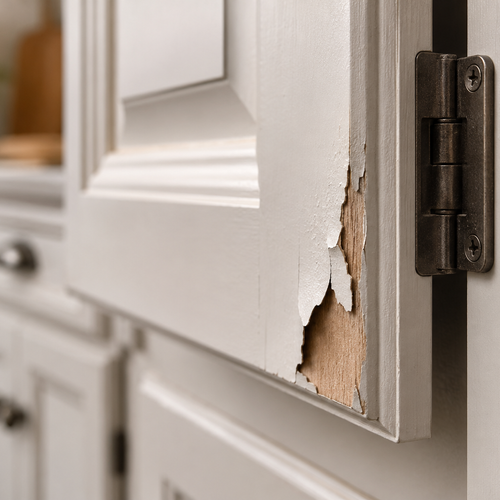
The first chip shows up somewhere embarrassing. Right at the corner of the door where your hand hits it every morning reaching for the coffee mugs — and the paint breaks off clean, a little flake the size of a thumbnail, exposing bare wood underneath.
It happened fast. You painted those cabinets three months ago.
That's not a paint failure. That's a prep failure. And the frustrating part is that by the time the chipping starts, the damage was done long before you ever opened a paint can.
Why Cabinets Are Harder to Paint Than Walls
Walls get touched maybe once a day. Cabinets get yanked open dozens of times, splattered with steam from a boiling pot, wiped down with dish soap, and bumped by a spatula handle on a busy weeknight. That's a lot of physical punishment in a day. Add kitchen humidity — and in a Minnesota winter, the whiplash between a steaming stovetop and bone-dry furnace air — and you've got a surface that demands a much more deliberate bond between the wood and the paint than anything else in the house.
That bond doesn't come from the paint. The paint does what it's told. The bond comes from prep.
The Chemistry of Why Paint Sticks — or Doesn't
Paint grips a surface two ways: chemical adhesion and mechanical adhesion.
Chemical adhesion happens when primer or paint molecules bond directly to the substrate. It's why certain primers work on slick materials like laminate — they contain adhesion promoters that actually react with the surface. Mechanical adhesion happens when paint seeps into microscopic scratches and pores, dries, and locks in. Sanding creates those scratches. Primer stabilizes the substrate so the topcoat has something consistent to hold onto.
Skip either one and you're counting on surface tension to keep your paint job together. That's a losing bet. Think of it like tape on a dusty wall — it sticks until it doesn't, and when it lets go, it doesn't come off in small flakes. It comes off in sheets.
The Grease Problem: Why Clean Doesn't Mean Clean
This is where most cabinet paint jobs actually fail. Not bad paint. Not cheap brushes. The surface looked clean and wasn't.
Kitchens build up an invisible film of airborne grease. Every time something sizzles on the stove, tiny oil droplets go airborne and settle on every surface in the room, including the cabinet fronts. You can't see it with your eyes. But wipe a white cloth across a door that looks perfectly clean and the cloth comes away yellowish.
Paint doesn't bond to grease. Primer doesn't either. When you paint over a greasy surface, the finish looks fine for the first few weeks. Then temperature swings and humidity changes start working on that weak interface, and the paint lifts. Not in one dramatic sheet — in small chips, usually starting at edges and corners where the film is thinnest and stress concentrates.
The fix is a dedicated degreaser applied before anything else. TSP — trisodium phosphate — is the traditional choice, effective but harsh. Most painters today use a purpose-made kitchen degreaser that cuts through years of residue without raising the wood grain. One detail that trips people up: let the surface dry completely before moving on. Moisture trapped under primer is just a different kind of problem.
Sanding: Creating the Grip That Primer and Paint Need
If the surface is already clean, why does it need sanding? Because cabinets have a factory finish.
Most kitchen cabinets were sprayed with catalyzed lacquer or conversion varnish at the factory — a finish so hard and smooth it has almost no porosity. Paint applied directly to that surface has nowhere to go. It can't soak in. It can't grip. It just sits on top of a surface that was designed to repel things.
A 120- to 150-grit sanding scratches that surface just enough to create mechanical grip for primer. You're not trying to strip the finish — you're dulling it. Creating micro-scratches the primer can lock into. The technical term is scuffing. The practical result is paint that stays put versus paint that peels when your kid picks at it with a fingernail.
There's a second reason sanding matters. Nicks, dried drips from the old finish, raised grain from humidity — all of it becomes part of your new paint job if you don't address it first. Once topcoat is on, those bumps telegraph right through, especially under a glossy sheen.
Primer: The Step That Does Two Jobs at Once
Primer gets treated like a formality. It isn't.
A good cabinet primer does two things the topcoat paint can't. First, it seals the substrate so the topcoat doesn't absorb unevenly. Raw wood is thirsty — without primer, the first coat looks blotchy because the grain drinks it in faster than the surrounding surface. Second, it blocks stain migration. Oak and other tannin-rich woods bleed yellow and brown tannins right through latex paint if there's no blocking primer between them. Within a year, your white cabinets develop amber spots spreading outward from the knots. I've seen homeowners repaint the same cabinets twice because they skipped this step and didn't know why the staining kept coming back.
For cabinets, an oil-based or shellac-based primer outperforms latex on most wood surfaces. Shellac — Zinsser BIN is the most widely available — provides exceptional adhesion on previously finished surfaces and blocks stains that latex primers won't touch. Cleanup takes denatured alcohol instead of water, which adds a step. But for a project that gets opened and closed hundreds of times a month, that tradeoff is worth it.
After the primer dries, sand lightly with 220-grit sandpaper before topcoating. You're just knocking down dust nibs and any raised grain — a two-minute pass with your hand. You'll feel the difference immediately, and the topcoat will level out noticeably smoother.
Using the Wrong Paint for the Job
Pick the wrong paint and even a perfect prep job will start failing inside two years.
Wall paint is built to cover large, relatively undisturbed surfaces. It's not designed for the friction of a door being opened a few thousand times a year. Cabinet-grade paint — also sold as alkyd enamel or waterborne alkyd — cures to a harder film. It resists scrubbing, moisture, and impact far better than standard interior latex. Sheen matters too: satin or semi-gloss is the standard for cabinets. Flat paint on a cabinet surface shows every fingerprint and goes chalky inside a year from regular wiping.
Products like Benjamin Moore Advance, Sherwin-Williams Emerald Urethane Trim Enamel, and Sherwin-Williams Cabinet Coat are built for high-use surfaces. If you're in love with a color that only comes in interior latex, it's still the wrong product here. A proper cabinet enamel isn't just cosmetically better — it's physically harder at the molecular level once fully cured.
The Topcoat Question
Most cabinet painting jobs stop at the final color coat. Some should go one step further.
A clear protective topcoat — polyurethane or polycrylic — adds a wear layer that absorbs the direct abuse from cleaning, impact, and moisture before the paint underneath ever does. It's not mandatory if you've used a high-quality cabinet enamel with solid prep. But it makes a real difference in kitchens with young kids or heavy cooking. And it helps near the sink, where water splashes on the same few cabinet faces day after day. The topcoat extends the life of the finish and makes the surface much easier to wipe clean without slowly grinding the paint away.
Dry Versus Cured: A Distinction That Trips Everyone Up
Paint feels dry to the touch in a few hours. It isn't cured.
Drying is just the evaporation of water and solvents from the film. Curing is the chemical cross-linking that makes the film actually hard. For most waterborne alkyds, full cure takes 21 to 30 days. During that window, the film is soft enough to dent or stick when doors are closed against frames.
November through March is the problem window in Minnesota. Running the furnace full blast drives interior humidity down to 20% or below. At low humidity, waterborne paints release solvents faster than the film can cross-link evenly — and that can leave the finish more brittle than it should be. Keeping interior humidity between 40% and 50% during cure helps the film develop properly. A small humidifier running during winter is a reasonable approach.
Load the shelves too fast. Hang doors before they've cured. You press surfaces into soft paint and those impressions stay.
Hardware and Door Removal: The Setup That Pays Off
Painting around hinges and handles seems like it saves time. It doesn't.
When doors stay on their hinges, you can't lay them flat. Paint runs to the low corner by gravity. You can't get a clean edge near the hinge plate, so the film builds up thick in some spots and thin in others. Corners and hardware zones are exactly where chipping shows up first — they're high-contact areas where the film was applied at an awkward angle instead of straight on.
Removing doors, pulling all hardware, labeling each door with painter's tape so you know where it goes back, and painting on sawhorses takes real setup time. The payoff is a finish that holds up at the corners and edges where your hand makes contact every single morning. That's the exact spot that fails first when doors stay on during painting, and it's entirely preventable.
Frequently Asked Questions
Almost always a prep issue. Grease left on the surface, insufficient sanding to create mechanical grip, or skipping primer — any one of these causes paint to chip within weeks. The paint itself isn't failing; the bond underneath it was never there to begin with.
Shellac-based primers, like Zinsser BIN, are the most reliable for previously finished wood cabinets. They bond to slick surfaces better than latex, block wood tannins from bleeding through, and give topcoat paint something solid to grip. Oil-based alkyd primers are a strong alternative and work particularly well on raw wood.
Yes. A quick pass with 220-grit between the primer coat and topcoat removes dust nibs and raised grain. It takes about 10 minutes per door and makes a visible difference in how smooth the final finish looks and feels, especially under kitchen light.
Most waterborne alkyds take 21 to 30 days to reach full cure at normal temperature and humidity. The paint feels hard before that point, but it's still soft enough to dent or stick. During Minnesota winters with interior humidity below 30%, full cure can take closer to the 30-day end of that range.
Not if you want the finish to last. Even when existing paint is adhering well, you need to scuff the surface to give new primer something to grip. Painting over a smooth, intact finish without sanding causes delamination — the new coat peels away from the old coat rather than from the wood itself.
Cabinet-grade alkyd enamel or waterborne alkyd paint: Benjamin Moore Advance, Sherwin-Williams Emerald Urethane Trim Enamel, or Sherwin-Williams Cabinet Coat. These products are formulated for surfaces that get hard use and cure to a harder film than standard interior latex. Satin or semi-gloss sheen is the standard choice. Flat finishes on cabinets look worn and chalky within a year of regular cleaning.
Cesar's Painting handles cabinet painting and refinishing across Woodbury, Maplewood, St. Paul, Minneapolis, Bloomington, and the Twin Cities metro. Every job includes full hardware removal, proper degreasing and sanding, and cabinet-grade enamel applied in controlled conditions. Call (651) 650-4747 to schedule a free estimate.
