
Deck Staining vs. Painting: Which Lasts in Minnesota?
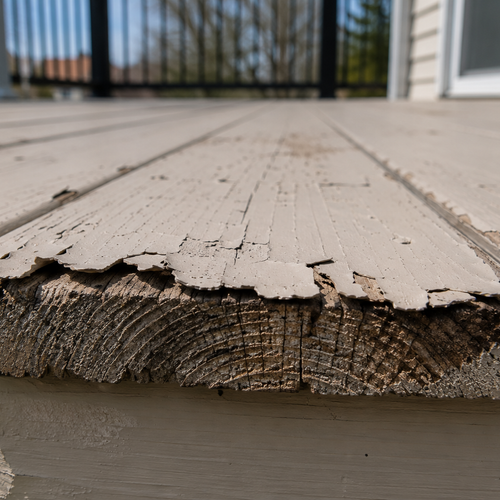
Your outer deck boards started lifting at the end grain by April. The paint had gone down the previous May — clean prep, dry wood, good weather — and eleven months later, every board had a curl of loose paint along the edge that you could peel with a fingernail. That's what a film-forming product does when it spends October through March inside a northern freeze-thaw cycle.
That's exactly why the stain-versus-paint question matters more in Minnesota than most product guides acknowledge. Both work. But the conditions here — cold enough to freeze moisture inside a wood fiber, then warm enough to thaw it, then cold again, across a five-month stretch — expose the difference between a film-forming product and a penetrating one in a way that warmer climates never quite do.
How Each Product Works on Wood
Paint is a film-forming product. It sits on the surface of the wood and relies on adhesion — the bond between the coating and the fiber below — to stay in place. When you paint a deck, you're wrapping the wood in a continuous membrane. That membrane blocks UV, repels water when it's intact, and gives you an opaque, color-consistent surface. It also creates a predictable failure mode: wherever the membrane loses adhesion, water gets under the film, and the film lifts.
Deck stain works differently. A penetrating stain — solid, semi-transparent, or semi-solid — soaks into the wood's pores rather than sitting on top. There's no film to lift. The product is inside the fiber. When it degrades, it fades and loses water repellency, but it doesn't peel because there's nothing sitting on the surface to peel.
Semi-transparent and transparent stains leave the wood grain visible. The color comes from pigment particles suspended in an oil or water-alkyd base that wicks into the surface. Solid stains contain enough pigment to obscure the grain but still penetrate rather than form a film — sitting halfway between paint and a semi-transparent stain in terms of surface coverage and what the maintenance cycle looks like down the road.
What Minnesota's Winters Actually Do to a Deck Coating
A freeze-thaw cycle works on paint like this: water gets into a small gap at the edge of a board — at the end grain, along a crack, under a lifted fastener — and freezes. Frozen water expands roughly 9 percent by volume. That expansion pushes the paint film up and away from the wood. When temperatures rise again, the water thaws and drains, leaving a slightly larger gap. The next freeze opens it further. By March, a board that had a hairline edge-lift in November has a full curl of loose paint along the end grain.
End grain is where it starts. The ends of deck boards — the cuts at the outer edge, around notches for posts, along butt joints — absorb water far faster than face grain. They're like the open end of a straw. Water travels up end grain readily, sits there, and freezes. This is the first place paint loses adhesion on any painted deck in a northern climate, and it's usually visible by the end of the first winter.
Stain doesn't share that failure mode. No film, nothing to lift. Moisture still moves into the wood — it always does — but the degradation shows as color loss and grain checking (small surface cracks along the wood's growth rings), not as peeling. A stained deck that needs recoating looks gray and weathered. A painted deck that needs recoating looks like it's been through something.
South-facing and west-facing decks run into a separate problem in summer: afternoon UV in Minnesota is intense enough to break down UV-blocking pigments faster than most homeowners expect. Paint takes that UV hit at its outer film surface. A semi-transparent stain lets UV pass through the coating and into the wood — which sounds worse, but it means degradation is spread through the wood fiber rather than concentrated at the film surface where it can cause sudden, widespread failure.
Comparing Stain and Paint: Performance, Maintenance, and Cost
| Factor | Deck Stain (Penetrating) | Deck Paint (Film-Forming) |
|---|---|---|
| Failure mode | Fades, grays, grain checking — no peeling | Peeling, flaking, bubbling — starts at end grain |
| First recoat window (MN climate) | 2–4 years (semi-transparent); 4–6 years (solid) | 4–7 years if prep was thorough |
| Prep required for recoat | Cleaning + light sanding or chemical strip if heavily grayed | Full strip of failed paint before recoat |
| Color options | Limited for semi-transparent; moderate for solid | Full palette |
| Grain visible | Yes (semi-transparent); no (solid) | No |
| End-grain moisture resistance | Higher — no film to lift at cut ends | Lower — end-grain lift is the most common failure point |
| Long-term maintenance burden | Lower — recoat is simpler | Higher — failed paint requires mechanical stripping |
The table reflects a penetrating stain against a film-forming paint. Solid stains sit in the middle — more color coverage than a semi-transparent, slightly more surface-building than a pure penetrating formula, with a maintenance cycle closer to paint than to a clear semi-transparent in terms of how often you'll need to address it.
When Paint Makes Sense on a Deck
Paint makes the most sense when color consistency is non-negotiable. If your deck is part of a designed outdoor living space and you need an exact match to exterior trim or railings, paint gives you a palette that stains simply can't. Some homeowners split the difference with a two-toned approach: paint on the vertical surfaces — railings, posts, fascia boards — where appearance is the priority and standing water isn't a constant, and stain on the horizontal deck floor where freeze-thaw exposure does the real damage. That combination can match the home exterior closely while keeping paint off the surfaces most vulnerable to moisture intrusion. It also makes sense when boards have enough surface damage — deep checking, heavy discoloration, old stain worn unevenly — that an opaque coating is the only way to get a clean look without replacing boards.
It makes less sense on a deck with heavy end-grain exposure: tight notch cuts around posts, butt joints in high-moisture areas, boards with a lot of exposed cut ends. Those spots lose adhesion first. Once a painted deck starts peeling in a northern climate, keeping up with spot repairs becomes its own ongoing commitment.
One more case for paint: heavily weathered and dried-out wood sometimes can't absorb a penetrating stain evenly. Wood that's been exposed for years has already lost some capacity to absorb oil-based carriers. In that situation, a pore-sealing primer and a paint system can produce a more uniform surface than anything a stain can achieve.
When Stain Makes Sense on a Deck
For most residential decks in a northern climate, a semi-solid or solid penetrating stain is the maintenance-friendly choice. The recoat process is simpler: clean the deck, let it dry thoroughly (which in Minnesota typically means waiting for a stretch of 50°F-plus days in late April or May), and apply the stain. There's no stripping unless a previous coat was paint or an incompatible formula that's flaking.
Semi-transparent stains work best on newer wood in good condition or on species with natural grain worth preserving — cedar and redwood in particular. They need recoating more often than solid stains, and they show every board-by-board variation in the wood, which some homeowners want, and others find distracting.
Solid stains are the practical choice for pressure-treated pine, which is the most common deck material in the Twin Cities for cost reasons. Pressure-treated pine doesn't have the grain character that makes semi-transparent stains worth using, and it grays and checks faster than most species. A solid stain gets you color coverage close to paint without the peeling risk.
The case against stain is mostly cosmetic. If you want a color outside the earth-tone-to-gray range most stain lines carry, or a surface that looks visually identical to painted trim, a stain won't get you there.
Prep Before Either Product Goes Down
Every coating failure story has a prep chapter. That's true for stain and for paint alike.
For bare, uncoated wood, the process is the same regardless of what's going on top: power wash to strip dirt, mildew, and gray oxidation from the surface; let the boards dry fully — 48–72 hours minimum, longer after a wet spring; then apply a deck cleaner or wood brightener to neutralize the alkaline residue left by pressure washing and open the wood's pores for better absorption. Apply in temperatures between 50°F and 90°F. Below 50°F, neither paint nor stain cures correctly — the binder in both products needs warmth to film properly.
For a deck with an existing coating, the approach depends on what's there and how it's holding. A stain that's faded but not peeling can usually be overcoated after a thorough cleaning. Paint that's peeling, or stain that's flaking and incompatible with the new product, has to come off first. That means chemical stripping — deck stripper applied and allowed to dwell, then pressure washed off — followed by a wood brightener to neutralize. Skip the brightener and you leave the surface too alkaline for oil-based stains to bond to.
And if you're switching products entirely — stain to paint or vice versa — strip down to bare wood. Overcoating an incompatible base almost always fails.
The Recoat Scenario: Where the Difference Becomes Real
Two decks, same size, same wood, applied the same summer. One painted, one stained with a semi-solid penetrating formula.
After three winters, the painted deck has end-grain lift at the outer board edges and two worn-through spots near the stairs. The stained deck has fading on the south-facing side and a few boards that have started to check. Both need attention.
On the stained deck: rent a pressure washer, clean, let dry, sand any rough checks, apply another coat. Two days, a gallon or two of stain. Done.
On the painted deck: scrape and sand the lifted areas, spot-prime, feather paint over the patches. Or commit to a full sand-and-repaint to get a consistent surface back — which means mechanical sanding or chemical stripping down to sound paint, not just cleaning. More time, more labor.
It adds up.
A stained deck at year 10 has probably been recoated twice with minimal prep each time. A painted deck at year 10 may be on its third recoat, carrying the history of those repairs — ghost lines where patches were feathered, uneven texture where sanding fell short. Or it's been stripped once. Either way, more work.
Frequently Asked Questions
No. Penetrating stains work by soaking into wood pores, and paint seals those pores. If you want to switch from paint to stain, all of the paint has to come off first — by sanding, chemical stripping, or a combination. On a large deck, it's one of the more time-consuming prep jobs in exterior work, and the stripped wood has to be in reasonable shape for the stain to absorb evenly.
Semi-transparent stains typically need recoating every 2–3 years in Minnesota — the freeze-thaw cycles and UV exposure shorten the window compared to southern climates. Solid stains and semi-solid formulas generally hold 3–5 years. Product quality matters significantly: a premium oil-based or water-alkyd formula from brands like Armstrong Clark, TWP, or Defy Extreme will outlast a hardware-store budget stain by a noticeable margin.
Late May through early September is the reliable window. The wood needs to be fully dry — not just surface dry — which means waiting at least 48–72 hours after the last rain and for air temperatures above 50°F during application and for several hours after. Decks that had heavy snow cover may still hold moisture in the lower layers of the boards well into May. A moisture meter reading above 15 percent means it's too early.
Solid or semi-solid stain is generally the better match. The chemical preservative treatment makes new pressure-treated lumber moisture-resistant but also temporarily repels oil-based coatings — new treated wood needs to dry out and weather for at least 6 months before staining, longer if the boards still feel damp. Once it's ready, a penetrating solid stain covers the greenish tint and holds up better long-term than paint on wood that tends to move and check.
Bubbling means moisture was trapped under the paint film when it was applied — either the wood wasn't dry enough at application time, or the paint went over existing paint that already had moisture underneath it. As water vapor pushes through the film in warm weather, it forms blisters. Spot-patching blisters just moves the problem around. The real fix is removing the affected paint, letting the wood dry fully, and starting over.
Solid stain can sometimes be painted over with proper adhesion primer, but semi-transparent and semi-solid stains generally can't — the residual oils interfere with primer adhesion, and the paint fails at roughly the same rate the stain would have. Switching from stain to paint typically requires mechanical sanding with coarse-grit paper or a chemical deck stripper before any primer goes down.
Which One to Choose
Paint and stain aren't competing for the same job in every case. Paint is the right call when color range matters and you're prepared for a higher-prep recoat cycle. For most wood decks facing a full Minnesota winter — end-grain boards, a long freeze-thaw season, wood that expands and contracts hard between July and January — a penetrating stain, solid or semi-solid, gives you a simpler path on the second and third recoat.
But if your deck already has multiple coats of paint in good condition, keep painting. Stripping an intact painted deck to switch to stain rarely makes sense unless the paint is already failing. On bare or stripped wood, the maintenance math in a northern climate favors stain.
Cesar's Painting handles deck staining and deck painting across Woodbury, Maplewood, St. Paul, Minneapolis, Bloomington, and the Twin Cities metro. We look at the condition of your existing deck surface before recommending a product — the prep determines how long any coating holds up. Call (651) 650-4747 to schedule a free estimate.
