
How Much Does Deck Staining Cost in Minnesota?
Three quotes come back, and you stare at them for a while. One says $700. One says $1,400. One says $2,800. Same deck, same square footage — wildly different numbers. You start wondering whether the cheapest contractor is skipping something important, or whether the priciest one is just padding the bill.
Usually, they're doing different work. The scope behind a deck staining quote isn't uniform, and Minnesota specifically changes some of the variables in ways a calculator built on national averages won't account for.
What a deck staining project actually includes
Before any stain touches wood, the deck has to be prepped. That's where most of the labor hours go — and it's where quotes split fastest.
A wash-only prep runs the deck through a pressure washer at wood-safe pressure, usually 500–800 PSI, to knock off surface dirt, mildew, and loose material. It's the lowest-cost option and it only makes sense on a deck in decent shape with no solid stain residue sitting on the boards.
Sanding and washing adds mechanical work. A random orbital sander opens the grain, knocks down raised fibers from previous pressure washing, and takes off the light gray weathering that shows up after a year or two without coating. More labor, more time on the quote.
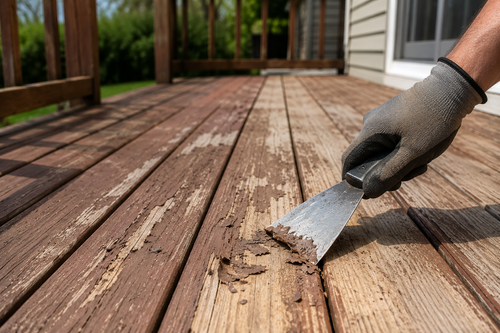
Full strip and prep comes in when a solid stain is peeling or the deck has accumulated incompatible coating layers. Chemical stripper gets applied, left to dwell, then washed off. It's the most time-intensive process on the list, and the price gap between a wash-only job and a full-strip job can hit $300–$500 on a mid-size deck. That alone explains most of the spread you'll see across bids.
What you should expect to pay
Deck staining is typically priced per square foot, but it's not as simple as footprint multiplied by a rate. Stairs, railings, and spindles get priced separately — they're far more labor-intensive per square foot than flat deck boards. A clean 12x16 deck with no railing takes two or three hours once it's been prepped. Add a full railing with balusters on three sides, and that same crew is back the next day.
Here's a realistic cost range for completed projects in the Twin Cities metro:
| Deck Size | Typical Cost Range | Notes |
|---|---|---|
| Small (under 200 sq ft) | $600–$1,000 | Ground-level, minimal railing |
| Medium (200–400 sq ft) | $900–$1,600 | Standard prep, one railing side |
| Large (400–600 sq ft) | $1,400–$2,400 | Full railing, stairs included |
| Complex (600+ sq ft) | $2,000–$3,500+ | Multi-level or second-story deck |
These ranges assume a stainable wood deck — cedar, pressure-treated pine, or redwood — in reasonable shape. A deck that needs full stripping, board replacement, or heavy sanding will land at the higher end of each range. Sometimes, above it.
How stain type affects the quote
The stain itself costs less than most homeowners expect — usually $80–$250 in materials for a mid-size deck. But the choice of stain changes how long application takes, which is what actually moves the labor number.
Transparent and semi-transparent stains penetrate the wood fiber rather than sitting on top. They go down faster, they're more forgiving about overlap, and on clear-grain cedar they look like the wood is just well-fed. They also benefit more from clean, open grain — which is why prep matters more with penetrating stains than with any other coating.
Solid stains behave more like paint. They hide grain, cover weathering and minor discoloration, and hold up longer on high-traffic surfaces before the next recoat. But they're harder to apply without lap marks, and when they fail — really fail — they peel in sheets. Getting old solid stain off a deck before recoating is a half-day job on its own.
And then there's oil-based versus water-based. Oil-based penetrating stains from manufacturers like Defy, TWP (Total Wood Preservative), and Armstrong Clark bond deeper into wood fiber and hold up better through freeze-thaw cycling. Water-based stains have improved, but they're more sensitive to temperature. Below 50°F, the emulsifiers in water-based formulas don't cure the way they should. That's a narrow window in a Minnesota spring.
Quality oil-based penetrating stains like TWP typically run $35–$55 per gallon and cover 200–300 sq ft per gallon. A 300–400 sq ft deck needs 1–2 gallons of stain — material cost alone is $70–$110 for a product that'll actually hold up.
How Minnesota climate changes the math
Freeze-thaw cycling — roughly October through March, with the temperature crossing 32°F dozens of times — is harder on deck coatings than sustained cold. It's not the temperature itself that breaks a coating. It's moisture that gets under or into the coating during a wet fall, then expands as it freezes, then contracts when it thaws. Do that 40 or 50 times in a single winter and a marginally prepped surface peels by April.
Contractors who work in Minnesota year-round price prep differently than contractors who only show up for the busy season. Thorough prep here isn't optional — it's what separates a coating that lasts 2–3 years from one that starts delaminating at 18 months.
July and August humidity adds another variable. At 70–80% relative humidity, stain can take 48–72 hours to cure fully instead of the 24 hours on the product label. An experienced crew schedules around that. An inexperienced one doesn't, and the homeowner finds out about it the following spring.
A quote that includes thorough prep and accounts for application windows isn't padded. It's accurate for the conditions your deck actually faces.
New decks: you have to wait
Here's something that catches a lot of people off guard. If your deck was just built — or if it's new pressure-treated lumber — contractors will tell you to hold off on staining. Sometimes for six months. Sometimes closer to a year.
Pressure-treated pine carries a high moisture content when it leaves the mill. Stain applied too early sits on the surface rather than absorbing into the fiber. It peels, it chalks, it cracks before the first winter is over. You end up paying to have it stripped and redone.
The test is simple: splash some water on the boards. If it beads and sits there, the wood isn't ready. When water absorbs quickly and darkens the board, the grain is open and the moisture content is low enough to stain. Most contractors will run this test during the estimate visit rather than quoting blind.
DIY vs. hiring a crew
Renting a pressure washer, picking up a quality penetrating stain, and putting a Saturday into a 300 sq ft deck is a real option. Materials usually run $100–$250 depending on stain quality and how much prep product you need.
Where DIY goes wrong is usually one of three places: not letting the deck dry long enough after washing (the wood needs at least 48 hours, ideally 72, before staining), applying the wrong product over an incompatible existing coating, or laying on too much stain and leaving a film on the surface that peels. That last one is the most common. More stain doesn't mean more protection. It means more to peel.
Think of staining over a badly prepped deck like painting a wall over peeling paint. Fresh coat, fresh color, looks fine for a couple months — then it starts lifting in sheets. The problem was always underneath.
Hiring a crew with the right equipment and the right product for your specific situation removes those failure points. On a deck that's been through several seasons, it's usually worth the cost difference.
Frequently Asked Questions
A 400 sq ft deck — typical for a standard backyard setup with stairs and one railing section — typically runs $1,000–$1,800 in the Twin Cities metro, depending on prep requirements and stain type. A deck in good condition needing only a wash and recoat will land at the lower end. A deck with failing solid stain that needs full stripping will hit the top of that range or push past it.
Deck paint generally costs slightly more to apply than a penetrating stain because solid coatings need more careful technique to avoid brush and lap marks. More importantly, when deck paint fails, the removal adds real cost — stripping a painted deck before recoating can add $200–$500 to the prep bill. Penetrating stains fail more gracefully and are cheaper to address on the next recoat cycle.
Transparent and semi-transparent penetrating stains typically last 2–4 years here. South-facing and west-facing decks take more UV and usually need recoating on the shorter end of that window. Solid stains can last 4–6 years but require a full strip cycle before recoating once they start to fail, which adds time and cost to the next project.
Yes, virtually always. A pressure wash removes surface mildew, tannin bleed, gray oxidation, and the dust and grime that would prevent a good bond. Most contractors include the wash in the scope. On decks with heavier weathering, the wash is often followed by an oxalic acid brightener treatment to neutralize tannins and open the grain before the stain goes down.
Late spring through early fall — May through September — gives you the best conditions. The deck needs 48–72 hours without rain before and after application, surface temperatures above 50°F for water-based stains or above 40°F for oil-based formulas, and enough sun to drive the cure. Most experienced Minnesota contractors stop taking deck staining work after mid-October.
Not the way you'd stain a wood deck. Composite decking — Trex, TimberTech, Fiberon — is manufactured from wood fiber and polymer and doesn't absorb penetrating stain the way natural wood does. Some manufacturers offer composite-specific coatings designed to bond to the surface layer, but that's a different product and a different process. Most composite deck maintenance comes down to regular cleaning and targeted spot treatment, not periodic restaining.
Read the prep line before you sign anything
The quotes you get back reflect how much prep your deck actually needs, how complex the surface area is, and whether the contractor has priced for Minnesota or just run the numbers through a national rate calculator.
Before anyone shows up for a walkthrough, know whether the deck was previously stained with a solid or penetrating product, and how that coating is holding up. That single detail tells a contractor more about what the job involves than the deck size does.
Cesar's Painting handles deck staining and refinishing across Woodbury, Maplewood, St. Paul, Minneapolis, Bloomington, and the Twin Cities metro. We assess prep requirements and stain compatibility on-site before quoting—so the number we give you reflects what the job actually involves. Call (651) 650-4747 to schedule a free estimate.
