
When Should a Ceiling Crack Be Fixed Right Away?
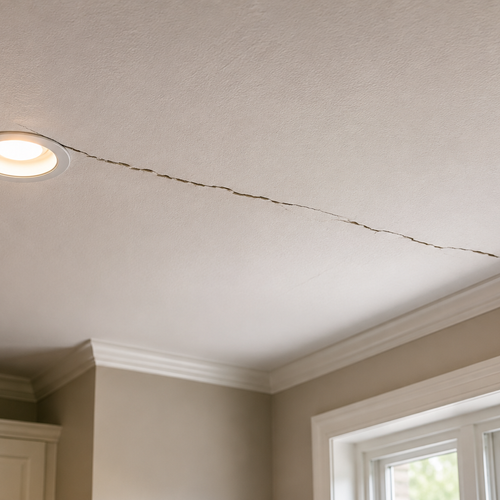
You notice it when the light hits the ceiling at the right angle. A crack — maybe two feet long, starting at the edge of the light fixture and heading toward the corner. You're not sure when it appeared. It may have been there all winter and you're only catching it now that the spring sun is coming through the south windows at a low angle.
Most ceiling cracks are cosmetic. A handful are not. From eight feet below, they can look nearly identical.
Here's how to read what your ceiling is actually telling you.
Two types of ceiling cracks — and why the difference matters
Ceiling cracks fall into two categories: surface cracks in the drywall tape seams or paint, and cracks that reflect movement in the structure above. The first category covers the overwhelming majority of what homeowners see — hairline lines at drywall joints, tape bubbles, fine surface checking in older plaster. The second category is rare but serious.
The problem is they can look the same from below.
A ceiling crack is a little like a warning light on a car dashboard. Most of the time it's the gas cap. Occasionally it's the transmission. The light itself doesn't tell you which — you have to look at the pattern.
Four things separate a cosmetic crack from a structural one: width, direction, what's happening at the edges, and whether the crack is moving.
Warning signs that a crack needs attention now
Some cracks can wait for a scheduled appointment. These cannot.
The crack is wider than 1/4 inch
A hairline crack is thinner than a dime — you cannot slide a coin into it. A crack at 1/4 inch or wider means the drywall panels have separated significantly, or the framing above them has shifted. Either needs to be evaluated, not patched over.
There's sagging near the crack
Run your hand along the ceiling near the crack. If the surface bows downward — or if you can see a shadow under overhead light that makes one side of the crack look lower than the other — stop. Sagging means the drywall is either saturated from above or is losing its mechanical connection to the joists. A section of the ceiling can come down.
The edges of the crack are stained
A brown, yellow, or rust-colored ring around a crack means water has traveled through the drywall and evaporated, leaving minerals behind. The crack may be a symptom of the real problem — a roof leak, a supply line sweating above the ceiling, or a slow drain leak from the bathroom above the kitchen. The water source has to be found and fixed before any ceiling repair holds.
You can see it getting worse
Take a photo of the crack. Come back in three to four weeks. If the crack has lengthened or widened, the underlying cause is still active. Cosmetic cracks from old settling do not grow — cracks connected to ongoing movement do.
The crack runs diagonally, or in a pattern that connects through rooms
Cracks that follow the drywall seams are usually cosmetic. Cracks that cut diagonally across a panel — or that appear at the corners of door frames upstairs at the same time ceiling cracks appear downstairs — are tracking structural movement.
| Crack Characteristic | Urgency |
|---|---|
| Hairline crack at a drywall seam, no staining, no change | Low — cosmetic, schedule when convenient |
| 1/4-inch wide or wider | Medium — needs professional assessment |
| Staining at the edges | High — find the water source before repairing |
| Sagging at or near the crack | Immediate — do not wait |
| Growing visibly over weeks | High — active movement, evaluate now |
| Diagonal across a drywall panel | Medium-high — structural evaluation warranted |
What makes a crack look minor when it isn't
Drywall cracks at the tape seams in nearly every house, given enough time. The tape bridges the joint between two panels, but it's embedded in joint compound — not bonded mechanically into the drywall itself. When the house settles, panels shift a fraction of an inch, the compound cracks along the seam, and you see a hairline. Usually that's all it is.
The problem is that structural cracks can start at those same seam locations. A settling foundation or an overloaded joist causes movement along the same lines where drywall panels meet. The crack looks identical. The cause is different.
Width and behavior over time are the only reliable distinguishing factors from below. A crack at a seam that has stayed the same width for two years is cosmetic. A crack at a seam that appeared after a wet fall and slowly lengthened through winter is not.
The situation that cannot wait
Sagging changes everything.
A drywall panel weighs roughly 2 pounds per square foot. A single 4-by-8-foot sheet is about 64 pounds. When a panel starts separating from the joists, the screws or nails are under shear load — they're holding the panel sideways rather than straight up, which is not what they're designed for. They can let go suddenly.
If you see sagging — even a quarter inch — keep people out of that area until the ceiling is evaluated. Move what's directly below it: furniture, pet beds, anything someone uses for extended time underneath.
A sagging ceiling is not a patching job. It's either structural (the joist connection is failing) or water damage (the panel is saturated and heavy). Both require more than compound and paint.
Press on a sagging area gently with a broom handle. If it feels soft or spongy instead of firm, the drywall has water in it. Wet drywall has no structural integrity — it will not hold screws, and any repair will fail until the panel is replaced and the water source is eliminated.
Cracks that are almost always cosmetic
For every urgent crack, there are many more that are nothing to worry about.
Hairline cracks running straight along a drywall seam, with no staining and no change over a year or more — these are the paper tape releasing slightly from dried compound. It happens in virtually every house between five and fifteen years in.
Small spiderweb or map cracks in older plaster ceilings — plaster shrinks and expands over decades, and fine surface checking is normal in homes built before 1970. It looks alarming. It almost never indicates structural movement.
Cracks that appeared after remodeling above the ceiling — banging, vibration, and temporary loading from construction work can release compound from tape seams. They're usually stable once work stops.
All of these can be repaired: tape re-embedded or replaced, compound feathered over a wide area on either side of the seam, dried fully, sanded, primed, and painted. The repair is straightforward. Skipping the primer after the compound is where most patch jobs fail — the crack shows through the first coat of paint.
Why Minnesota ceilings crack more than you might expect
The freeze-thaw cycle from October through March does predictable damage to exterior walls. It also works on ceilings — particularly on the top floor of a house.
Attic temperature in a Minnesota winter swings dramatically. A warm spell pushes moist indoor air up through gaps in the insulation; that moisture condenses on cold surfaces; when it freezes and thaws repeatedly, the drywall at the ceiling level absorbs and releases moisture. That cycling causes the drywall and framing to expand and contract more than they were designed for. Joints that were perfectly bonded at installation can crack a little more with each winter.
The result: a crack pattern that tends to appear or worsen in March and April, when owners see it for the first time because low-angle spring light hits the ceiling in a way it didn't during winter. If your ceiling crack follows that seasonal pattern — more visible in spring, stable through summer — the mechanism is moisture cycling, not structural movement. It still needs repair. It's just a different problem than a growing crack in July.
Frequently Asked Questions
Use a quarter inch as the threshold. A crack that wide has involved real separation — not just a surface line in the joint compound. Anything narrower than the edge of a dime can typically wait for a scheduled repair appointment.
Heavy snow loads cause temporary deflection in rafters. If the crack appeared during a major accumulation and closed or stabilized once the snow melted, that's the framing flexing under load — the drywall couldn't absorb the movement. It still needs repair. If the crack stayed after snow was gone, the framing may have taken a permanent set, which warrants a closer look.
Paint alone won't hold a crack. Even a hairline will telegraph back through fresh paint within a season. Cosmetic cracks need the tape lifted or re-embedded, compound feathered out 12 to 16 inches on each side, allowed to fully dry, sanded, primed, and then painted. Skip any step and the crack returns.
Brown or yellow staining at the edges is dried mineral deposits from water that moved through the drywall. The water had a source. That source needs to be identified and fixed before any repair — otherwise water will migrate through again and the repair will fail.
Wall-ceiling corners are one of the most common places for tape seams to crack. It's a joint under constant stress, because the framing in the wall and the ceiling expand and contract differently through seasons. A clean crack right at the corner, with no staining or sagging, is almost always cosmetic. A crack that starts at the corner and then runs across the ceiling field is more likely structural.
Foundation settling usually shows up in a pattern — diagonal cracks at door frames, cracks in walls, and ceiling cracks that continue from wall cracks. An isolated ceiling crack in the middle of a room, with no companion damage in the walls or frames, is rarely from the foundation. If you're seeing cracks appear in multiple locations at once, a structural engineer is the right call before any surface repair.
Cesar's Painting handles ceiling repair across Woodbury, Maplewood, St. Paul, Minneapolis, Bloomington, and the Twin Cities metro. We repair cracks, match existing texture, and repaint so the ceiling looks like the damage was never there. Call (651) 650-4747 to schedule a free estimate.
