
What Type of Paint Holds Up Best to Kitchen Grease and Oils?
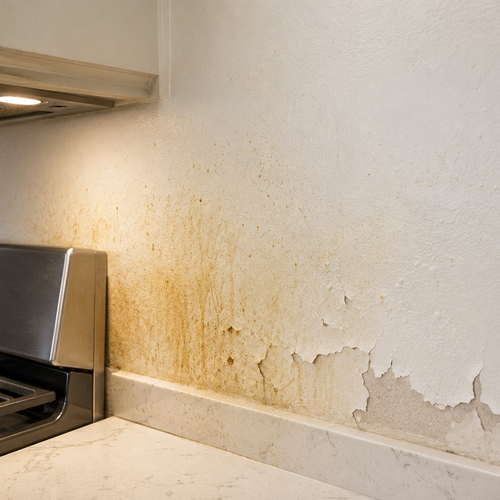
You're wiping down the wall next to the stove and the color comes off on the rag. Not in sheets — just a smear, a dull patch, the finish gone soft where the grease worked in. It happened to the cabinet faces six months after the last paint job too. The paint wasn't cheap. The problem was never the price.
Every time a burner runs at medium-high, hot vaporized oil drifts through the air in a thin mist. It lands on every vertical surface within four feet — walls, cabinet faces, door stiles, the side panels flanking the range. Cools. Condenses. A week later you can feel it. A year later you can see it: a yellowish haze near the hood, dull patches where the sheen has been chemically attacked, paint that flakes when you try to clean it.
Not every paint fails the same way. Some finishes hold. Others surrender in a season. The difference comes down to what the film is made of and how porous its surface actually is.
Why Grease Attacks Paint the Way It Does
Cooking oils are nonpolar molecules. That matters because most water-based paints form a film through coalescence — latex particles fuse as the water carrier evaporates, creating a continuous plastic-like membrane. That membrane is water-resistant once cured, but its porosity varies dramatically by sheen level.
Flat and matte paints get their texture by loading the formula with extender pigments — calcium carbonate, silica, and similar compounds that break up the surface into microscopic peaks and valleys. Those peaks and valleys mean surface area. A lot of it. Grease mist lands on that texture, finds the low spots, and works in rather than wiping off. Trying to clean a flat-painted wall next to an active stove is like trying to wipe cooking oil off a paper towel — the surface isn't rejecting it, it's absorbing it.
Higher-sheen paints carry fewer extender pigments. The resin matrix sits denser at the surface. The result is a film that behaves more like smooth plastic than textured paper. Grease hits it, beads slightly, and wipes clean rather than soaking in.
Range hoods pull in some of that airborne grease, but not as much as most people assume. A properly functioning hood running at full speed catches roughly 50–70% of cooking emissions. The rest drifts across the room. That's why walls four or five feet from the stove end up with the same slow buildup as the backsplash behind the burners.
Steam adds a second problem, and the mechanism is different. Hot water vapor from boiling pots, an open dishwasher door, or a running espresso machine pushes moisture directly into the paint film. Where grease attacks the surface, steam works deeper — reaching the interface between the coating and the drywall or primer beneath. Repeated wetting-and-drying at that bond layer weakens adhesion from the inside out. Kitchens with frequent humidity swings see this on walls near the sink and stove faster than anywhere else in the house.
And then there's heat. A wall immediately adjacent to a gas range can reach 90–100°F during heavy cooking. Heat softens most latex films slightly, making the surface temporarily tacky. A tacky film catches aerosolized oil more readily than a cool one — and repeated heat-and-cool cycles accelerate this, especially in the first 30 days before the paint has fully hardened.
Sheen Level: Where the Real Decision Happens
Sheen is usually treated as an aesthetic preference. Near the stove and on kitchen cabinet faces, it's a durability decision.
| Sheen Level | Gloss Units (60°) | Grease Resistance | Where It Works |
|---|---|---|---|
| Flat / Matte | 0–10 GU | Poor — absorbs grease | Ceilings away from heat only |
| Eggshell | 10–25 GU | Marginal | Low-traffic living areas |
| Satin | 25–35 GU | Fair | Kitchen walls away from stove |
| Semi-Gloss | 45–70 GU | Good | Kitchen walls, trim, cabinet faces |
| High-Gloss / Full Gloss | 70+ GU | Excellent | Heavy-use cabinet faces, trim |
For the splash zone around a range — the four to five feet of wall that sees the most grease contact — semi-gloss is the minimum. Satin can work on walls farther from the heat. Flat and matte have no business on any kitchen wall that sees regular cooking.
On cabinet faces, the floor rises further. Semi-gloss is acceptable as a baseline. But cabinet-grade paints formulated to cure harder are the better call. A face-frame stile or drawer front takes hand contact every single day — fingertips carrying oils, cleaning products, and food residue all at once. Wall-formulation latex in eggshell won't last two years in that environment no matter how carefully it was applied.
Oil-Based vs. Water-Based: What the Chemistry Actually Says
The residential market shifted away from solvent-based alkyd paints over the past two decades — lower VOCs, easier cleanup, faster dry times. That shift was good for most rooms. In kitchens, there are trade-offs worth knowing before you choose.
Solvent-based alkyd cures through oxidation. The binder cross-links with oxygen over days and weeks, forming a film that's harder and more chemical-resistant than most latex coatings at the same sheen level. A fully cured alkyd resists grease, scrubbing, and household cleaners better than the equivalent latex semi-gloss. The trade-off is time: true alkyds take 30 days to reach full hardness, which in a working kitchen means 30 days of vulnerability. Alkyd also yellows in interior spaces as the resin oxidizes — particularly noticeable in white and off-white kitchens.
Waterborne alkyd technology threads the needle. Products like Sherwin-Williams Emerald Urethane Trim Enamel and Benjamin Moore Advance use water as the carrier but cross-link like an alkyd as they cure. Full hardness typically arrives in 7–21 days depending on temperature and humidity. The film resists grease, handles scrubbing, and cleans up with soap and water — without the yellowing of traditional alkyd. Expect to pay $75–$90 per gallon. On kitchen cabinet work specifically, it's the upgrade that earns back its cost.
Standard latex semi-gloss at $35–$60 per gallon works fine for kitchen walls. On cabinet faces, it tends to stay soft enough that regular wipe-downs cause dulling within a year. The film never gets as hard as a cured alkyd-hybrid product. That's not a knock on latex — it's just the wrong tool for the job.
Why Cabinet Faces Are a Different Problem Than Walls
A wall receives occasional contact — a wipe here, a splatter there. A cabinet face takes daily use. Drawer pulls get yanked, door faces get touched a dozen times before breakfast, cabinet sides near the range absorb steam and heat every time something goes on the stove. The paint on a cabinet door isn't decoration. It's a functional barrier.
What fails is usually the bond between the film and the substrate, not the film itself. Grease that works into a micro-crack at the edge of a cabinet face sits at the interface between the paint and the wood or MDF. A separation layer forms. The paint doesn't just get dirty — it starts to delaminate. You recognize this when a chip of paint lifts cleanly with a clean edge rather than breaking rough. The film was already parting from below.
That's why prep determines outcome as much as product selection. A film laid over any residual grease — from cooking, from previous cleaning with an oil-based product, from surfaces that weren't degreased before priming — will never fully bond. The best cabinet paint on the market won't overcome contamination at the primer interface. Thorough degreasing with a TSP substitute before sanding and priming isn't an optional step. It's what the rest of the job stands on.
What the Label Actually Tells You
The resin type is the most important specification on the can. Acrylic-latex works for walls. Alkyd, urethane-alkyd, or "enamel hardener compatible" formulas perform better on cabinet faces and high-contact trim. Some products call this out as "hard enamel finish" or "maximum block resistance."
Block resistance is the spec people overlook until they've experienced the problem. A cabinet door that swings shut and presses against the face frame will stick if the paint has poor block resistance — even if it feels dry. You open the door and hear a peel. Or worse, the paint transfers. Semi-gloss latex is more prone to this than waterborne alkyd; high-gloss is better than semi-gloss. Cabinet-specific formulas address this directly.
Antimicrobial additives are worth looking for, particularly on any wall with limited airflow — behind appliances, in corners, and along exterior-facing walls where seasonal condensation can keep surfaces slightly damp. Standard paint won't stop mold from establishing beneath the film in those spots. Kitchen-grade and bath-grade formulations typically include mildewcide; that term should appear in the product description.
Dry time and cure time are separate things. Dry time — surface dry and ready to recoat — might be 2–4 hours. Cure time — full hardness, cleanable, and block-resistant — is 7–30 days. Grease resistance, washability, and durability all depend on the cured film, not the surface-dry film.
On cabinet door faces, wait at least 7 days after the final coat before rehinging. Pressing a freshly painted door against its face frame before cure is complete is the most common cause of paint transfer and blocking damage in kitchen refinishing work.
A Quick Comparison: Products Worth Considering
| Product | Type | Approx. Cost/Gal | Full Cure | Best Use |
|---|---|---|---|---|
| Standard latex semi-gloss | Acrylic-latex | $35–$60 | 30 days | Kitchen walls |
| Benjamin Moore Advance | Waterborne alkyd | $75–$85 | 14–21 days | Cabinets, trim |
| Sherwin-Williams Emerald Urethane Trim Enamel | Urethane-alkyd | $80–$90 | 7–14 days | Cabinets, high-use doors |
| Traditional oil-based alkyd | Solvent-based alkyd | $40–$65 | 30 days | High-use trim (with VOC trade-off) |
Prices vary by region and supplier. These are general ranges as of 2025–2026.
Frequently Asked Questions
Semi-gloss is the minimum for any wall within four or five feet of an active range. The denser resin surface resists grease penetration better than eggshell or satin, and it wipes clean without the film softening. For walls directly beside the cooking surface, a quality semi-gloss latex or a satin waterborne alkyd both hold up well.
Waterborne alkyd — sometimes labeled urethane-alkyd or alkyd-hybrid — is the best practical choice for most kitchen cabinet work. It cures to a harder film than standard latex, resists grease and cleaning products, and cleans up with soap and water. True solvent-based alkyd cures harder but takes 30 days to reach full hardness and emits higher VOCs in an enclosed space. Products like Benjamin Moore Advance ($75–$85/gallon) and Sherwin-Williams Emerald Urethane Trim Enamel ($80–$90/gallon) fall in the waterborne alkyd category.
Two causes, depending on the paint type. If it was an oil-based alkyd, yellowing is a predictable aging behavior — alkyd resins oxidize to yellow as they age, particularly on interior surfaces with limited UV exposure. If it was latex paint, yellowing near a heat source usually means the film has been absorbing aerosolized cooking oil. That oil darkens as it heats and cools repeatedly. Semi-gloss and higher-sheen finishes resist this better because less oil penetrates the denser film surface.
On a kitchen ceiling that sits well away from the range, flat works fine — it hides imperfections and doesn't get the grease contact that walls do. On any wall within range of cooking activity, or on cabinet faces, flat paint will fail quickly. The porous surface absorbs rather than repels grease, and cleaning attempts strip the finish rather than cleaning it.
Surface dry happens in 2–4 hours for most latex and waterborne alkyd products, but that's not cleaning-grade durability. For standard latex semi-gloss, wait at least two weeks before scrubbing. For waterborne alkyd formulas, follow the manufacturer's cure time — usually 7–21 days. Cleaning or wiping cabinet faces before full cure is one of the fastest ways to dull the finish you just applied.
Yes — more than most people realize. On cabinets with grease contamination or that were cleaned with an oil-based product, a bonding primer creates adhesion that standard latex primer won't. On bare MDF (common in routed cabinet doors), a shellac-based primer seals the surface against moisture absorption and grain raise that can telegraph through the topcoat as a rough texture. The topcoat only performs as well as the layer beneath it.
Getting Kitchen Paint Right the First Time
Paint selection and prep work together. The right product over a contaminated, improperly primed surface won't hold. Thorough degreasing, a bonding primer, and a waterborne alkyd topcoat in semi-gloss or higher — in that order — is what produces a cabinet finish that survives a real kitchen.
If the walls near the range keep failing on repaint after repaint, another coat isn't the answer. It's cleaning down to a sound surface, resealing, and choosing a finish built for the conditions it's living in.
Cesar's Painting handles cabinet painting and interior painting across Woodbury, Maplewood, St. Paul, Minneapolis, Bloomington, and the Twin Cities metro. We use waterborne alkyd formulas on all cabinet work and include full degreasing, sanding, and bonding primer before any topcoat. Call (651) 650-4747 to schedule a free estimate.
