
Paint vs. Stain for Kitchen Cabinets: Which Is Better?
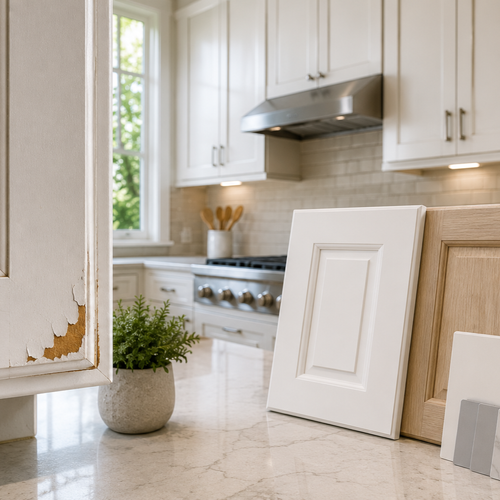
You are standing in your kitchen on a Saturday morning, coffee in hand, staring at the same tired cabinets you've been ignoring for three years. The finish is shot. Something has to change. The question that always follows: paint them or stain them?
Sounds like a preference question. It isn't. Paint and stain don't just produce different looks — they behave differently on the surface, hold up differently in a kitchen, and aren't equally available depending on what your cabinets are actually made of. Pick the wrong one for your situation and you're redoing it inside two years.
What Paint and Stain Actually Do to a Cabinet Surface
These two finishes work in opposite directions. That matters.
Stain goes into the wood. The colorant bonds with the cells in the wood fibers themselves, which is why the grain stays visible — the stain darkens the wood without sitting on top of it. A clear topcoat goes over it to protect the surface, but the color is inside the wood, not on it.
Paint builds a film. It doesn't go into the wood at all — it sits on top, and the whole bond depends on mechanical adhesion. The paint grips the surface because it was prepped correctly, primed with the right product, and applied properly. When that bond breaks down, the paint lifts off as a film. When stain breaks down, it fades. Those are very different failure modes. A chipped painted cabinet looks like a hole in the coating. A worn stained cabinet just looks lighter.
And that difference follows you through every other decision: how the finish holds up to cleaning, how a scratch reads from across the room, whether a touch-up blends or sticks out, and whether your wood type even gives you a real choice.
Your Cabinet Material Narrows the Choice Immediately
Before you get into colors or finishes, find out what your cabinets are made of. Not every material can take both.
Stain needs real wood with actual grain to penetrate. On MDF — the engineered wood composite used in most budget and mid-range cabinet boxes — stain sits on the surface unevenly and produces nothing that looks like a wood finish. On laminate or thermofoil wrap, it won't bond at all.
If your cabinets are solid wood or wood veneer over plywood, you've got a real choice. If they're anything else, you're painting. Period.
| Cabinet Material | Can Be Stained? | Can Be Painted? |
|---|---|---|
| Solid wood (maple, oak, cherry, hickory) | Yes | Yes |
| Plywood with wood veneer | Yes | Yes |
| MDF core | No | Yes (with oil-based primer) |
| Laminate or thermofoil | No | Yes (with adhesion primer and proper prep) |
| Previously stained cabinets | Yes (strip and re-stain) | Yes (sand, prime, paint) |
| Previously painted cabinets | No (paint film blocks penetration) | Yes |
The Grain Issue — Especially on Oak
Oak is everywhere in Twin Cities kitchens from the 1980s and 1990s. And oak has open grain — small channels running along the surface that are visible to the naked eye and easy to feel when you run your fingertip across the door.
Paint is a film, not a filler. Apply it straight over unprimed oak without grain filling first, and those channels show right through the finished surface. You end up with a painted cabinet that still has wood texture under the color. It doesn't look painted — it looks like someone rolled gray or white paint over a rough surface without caring what was underneath.
Getting a smooth, grain-free result on oak means filling those channels before any primer goes on. Water-based grain filler gets worked into the surface, sanded back flat, then primed before paint. It's an extra step most people skip. It's also the difference between a factory-smooth result and a finish that reveals its DIY origins the first time the light hits it at an angle.
Maple doesn't have this problem. Neither do birch or poplar — tight-grained woods take paint cleanly without filling. If you've got maple cabinets, the process is simpler.
How a Kitchen Tests Both Finishes
A kitchen is not a bedroom. Steam comes off pots. Grease floats in the air near the range and settles on every surface, including the cabinet faces above and beside it. Doors open and close all day, every day, and the corners and edges take the most hits.
Both finishes can hold up for a decade or more in a kitchen. But what determines whether they actually do is product quality and prep — not whether you painted or stained.
The one prep step that ends more cabinet jobs early than anything else is skipping degreasing. Kitchen cabinets carry an invisible film of cooking oil on the surface. You can't always see it, but it's there — and it breaks the mechanical bond between the existing surface and any new finish. Paint over an oily cabinet peels within months. Stain won't penetrate evenly through it. Both need a real chemical degreaser, not a wipe with a wet rag.
TSP (trisodium phosphate) or a dedicated cabinet degreaser removes the invisible cooking oil film that causes premature peeling. A damp cloth moves grease around; it doesn't break it down. Apply the degreaser, let it dwell, then wipe clean before any sanding or priming.
Product choice matters on the paint side, too. Waterborne alkyd paints and straight alkyd enamels cure to a harder film than standard interior latex. Most cabinet-grade paints need 3–4 weeks to reach full hardness, even after they feel dry. Put the doors back on the hinges and start slamming them the next day, and you'll scratch a finish that needed another three weeks to fully cure.
For stained cabinets near the stove, an oil-based polyurethane topcoat handles heat and steam better than a waterborne poly.
Paint vs. Stain: Side by Side
| Factor | Paint | Stain |
|---|---|---|
| Look | Solid color, hides wood grain | Shows natural wood grain and character |
| Works on | All wood, MDF, laminate (with right primer) | Solid wood and wood veneer only |
| Color range | Unlimited | Limited to shades that work with wood tones |
| Grain visibility on oak | Requires grain filler for smooth result | Part of the intended look |
| Edge wear over time | Chips — paint film can flake off | Scratches fade naturally; no film to lift |
| Touchup difficulty | Harder — requires color matching | Easier on exposed raw wood |
| Best for resale | Neutral whites and grays photograph well | Works well in traditional or Craftsman interiors |
| Durability ceiling | Very high with the right product and prep | High with a quality topcoat |
What Happens at the Edges
Nobody mentions this upfront about painted cabinets: they chip. A stained cabinet that takes a hit at a corner shows a nick or a light raw spot. A painted cabinet chips — a piece of the film breaks away at the edge and exposes bare wood or the primer underneath, often in a very different color than the surface.
Stain doesn't do that. The wood and the color are the same material in the same layer. A scratch on a stained door usually reads as a slightly lighter version of the finish, not a missing piece of it.
The most vulnerable spots are always the same: around door handles, the top edges of lower cabinet doors, and the bottom edges of upper cabinet doors. Those areas take contact all day. On a well-traveled kitchen, that edge wear is visible within a few years, no matter what finish you used — but it reads very differently depending on whether you painted or stained.
Alkyd and waterborne alkyd paints resist edge chipping better than standard latex because they cure to a harder film. The product choice going in matters more than most people realize until they see what three years of daily use does to a soft latex finish on cabinet edges.
Resale and the Neutral Cabinet Question
White and off-white painted cabinets photograph well. That's the core of it. Real estate agents have been steering sellers toward white and gray kitchens for years because they show neutral, versatile, and easy to imagine living with — which matters when someone is walking through your house deciding whether to make an offer.
Stained cabinets in warm honey or medium-brown tones read differently in listing photos. Whether they feel dated depends on the style of the house and what's around them. Darker stains — espresso, dark walnut — have cycled in and out enough times that they're now a polarizing choice for resale.
But resale value isn't a formula. A well-maintained stained kitchen in a Craftsman-style home holds its own. What actually hurts resale is a finish that's worn through, chipping at the edges, or clearly five years past needing attention. A tired painted kitchen and a tired stained kitchen both work against you. The finish type is less important than whether it looks cared for.
Frequently Asked Questions
No. Stain goes into wood fibers — it can't pass through a paint film sitting on top. To stain painted cabinets, you'd have to strip them down to bare wood first, which is a major project. Painting over the existing paint with proper prep and a stain-blocking primer is almost always the simpler answer.
Painting tends to cost more when done professionally, because of what goes into the prep: degreasing, sanding, priming, grain filling on open-grain woods, and multiple topcoats. Staining clean raw wood moves faster. The gap narrows once you add the polyurethane topcoat required over the stain. Cabinet condition and the number of doors and drawers typically move the price more than the finish choice does.
A professionally applied alkyd or waterborne alkyd paint job should hold up 8–15 years under normal kitchen use before a full redo makes sense. Doors in the highest-traffic areas may need touch-ups before that. Cut corners on the prep or use standard latex instead of a cabinet-grade product, and that number drops fast.
Yes, if the prep is done right. Scuff the stained surface with fine-grit sandpaper, then apply a stain-blocking primer before any paint goes on. That breaks the slick topcoat surface and keeps wood tannins from bleeding through. Skip the stain-blocking primer — or use a general-purpose one instead — and you'll see a yellowish or brownish tint bleeding through the paint a few weeks later, even if it looked clean on day one.
Both get tested hard by heat, steam, and grease next to a range. What matters is how well the surface was prepped and sealed, not whether it was painted or stained. For stained cabinets near the stove, oil-based polyurethane handles heat better than waterborne poly. For painted cabinets, an alkyd or enamel finish with a harder cure holds up better than standard latex. The range-adjacent cabinets also get wiped down more often — that daily friction matters more than the finish type.
You're painting. White-stained oak is a specific look — a wash or whitewash — and it doesn't produce the clean, solid white most people have in mind. For true white or off-white on oak, paint is the only path. Just budget for grain filling before primer if you want a smooth result rather than a textured paint-over-wood-grain finish.
Which One Fits Your Kitchen
Stain belongs on solid wood where the grain is worth showing — traditional kitchens, Craftsman style, anything where natural wood warmth is the point. It wears more forgivingly at edges, touches up more naturally, and doesn't demand the same level of prep that paint does.
Paint belongs on cabinets where you want full color control, need to cover MDF or laminate, want to hide oak grain entirely, or are selling the house and want something that photographs clean and neutral. It requires better prep and a better product to hold up long-term. But done right, it's hard to beat.
The cabinets that fail early — painted or stained — almost always trace back to the same place: a prep step that got skipped.
Cesar's Painting handles cabinet painting and refinishing across Woodbury, Maplewood, St. Paul, Minneapolis, Bloomington, and the Twin Cities metro. We spray cabinet doors with waterborne alkyd products that cure to a hard, chip-resistant finish — and we grain-fill oak before priming. Call (651) 650-4747 to schedule a free estimate.
