
How Much Does Exterior Painting Cost in the Twin Cities?
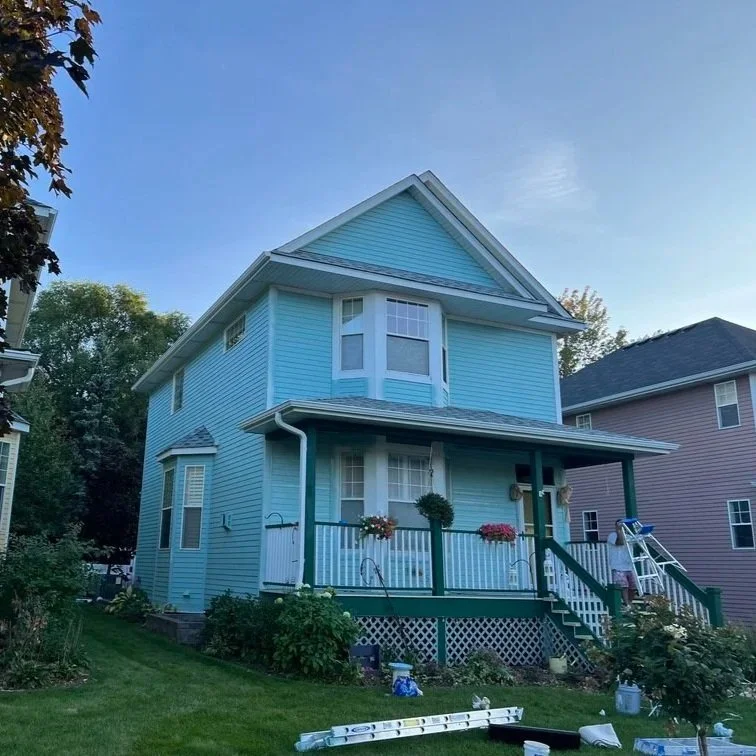
You get two or three quotes and they're not even close to each other. One comes in at $4,800. Another is $9,400. A third is somewhere in the middle. All three contractors walked around the same house. How do the numbers end up that far apart?
The short answer is that exterior painting estimates are built from a lot of variables — and a low bid almost always means something got left out. This guide walks through what actually drives the cost of exterior painting in the Twin Cities, so you can look at a quote and understand whether you're comparing apples to apples.
What most Twin Cities homeowners actually pay
For a typical single-story home in the metro — somewhere in the 1,400 to 2,000 square foot range — a complete exterior paint job runs between $5,000 and $8,500. That includes prep work, primer where needed, two coats of finish, and trim (windows, doors, soffits, fascia).
Two-story homes cover more surface area and require equipment to safely reach upper gable ends and eaves. Those projects typically land between $8,000 and $14,000. Larger homes, homes with a lot of ornate trim, or houses that need significant scraping and repair work push past that.
| Home Type | Estimated Range |
|---|---|
| Small rambler / one story (1,200–1,800 sq ft) | $5,000–$7,500 |
| Average two-story (2,000–2,800 sq ft) | $8,000–$12,000 |
| Larger two-story or complex roofline (3,000+ sq ft) | $11,000–$16,000+ |
| Trim-only (soffits, fascia, windows, doors) | $1,500–$3,500 |
These are real-world Twin Cities ranges based on current labor and materials. National averages tend to run lower — $2.50 to $4 per square foot — but they don't account for the prep demands that come with Minnesota's climate, and they are usually written for markets with lower labor costs.
The paintable surface area of your house is not the same as your home's square footage. A 2,000 sq ft house typically has 1,500 to 2,400 square feet of exterior wall surface, depending on story height and how much of the exterior is covered by roofline, foundation, or windows.
The biggest things that move your number
House size and surface area
Square footage drives the base cost, but the number that matters is paintable surface — every wall face, every gable end, every band board, every inch of trim. A modest-looking split-level can have surprisingly large exterior wall area once you account for all four sides. A two-story with a steep pitch has more gable area than you'd expect.
Contractors who price by the job (rather than a rough per-square-foot estimate) usually measure this out. If someone gives you a number over the phone without seeing the house, treat it as a rough ballpark only.
Number of stories
More stories mean more labor, plain and simple. Getting paint up to a second-story gable or a fascia board three feet above the roofline takes time to set up safely — ladders repositioned, scaffolding sections moved, and angles that are awkward to work from. Most contractors price the premium at 30 to 40 percent more per square foot on the upper portions of two-story homes. A three-story, or a home on a slope (where the back of the house sits higher than the front) adds another layer.
Siding material
What your house is sided with changes how much prep is involved and what products have to go on it.
| Siding Type | Prep Needs | Notes |
|---|---|---|
| Wood (lap, shiplap, cedar) | High | Scraping, sanding, spot priming, or full prime coat common |
| Fiber cement (Hardie) | Moderate | Needs alkyd or acrylic primer formulated for cement; holds well once prepped |
| Vinyl | Low to moderate | Must use vinyl-safe paints; going darker than original color risks heat absorption and warping |
| Aluminum | Moderate | Bonding primer required; existing paint often chalky and needs cleaning |
| Brick | Moderate | Masonry primer needed; once painted, it needs ongoing maintenance — hard to reverse |
| Stucco | Moderate to high | Often has cracks to fill; elastomeric paint typically specified |
Wood siding is almost always the most expensive to paint because it takes the most prep time. A house with cedar lap siding that's been in the sun for fifteen years is going to need serious scraping, possibly some board replacement, and a full prime coat before the finish coats go on. That prep work costs as much as the painting itself on some jobs.
Existing paint condition
Paint condition is the single hardest thing to predict from the street. A house that looks okay from 50 feet away sometimes has peeling on the north side, near the roofline, or anywhere water collects. What looks like surface peeling can turn out to be a moisture problem that goes deeper — paint lifting off bare wood because the substrate was never properly primed, or blistering from inside moisture pushing out through the siding.
Heavy scraping and spot priming adds time. Some jobs add a few hundred dollars. Jobs with widespread adhesion failure across multiple walls can add $1,500 to $3,000 to the base quote — and contractors who skip that prep aren't doing you a favor, they're just deferring the failure until after you've paid them.
Color change
Switching from a light color to a dark one — or trying to cover a saturated existing color — almost always requires an extra coat. Going from a medium gray to white, for example, might need three finish coats to fully opaque the old color. That's 30 to 50 percent more material and a significant amount of additional labor. Good contractors account for this when they quote; lower bids sometimes don't.
Trim complexity
"Exterior painting" to most homeowners means the siding. To a contractor, the trim is a separate line item — and it's often where the most time goes. Windows with multiple panes, dentil molding, decorative brackets, wood shutters, ornate fascia profiles — these details can't be rolled. They are cut in by brush or sprayed and back-brushed, and they take a disproportionate amount of time relative to their square footage.
A plain ranch with flat trim boards across the front might add $800 to the total. A craftsman-style home with window surrounds, frieze boards, and corner boards might add $2,500 to $3,500 for trim alone.
Why Twin Cities pricing runs above national averages
National cost guides put exterior painting at $2.50 to $4 per square foot. Twin Cities projects run $3.50 to $6 or more per square foot, and there are real reasons for that gap.
The first is the climate. Paint that goes on a Woodbury house has to survive freeze-thaw cycles that run from October through March. Those cycles don't just test the paint — they test the caulking, the substrate condition, and every gap that moisture can get into. Premium exterior paints engineered for thermal movement cost more. Applying them correctly in Minnesota requires timing the project around temperature and humidity windows that don't exist in the same way in warmer climates.
The second is prep. Homes that go through five or six winters between paint jobs accumulate more moisture damage, more caulk failure, and more adhesion loss than comparable homes in moderate climates. More prep time means more labor hours baked into every estimate from a contractor who's actually planning to do the work right.
The third is the compressed season. Exterior latex needs ambient temperatures above 50°F and falling — you can't apply it when the surface is going to drop below that within the next several hours after application. In the Twin Cities, that limits the realistic exterior painting window to roughly late April through mid-October. High demand in a short season doesn't bring prices down.
What separates a $5,000 quote from a $9,000 quote on the same house
Paint on an unprimed or inadequately prepped surface behaves like tape on a dusty wall. It sticks. Until it doesn't.
Low bids often win on paper by assuming the prep is fine, using one coat where two are needed, skipping caulking, using a mid-grade paint instead of a 100 percent acrylic exterior product, or simply not accounting for the full scope of the trim. You won't know the difference at the start of the job. You'll know it in two or three years when the paint starts failing in the same spots the low bidder didn't address.
Things to confirm when comparing quotes:
- How many coats of finish, and what product?
- Is primer included — and where specifically?
- What does the prep scope cover (scraping, sanding, caulking, washing)?
- Is trim included, and which trim specifically?
- What's the warranty, and what does it cover?
An itemized quote is almost always a better sign than a lump-sum number.
When to get estimates and time the project
The two best windows for exterior painting in the Twin Cities are late spring (mid-May through June) and late summer through early fall (mid-August through September). Both offer moderate temperatures, lower humidity, and enough warm hours in the day for coats to cure properly before evening.
Mid-July can work, but humidity during heat waves slows dry time and can cause lap marks if conditions aren't managed. Early spring is risky — ground is wet, nights still drop below 50°F without much warning, and some surfaces hold moisture from snowmelt.
If you're planning to sell in the spring, get the exterior done in September of the prior year. The paint has time to fully cure through the fall before the first hard freeze, and it looks fresh when buyers are walking the yard in April.
Frequently Asked Questions
Most single-story homes in these areas run $5,500 to $8,500 all-in. Two-story homes generally fall between $8,500 and $13,000. Condition, siding type, and trim scope move the number in either direction.
A properly prepared and painted exterior with a quality 100 percent acrylic product should hold seven to ten years in the Twin Cities. Homes with extensive south- or west-facing exposure, or houses where the original prep was inadequate, often need attention in five to six years.
A fresh exterior paint job is consistently cited as one of the highest-ROI pre-sale improvements. In a competitive market, peeling or faded paint reduces buyer confidence and can affect appraisal. Beyond resale, it protects the substrate — wood rot repairs on a neglected house cost far more than a paint job.
Yes, but not with any exterior paint. It requires a vinyl-safe product — typically a lighter color than the original or a tone that doesn't absorb significantly more heat. Dark colors on vinyl can cause the siding to warp or buckle from thermal expansion. This is worth asking about specifically if your house has original vinyl siding and you're considering a color change.
Scope assumptions are the biggest driver. One contractor is quoting one coat of finish and minimal prep. Another is quoting full caulking, a spot prime on bare areas, and two finish coats. A third includes all trim. Unless each quote spells out exactly what's included, the numbers aren't comparable.
The most reliable indicators: paint peeling or flaking on any surface, chalking (a powdery residue that comes off on your hand when you run it across the siding), visible bare wood anywhere, caulk that's cracked or pulling away from trim joints, or a color so faded that the south-facing wall looks noticeably lighter than the north. Any of these means the paint is no longer doing its job.
Cesar's Painting handles exterior painting across Woodbury, Maplewood, St. Paul, Minneapolis, Bloomington, and the Twin Cities metro. We provide detailed, itemized estimates so you can see exactly what you're getting — prep scope, product, coat count, and trim coverage — before any work starts. Call (651) 650-4747 to schedule a free estimate.
