
How Much Does Concrete Floor Coating Cost in Minnesota?
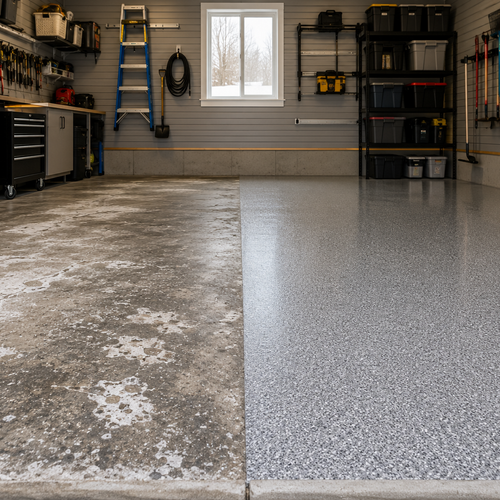
April hits and you finally pull your car out of the garage to let the floor dry out. The concrete looks rough — pitted, stained from months of salt and snowmelt sitting on it, the gray gone blotchy where the water pooled. You’ve been thinking about a coating for two winters now. The question is always the same: what does it actually cost?
Concrete floor coating in Minnesota runs $4–$10 per square foot installed, depending on the coating system, the condition of the slab, and the size of the space. For a standard two-car garage around 400 square feet, most projects land between $1,600 and $4,000. No hidden footnotes. Here’s what moves you from the low end to the high end, and where the surprises tend to show up.
Why Minnesota slabs need more prep than most
Bare concrete behaves like a sponge. It pulls in whatever sits on it — water, salt, oil, road chemicals — and holds it in the pore structure. A slab in a mild climate might go years without showing much damage. A Minnesota garage floor takes a harder hit.
From October through March, ice melt gets tracked in from driveways and sidewalks almost daily. Freeze-thaw cycles work at any moisture that’s gotten into the concrete — expanding it on the way down, contracting on the way back up, opening small cracks a little wider each time. Then July arrives, and relative humidity climbs past 75%, and the slab starts transmitting moisture vapor upward from the ground. By December, it’s back to bone-dry heated air. The slab moves — not visibly, but chemically and dimensionally — through all of it.
All that history means prep before a coating is more involved here than it is in most of the country. Diamond grinding to open the concrete’s pores for proper adhesion is standard on any reputable job. But a floor that’s absorbed five or ten winters of salt deposit often needs additional crack filling, pit repair, and sometimes moisture mitigation before anything goes down.
Budget for prep. It’s the work you don’t see that determines whether the work you do see still looks good in five years.
What you actually pay: price by coating type
Different systems use different materials, and the price gap between them is real. Here’s where they land:
| Coating Type | Price per Sq. Ft. | Best For |
|---|---|---|
| Solid-color epoxy | $3–$7 | Storage areas, utility spaces |
| Decorative flake epoxy | $7–$10 | Garages, workshops, basements |
| Metallic epoxy | $9–$12 | Showroom and display spaces |
| Quartz broadcast | $9–$12 | High-traffic areas, commercial floors |
| Urethane/polyurethane system | $8–$20 | Exterior slabs, pool decks, driveways |
Decorative flake systems are the most common choice for residential garages — the ones most installers in Minnesota default to. The system is a base coat of 100% solid epoxy, a full broadcast of colored plastic chips across the wet surface, and a polyaspartic or polyurethane topcoat. The flake texture handles slip resistance automatically. The topcoat resists UV yellowing through south-facing open garage doors. The base coat bonds aggressively to the slab once the concrete has been properly ground.
Metallic epoxy comes up often — the photos online are hard to ignore. Swirled pigment suspended in a glossy floor, almost like marble. In a showroom or photography studio it’s a strong choice. In a working garage, it shows tire marks, scuffs, and cleaning swirls more readily than a flake surface. Most concrete installers won’t recommend it for a daily-driver garage.
One-day polyaspartic systems come up frequently too. The pitch is real: one day on-site, lower price, drive back in tonight. But the tradeoff is adhesion. Polyaspartic cures so fast that it doesn’t penetrate the concrete pore structure the way a properly applied epoxy base coat does. On a brand-new slab in perfect condition, you might get a few good years. On a Minnesota garage floor with existing salt damage or active moisture vapor pressure, fast-cure systems tend to peel from the edges in — usually within the first or second winter after install. The price looks better upfront. The long-term math usually doesn’t.
Cost estimates by garage size
These ranges are for a professionally installed decorative flake system — base coat, full flake broadcast, polyaspartic topcoat — with standard surface grinding and prep included:
| Garage Size | Square Footage | Installed Cost Range |
|---|---|---|
| 1-car garage | ~200 sq. ft. | $800–$2,000 |
| 2-car garage | ~400 sq. ft. | $1,600–$4,000 |
| 3-car garage | ~600 sq. ft. | $2,400–$6,000 |
| Oversized 3-car or tandem | ~800 sq. ft. | $3,200–$8,000+ |
These are averages. Your actual quote depends on what the slab looks like — more on that below — and whether any extras are needed.
One thing about scale: larger projects don’t always cost less per square foot. The fixed costs of bringing a crew and a floor grinder to the job exist regardless of size. On a heavily damaged slab, prep time scales with square footage. A 600-square-foot floor with significant oil staining and freeze-thaw pitting might cost nearly as much per square foot as a 400-square-foot floor in clean condition.
What drives the price up
The slab’s condition is the single biggest variable. A floor with deep oil staining that’s soaked into the concrete for years, significant pitting from salt, or existing cracks that need addressing before coating adds both time and materials. Crack filling and pit repair on a typical residential slab runs $250–$750 on top of the base installation cost.
The coating system’s solids content matters, even if nobody mentions it in the initial conversation. One hundred percent solids epoxy is the professional standard for base coats — it contains no water or solvent, so the full thickness of the material stays on the floor after it cures. Water-based epoxy systems run 40–50% solids, meaning roughly half the material evaporates off during cure. They bond less aggressively to the substrate and apply thinner. The installed cost looks lower. The performance over a Minnesota winter is a different story.
And the topcoat choice factors in too. A polyaspartic topcoat costs more than a basic polyurethane but offers faster return-to-use time — usually light foot traffic in 12 hours versus 24 — and better UV stability. On a garage where the door faces south or west, UV yellowing without a stable topcoat is a real issue.
Surface preparation method is worth asking about directly. Diamond grinding opens the concrete’s pores mechanically and gives the coating something to bite into. Acid etching — a cheaper prep method — cleans the surface but doesn’t create the same mechanical profile. Properly ground concrete looks slightly dusty and rough to the touch. Acid-etched concrete looks cleaner. The coating knows the difference.
The add-ons that catch homeowners off guard
Two line items show up on quotes that most people don’t expect.
Moisture testing runs $200–$500. It’s not optional on slabs where vapor transmission is a concern — and in Minnesota, most basement floors and any slab with a high water table nearby qualify. Epoxy can’t go down on concrete that’s transmitting moisture vapor above a certain threshold. Apply it anyway and the coating blisters from below, lifted by water pressure it can’t escape. Moisture testing catches that before it becomes your problem. A contractor who skips it isn’t saving you money.
Crack repair is separate from standard prep. If your slab has cracks wider than a hairline — settlement cracks, freeze-thaw damage, anything that shows seasonal movement — those get routed and filled with a flexible epoxy filler before the base coat goes down. Surface prep grinds the slab flat; crack repair addresses what’s underneath. The $250–$750 range covers most residential slabs. Floors with significant settlement cracking or large spalled areas can run higher.
DIY kits vs. professional installation
Home-improvement stores sell water-based epoxy kits for $200–$700, which works out to $2–$3 per square foot. The pitch is simple: prep over an afternoon, roll it on, cure over the weekend.
But the floors tell a different story. Water-based retail epoxy bonds to concrete with roughly half the adhesion strength of a professional 100% solids system. Without diamond grinding to open the concrete’s pores, the kit is sticking to the surface film rather than the substrate itself. It looks fine in summer. After two or three freeze-thaw cycles, peeling typically starts at the edges and works inward.
Most homeowners who’ve done a retail kit and then called in a professional describe the same sequence: looked good for about a year, maybe 18 months, then started lifting. Removing a failed coating before a professional installation adds labor to the job. The kit ends up costing more — you’ve paid twice for the same floor.
A professional system — properly prepped, 100% solids base coat, UV-stable topcoat — lasts 15–20 years with standard residential use. That’s two cars, seasonal salt, occasional fluid spills, and the full range of what a Minnesota garage floor actually goes through.
When comparing quotes, ask each contractor what percentage solids their epoxy base coat is. 100% solids is the professional standard. Water-based systems run 40–50% solids. That number predicts adhesion and longevity more reliably than any brand name on the label.
How long a quality concrete coating lasts in Minnesota
A professionally installed flake epoxy system on a well-prepped slab handles freeze-thaw cycles without delaminating or cracking, as long as the slab itself stays stable. The polyaspartic topcoat resists UV through south- and west-facing garage door exposure that yellows unprotected epoxy. Road salt tracked in from winter driveways wipes off the surface instead of soaking in.
Fifteen to 20 years is a realistic lifespan under normal residential conditions — a couple of cars, occasional automotive fluid spills, standard foot traffic. Heavy commercial use compresses that timeline. Light residential use can push it further.
Maintenance isn’t complicated. Sweep regularly, damp-mop with a pH-neutral cleaner, and address any chips or edge lifts before moisture gets underneath. That’s the whole list. The coating’s job is to seal the slab so it stops absorbing and starts shedding — and once it’s doing that, it mostly takes care of itself.
Frequently Asked Questions
Most residential projects run $4–$10 per square foot installed. A standard decorative flake system on a two-car garage typically runs $1,600–$4,000 total, depending on slab condition and system type.
Epoxy is the base coat that penetrates and bonds to the concrete substrate. Polyaspartic is typically applied as a topcoat over epoxy — it cures faster, resists UV exposure better, and provides the final wear surface. A “polyaspartic only” system skips the epoxy base and can have adhesion issues on older slabs with salt damage or moisture vapor pressure.
Salt exposure and freeze-thaw cycling leave chemical residue and microscopic damage in the concrete’s pore structure that has to be addressed before a coating will bond properly. On a slab that’s been through a decade of Minnesota winters, prep time is often longer than the coating application itself.
Most epoxy systems require surface and air temperatures above 50°F for proper curing. In Minnesota, that generally limits garage projects without supplemental heat to May through September. A heated garage can be coated year-round if the slab temperature holds above the application threshold.
It improves the presentation without a guaranteed dollar figure in appraisals. A coated garage floor photographs better, stages better, and signals to buyers that the home’s been maintained. In markets where finished garages are common, an uncoated floor can stand out unfavorably.
The two most common causes in Minnesota are moisture failure — coating applied over a slab that was transmitting too much vapor — and inadequate surface prep. A slab that wasn’t diamond-ground before application, or where salt residue wasn’t fully removed, doesn’t bond correctly and starts lifting under thermal stress. Both failures are preventable with proper testing and prep before the first coat goes down.
Cesar’s Painting handles concrete coating across Woodbury, Maplewood, St. Paul, Minneapolis, Bloomington, and the Twin Cities metro. We assess the slab condition first, perform full diamond grinding, and apply systems designed for Minnesota’s freeze-thaw climate — not retail kits. Call (651) 650-4747 to schedule a free estimate.
