
Brick Paint vs. Limewash: Twin Cities Home Exteriors
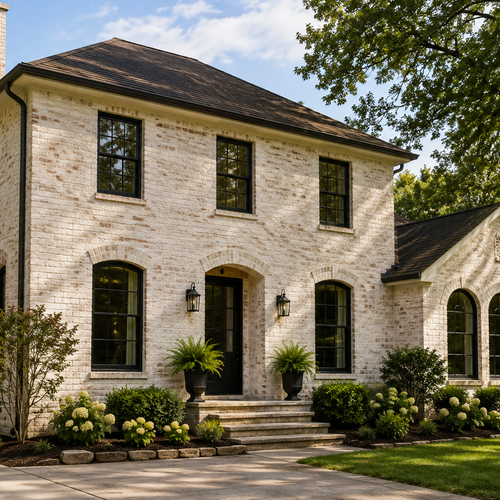
You are standing in the driveway staring at the front of your house. Orange-tan brick, 1970s vintage, completely solid — but it reads like the decade it was built. The neighbors with vinyl siding changed their color years ago. Your house hasn't.
Two names keep coming up when you start researching: brick painting and limewash. Both can make a brick exterior look completely different. But they work differently, they look different, and they hold up differently against a Minnesota winter — which matters, because freeze-thaw cycles running from October through March will find any weakness in an exterior coating and push on it until something gives.
Here's how they actually differ.
What brick paint is and how it fails without the right prep
Masonry paint — elastomeric or acrylic — is a film coating that sits on top of the brick surface. Done correctly, it creates an opaque, uniform finish in whatever color you choose. Done without proper prep, it looks fine for a season before it starts to crackle.
The mechanism: brick is porous, and it holds moisture. When temperatures swing from 15°F in January to 90°F in July, that moisture expands and contracts inside the brick. If paint bonds directly to the brick surface without a masonry primer first, vapor pushing out of the wall has nowhere to go. It lifts the paint from below. Once peeling starts, you're not touching it up — you're stripping the surface and starting over.
The fix is masonry primer applied to clean, dry brick before any topcoat. Primer penetrates the pores, creates a stable bonding layer, and gives the topcoat something to grip that won't shift with moisture movement. Properly executed — pressure-washed brick, 48-hour dry time, masonry primer, then two coats of a breathable elastomeric paint — painted brick lasts 7 to 10 years in a Minnesota climate. Sherwin-Williams Loxon XP is one of the better elastomeric options for this climate; Benjamin Moore Aura Exterior also performs well on properly primed masonry.
One more thing. Painted brick is permanent. Removing it means chemical strippers and mechanical work that's expensive and often damages the brick face. If you paint and later want natural brick back, that road is very long and very costly. Know that going in.
What limewash is and how it works differently
Limewash is not paint. It's a mineral finish made from slaked lime — calcium hydroxide — mixed with water. The consistency is thinner than paint, and rather than sitting on the brick surface, it penetrates into the masonry. It bonds chemically with the calcium in the brick.
Think of it as a mineral stain, not a coating. It doesn't add a layer you can eventually peel back. It becomes part of the brick.
What you get is soft and semi-transparent. Limewash doesn't fully cover the brick — it washes over it, leaving the natural texture and variation showing through. The effect reads as layered and organic. Not crisp. Not flat. Something that looks like it accumulated on the brick over decades, not something someone applied last spring.
Color options are limited. Limewash comes in whites, off-whites, warm taupes, and light grays. Romabio Classico Limewash — one of the more widely used products in this category — runs in that white-to-warm-neutral range. If you want charcoal, navy, or a specific greige, that's a masonry paint job.
Because limewash is mineral-based, it breathes. Moisture vapor passes through it freely. There's no film to crack, blister, or push off when temperatures drop. In freeze-thaw terms, limewash behaves about as close to bare brick as any finish you can apply. It fades slightly over time — a little more patina, a little softer in color — but it doesn't fail the way a film coating fails.
And it's partially reversible in the first few years. A pressure wash can take it back significantly, and you can add more coats on top if the finish drifts in a direction you don't like. Masonry paint is a one-way door.
What to look at on your brick before deciding anything
Pull on your shoes and walk the whole perimeter before you commit to anything. The brick will tell you things a photo estimate won't.
Efflorescence — white or grayish powdery deposits on the brick face — signals active moisture movement through the masonry. Water is getting into the brick from somewhere (usually through deteriorated mortar joints or poor grading near the foundation) and depositing dissolved mineral salts as it evaporates. Neither paint nor limewash stops this. Both will fail faster on brick that's actively cycling moisture. Find the source and fix it first.
Spalling is a bigger problem. Brick faces that have physically fractured or crumbled indicate that the masonry has already absorbed water and undergone enough freeze-thaw cycles to crack from the inside out. Coating spalled brick traps moisture in existing fractures and makes things worse. Spalled courses need to be replaced before anything is applied to the surface.
Soft or crumbling mortar between joints is the most common water entry point in older brick homes. Tuckpointing — grinding out and replacing the deteriorated mortar — should happen before any coating goes on. If the joints are failing, the coating will fail along them before the rest of the surface moves.
Good condition on both counts? Either option is on the table. Active issues visible? Fix them first — no coating substitutes for that work.
What each finish looks like on your house
Painted brick looks intentional and modern. You get clean edges, uniform color, a finish that photographs crisply. A well-painted brick exterior in warm white or dark charcoal reads like a deliberate design choice made this year. South-facing and west-facing walls take real UV pressure through Minnesota summers — premium elastomeric products hold color better, but some fading before the 7-year mark is normal on heavily sun-exposed elevations.
Limewash looks organic and layered. The brick texture shows through. Light changes how it reads across the day — nearly white in direct afternoon sun, cooler and softer in shadow. I've seen this finish make 1960s orange brick look like it'd been on a French farmhouse for a hundred years. It's not a trick of photography. It's genuinely how the finish behaves in real light.
Neither is the wrong choice. They're answering different questions about what you want your house to look like.
How freeze-thaw cycles affect each finish
A freeze-thaw cycle does this: water enters porous masonry, temperatures drop below 32°F, and that water expands roughly 9% as it turns to ice. That expansion exerts hundreds of pounds of pressure per square inch against whatever contains it. Repeated hundreds of times between October and March, it breaks down almost any material with imperfect drainage.
For painted brick, the critical variable is breathability. A breathable elastomeric masonry paint allows moisture vapor to escape while blocking liquid water from penetrating. If the product is elastomeric and prep was done correctly, the coating handles freeze-thaw well. But a standard exterior acrylic applied without primer — or any non-breathable coating — creates a moisture trap. What freezes inside doesn't stay inside. It pushes the coating off.
For limewash, there is no film to trap moisture. Vapor moves through freely. The product weathers — a little more patina each season — but it doesn't delaminate or blister. For brick with any residual moisture sensitivity, limewash is far more forgiving than paint.
What each option costs
Brick painting typically runs $1.50 to $3.50 per square foot for labor and materials. A 1,500-square-foot front elevation might cost $2,250 to $5,250. Surface condition drives the range — heavily deteriorated brick, visible efflorescence, and mortar repairs all add to prep time before the first coat goes on.
Limewash runs higher — $3.50 to $5.50 per square foot in most cases — because of product cost and the skill required to achieve even coverage without tide lines or lap marks. That same 1,500-square-foot surface could run $5,250 to $8,250.
The cost gap narrows over time. Painted brick needs recoating every 7 to 10 years. Limewash fades gradually and can go 15 to 20 years before it needs real attention, because it doesn't fail catastrophically — it just slowly changes.
Budget for tuckpointing before you get coating quotes. Mortar joints in poor condition under a new coating fail faster, not slower — the coating seals the joint, moisture cycles behind it, and you'll be reprepping before the paint hits its natural end of life.
Side-by-side comparison
| Brick Paint | Limewash | |
|---|---|---|
| Color range | Virtually unlimited | Whites, off-whites, light grays, warm taupes |
| Appearance | Opaque, uniform, modern | Semi-transparent, textured, organic |
| Breathability | Elastomeric products: good. Standard acrylics: poor | Fully vapor-permeable by nature |
| Freeze-thaw durability | Good with correct prep and product | Excellent |
| Recoating interval | 7–10 years | 12–20 years |
| Reversibility | Essentially permanent | Partially reversible |
| Approximate cost | $1.50–$3.50/sq ft | $3.50–$5.50/sq ft |
| Best fit | Modern aesthetic, wide color range | Organic/aged look, moisture-sensitive surfaces |
Frequently Asked Questions
No. Limewash needs to penetrate into the masonry to bond chemically with it. An existing paint film blocks that penetration entirely. You'd need to strip the current paint first — a significant and often brick-damaging process. If your brick is already painted and you want to switch to limewash, get a restoration assessment before assuming the conversion is straightforward.
Applied to clean, stable masonry in a freeze-thaw climate, limewash typically holds well for 12 to 20 years. It doesn't fail — it fades. Some homeowners prefer the deepening patina. Others do touch-up coats every 8 to 10 years to keep the color more consistent.
Both can add value when executed well. Painted brick in a current color — warm white, charcoal, a neutral greige — tends to photograph better for listings and appeal to buyers who want a modern exterior. Limewash reads as intentional and design-forward, which plays well at higher price points. Poorly done versions of either — peeling paint, uneven limewash with visible lap lines — will work against you in a showing.
Most elastomeric masonry paints and limewash products require surface and ambient temperatures above 50°F, with no rain forecast for 24 to 48 hours after application. In Minnesota, that means May through September is the realistic window. Projects planned for early spring or late fall need weather checks built into the schedule — a cold night after application can ruin adhesion.
Always. Masonry primer seals the porous surface so the topcoat absorbs evenly, and it creates a bonding layer that won't shift with moisture movement inside the brick. Skipping primer is the most common reason painted brick peels well before the 7-year mark.
No. The brick's base color shows through and tints the finish. White limewash on red or orange brick has a warm, rosy cast. The same product on darker brown or gray brick reads cooler and more neutral. A test patch on an inconspicuous area — somewhere with similar sun exposure to the main elevation — is worth doing before committing the full surface. The test patch also lets you see how the patina develops as it cures.
Cesar's Painting handles brick painting and limewash applications across Woodbury, Maplewood, St. Paul, Minneapolis, Bloomington, and the Twin Cities metro. We work with both elastomeric masonry paint and Romabio mineral products and can walk you through which option makes sense for your brick's condition and your aesthetic goals. Call (651) 650-4747 to schedule a free estimate.
