
How Much Does Cabinet Painting Cost Compared to Refacing?
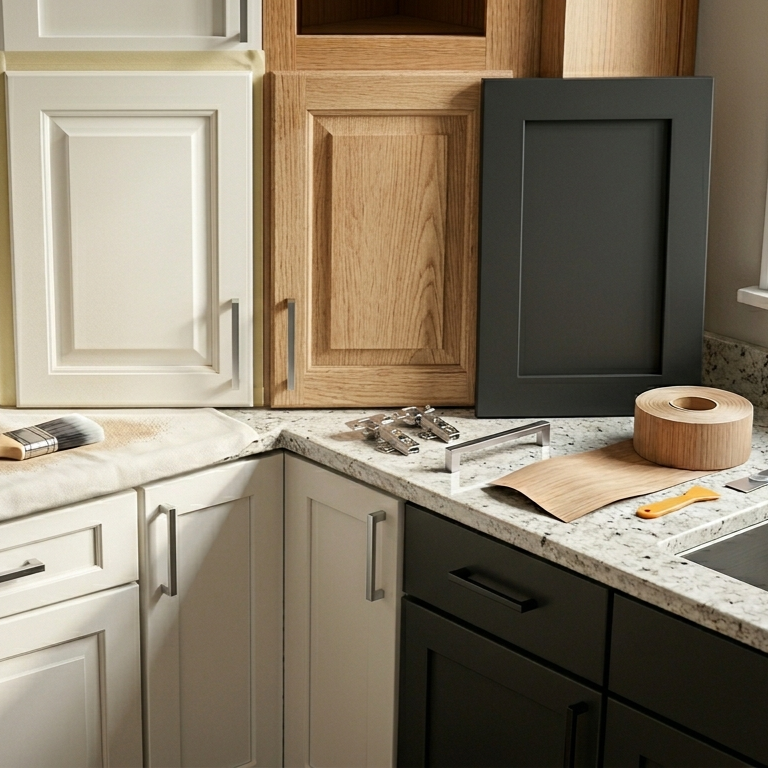
You reach up to open the cabinet above the stove and feel it again — that slight drag where your fingers always land, the paint edge catching instead of sliding. You have been ignoring it for two years because a kitchen overhaul sounds expensive and disruptive. But the corner is actually chipping now, and every time you catch it under the overhead light, the whole kitchen looks tired.
Cabinet painting and cabinet refacing both solve that problem. Neither requires demo work. Neither touches your counters or plumbing. But they're different enough in process, cost, and what you walk away with that choosing the wrong one means either overspending for what you needed or redoing the job in four years. Here's what drives the price of each, and how to figure out which one fits your kitchen.
What you're actually paying for with each option
Cabinet painting changes the finish. Every door comes off. Every surface gets degreased — kitchen grease is the real reason painted cabinets fail early, not bad paint — then sanded, primed, and coated with two or more layers of cabinet-grade enamel. The doors go back on after the paint cures. Same door. Same wood species. Same profile. New color.
Cabinet refacing replaces the parts that show. The boxes stay in place, but the door fronts and drawer faces come off entirely. New doors, new material, new style. The exposed face frames get skinned with a matching veneer or laminate. Hardware swaps out. You end up with a kitchen that looks structurally different, not just a different color.
That's the real gap between them. Painting renews the surface coating. Refacing replaces the door itself.
The numbers
Prices vary by kitchen size, door count, and how much prep or material work is involved. For a standard kitchen with around 20 linear feet of cabinetry — a 10×12 or 12×12 layout with upper and lower runs — the ranges look like this:
| Option | Typical Cost | Per Linear Foot | Project Timeline | Lifespan |
|---|---|---|---|---|
| Cabinet painting | $1,500–$4,000 | $75–$200 | 5–7 days + cure | 5–8 years |
| Cabinet refacing | $4,000–$9,000 | $200–$450 | 3–5 days | 15–20 years |
| Full replacement | $12,000–$35,000 | $600–$1,750 | 3–4 weeks | 20–30+ years |
The painting range is wide because prep work is where most of the labor lives, and it varies a lot depending on the existing surface. Cabinets that haven't been refinished since the 1990s have years of grease baked into the wood at the joints and around the hardware holes. Getting that off takes time. Cabinets last painted eight years ago take much less.
Refacing costs more upfront. But spread that cost over the lifespan, and the math shifts. A $3,500 paint job that needs redoing at year six isn't cheaper than $6,500 in refacing that holds for 18 years. Worth knowing before you decide based on price alone.
What drives the price of cabinet painting
Door count. Most painting estimates work off a per-door rate plus a flat charge for the frames. An average kitchen has 10–15 cabinet doors. A larger kitchen with a pantry and an island can have 20 or more, and every door adds labor hours.
Wood species and existing finish. Oak grain telegraphs through paint unless the surface gets grain-filled before priming. Skip that step and the wood texture shows right through the finish under direct light. Cabinets with factory-applied conversion varnish — common in kitchens from the late 1980s and 1990s — need aggressive deglossing or mechanical scuffing before paint will bond. If that step gets skipped, the finish peels at the corners in under a year.
Paint product. A water-based alkyd or cabinet-specific enamel costs more per gallon than standard latex wall paint, but it bonds harder, cleans better without scuffing, and doesn't yellow near the stove. What gets specified here affects both the line item on the estimate and how long the job holds.
Coat count. Two-coat jobs are the floor, not the standard. A quality cabinet finish runs three coats with sanding between each one. That's part of why a $1,000 quote and a $3,500 quote exist for the same kitchen — the lower number is often two coats with no blocking primer. The higher number includes proper prep, a blocking coat, three finish coats, and light cuts in between.
What drives the price of cabinet refacing
Door replacement vs. frame-only refacing. If you keep your existing doors and just skin the frames with veneer, the job costs less. If you replace the door fronts entirely — which is where the actual style change happens — costs go up because you're paying for new door blanks, hinges, and fitting labor on top of the framework.
Material selection. Thermofoil wrap is the least expensive option and looks clean on flat-panel doors. But it can peel at the edges in kitchens with high heat near the stove or dishwasher. Wood veneer holds up longer and costs more per running foot. Real wood door replacements carry the highest price but give you the most durable surface.
Add-ons. Refacing is a natural point to add soft-close hinges, pull-out shelves, or lazy Susans — those get built into the new door and hardware order. A basic refacing job is one price; a refacing job that converts six fixed shelves to pull-outs is a different number entirely.
Kitchen shape. A galley kitchen with two straight runs is the simplest layout. An L-shaped or U-shaped kitchen with corner cabinets, tall pantry units, and glass insert doors adds labor and material hours. Corner units require custom-cut veneers and careful fitting that a straight run doesn't.
Why the price gap between painting and refacing exists
Think of a painted cabinet finish like a hardwood floor that's been surface-coated instead of penetration-stained. It looks great and holds up fine for years — until daily contact works through it at the edges. You screen and recoat, you repair the worn spots, eventually you strip back to bare wood and start over. The wood itself hasn't changed. You're renewing the coating on a cycle.
Refacing replaces the parts that take the wear, rather than putting a new coat on top of them. New door fronts don't carry the old finish's failures. New veneer on the frames starts clean. That's where the lifespan gap comes from — not magic materials, just replacing what wears out instead of recoating it.
Neither option is universally right. Painting makes sense when the door style is what you want, and you only need a color change. But refacing is the answer when the door style itself is what feels dated — raised-panel oak in a kitchen you're trying to modernize, for example. Painting won't fix that. You'd spend $3,500 and still have a kitchen that looks like 2002.
How to decide
One thing applies to both options before anything else: the inside of your cabinet boxes matters. If the box wood shows any swelling, soft spots, or water staining — from a dishwasher leak, an under-sink drip, or years of condensation — painting or refacing the outside just puts new finish on a failing structure. Deal with any moisture source first.
Before getting any estimate, press lightly on the face frame inside each corner joint. Solid wood shouldn't flex. Any give at a joint, or any softness in the frame rather than firm wood, points to moisture damage inside the box — and that has to be addressed before paint or veneer goes on top of it.
With that checked, here's a quick guide to match your situation to the right path:
| Your situation | Consider |
|---|---|
| Like the door style, just want a new color | Cabinet painting |
| Door style feels dated and you want to change it | Cabinet refacing |
| Finish is peeling at handles and corners | Painting (with full prep) or refacing |
| Want to change door profiles or add storage features | Cabinet refacing |
| Budget under $4,000 | Cabinet painting |
| Budget $5,000–$9,000, staying in home 10+ years | Cabinet refacing |
| Cabinet boxes have soft spots or moisture damage | Full replacement |
One thing worth knowing in Twin Cities kitchens specifically: the humidity swing between July and January is steep. Summer kitchen humidity — especially without a vented range hood — runs high and puts moisture into the wood at the joints. By January the air is bone-dry and that wood contracts. Where paint bridges a joint, it eventually cracks along that seam, letting a little moisture in each summer. Over a few seasons, the paint starts lifting from the edge outward. Kitchens with a lot of steam cooking and no outside-venting hood will see painted cabinet edges wear faster than one that's properly ventilated.
Frequently Asked Questions
A well-prepped and properly applied cabinet paint job holds 5–8 years before you see meaningful wear at the high-contact points — edges, hinges, the area just above where handles get grabbed. Prep matters more than paint product. A cabinet that wasn't degreased properly before painting can start failing at those same spots in under two years, even with expensive paint on top of bad prep.
It depends on how long you plan to stay and what you're trying to change. If you're staying 10 or more years and the door style is part of what you want to update, refacing delivers more value than two rounds of painting over the same period. If you're planning to sell in three to four years, painting gets the kitchen looking fresh at a cost you're more likely to recover in the sale price.
Most solid-wood and plywood-box cabinets can be painted well. Thermofoil-wrapped or laminate door faces are harder — paint doesn't bond to the foil surface the same way it does to bare wood or MDF, and a loose edge anywhere on the door causes problems before the job's even done. Real wood and MDF doors are the best candidates. If your doors are thermofoil that's already peeling, painting isn't the right fix — that's a door-replacement situation.
High kitchen humidity — particularly in homes without a range hood that vents outside — speeds up finish wear at the joints and around hinges. Wood expands in humid conditions; where paint bridges a joint, it eventually cracks. That crack lets moisture in, and the paint starts lifting from the edge outward. This is also why some painted oak cabinets develop a network of fine lines across the flat panels: the grain moves with the seasonal humidity cycle and the paint can't move with it.
A cabinet painting quote should cover door removal, degreasing and sanding prep, primer, finish coats — ask specifically how many — and reinstallation. A refacing quote covers the material for door fronts and drawer faces, the veneer or laminate for the exposed frames, new hinges and hardware, and installation labor. Both should include a walkthrough of existing cabinet condition before any agreement. If a painter quotes without seeing the surfaces in person, the number they give you isn't reliable.
Solid wood in good structural shape is the best candidate for either option. But if the existing finish is failing badly — peeling all the way to bare wood, chipping in large sections, showing deep scratches through the primer — the prep work for a quality paint job increases significantly. In that scenario, get estimates for both painting and door-replacement refacing before deciding. The labor cost of heavy prep can close the price gap enough that refacing's longer lifespan makes more financial sense.
The math on your actual kitchen
Cabinet painting is the lower-cost option for a reason: it changes what the finish looks like without changing what the door is made of. That's a good fit when the door style works, the box is solid, and a color change is genuinely all you need. Refacing costs more because you're replacing the components that wear out, which resets how long before you're back to this same decision.
Neither option saves money if the box has a moisture problem underneath. And neither makes sense if the kitchen layout itself needs to change — at that point, the disruption cost of replacement is already priced in.
Cesar's Painting handles cabinet painting and refinishing across Woodbury, Maplewood, St. Paul, Minneapolis, Bloomington, and the Twin Cities metro. We do the degreasing, sanding, and priming before any finish goes on — because that's what the final coat actually depends on. Call (651) 650-4747 to schedule a free estimate.
