
Can You Paint Laminate or Thermofoil Cabinets?
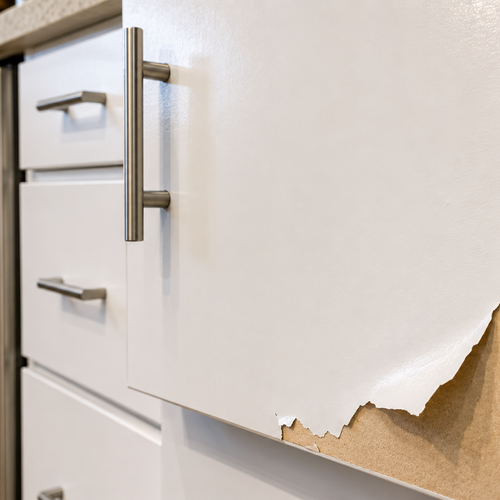
The white cabinet doors have been sticky for a year. You've scrubbed the edges a dozen times, but the peeling near the dishwasher keeps spreading — that thin plastic skin pulling away from the door like an old bumper sticker. You're not ready to spend $20,000 on new cabinets. So you're wondering whether paint is a real option.
It is. But what holds on laminate and thermofoil is different from what holds on wood, and the gap between doing it right and doing it over is almost entirely in what happens before a drop of paint touches the surface.
What laminate and thermofoil actually are
Both surfaces cover MDF — medium-density fiberboard, the same flat, uniform sheet material used for most budget-to-mid-range cabinets. Neither one is wood. That distinction matters when you're thinking about paint adhesion.
Thermofoil is a vinyl film vacuum-pressed onto the MDF face using heat. It's smooth, seamless, and looks like painted wood at a glance. Laminate is a plastic layer — sometimes flat-pressed, sometimes lightly textured — also bonded to the substrate, though the adhesive process differs slightly by manufacturer.
Both surfaces feel the same to the touch: almost glassy. That's the problem.
Paint bonds by gripping microscopic texture — tiny peaks and valleys that let the coating lock in as it cures. On bare wood, those peaks come from the grain itself. On laminate and thermofoil, you're working against a surface engineered to be perfectly flat and easy to clean. Easy to clean is the opposite of easy to paint.
Why standard paint fails on these surfaces
The chemistry matters here. Standard latex primers carry an acrylic resin binder that needs surface texture to mechanically grab onto. On a slick vinyl or plastic film, the binder sits on top rather than locking in. It looks fine for weeks. Then someone wipes the door too aggressively, or the door flexes when it's closed hard, and the paint sheet-separates. Not flakes — sheets.
Temperature makes it worse. Thermofoil's adhesive bond to the MDF weakens above roughly 150°F. Near a dishwasher door or a range hood, the heat cycling softens the vinyl and pulls at whatever coating is sitting on top. In a Minnesota kitchen, you get the opposite problem half the year: bone-dry air in January contracts both the MDF substrate and the vinyl film, while July and August bring 70 to 80% relative humidity that expands them back. That seasonal movement is slow and invisible — but over a couple of years, it finds every weak point in your primer bond.
The prep that actually changes the outcome
Eighty percent of whether painted laminate or thermofoil lasts comes down to three steps before you open a paint can.
Degrease first. The surface looks clean, but a kitchen cabinet door has months or years of cooking oil atomized onto it. Soap and water aren't enough. Use a dedicated degreaser — TSP substitute or a concentrated cabinet cleaner — and wipe every surface twice. The second pass usually comes off dirtier than you'd expect.
Sand after. This is where people go wrong in both directions. Too light and you haven't created enough texture. Too heavy and you break through the vinyl film and expose raw MDF, which absorbs primer like a sponge and creates soft spots under the finish. A 220-grit sanding block or sponge, light hand, full surface coverage. You're not removing material. You're scuffing the surface just enough that a bonding primer has something to grip.
After sanding, wipe every surface with a tack cloth or slightly damp rag to remove every particle of dust. Dust acts as a release agent between primer and surface. It ruins the bond.
Any edges that are already peeling need attention before paint goes near them. Re-glue them with contact cement, press flat, and let them fully cure. Painting over a lifted edge produces paint that lifts off with the thermofoil when the film continues to delaminate.
Primers that stick — and one that often doesn't
Not all primers work on slick surfaces. A standard interior latex primer will fail on thermofoil. Possibly not immediately, but it will fail.
Two products consistently produce results on these surfaces:
INSL-X Stix bonding primer is specifically formulated for non-porous and glossy surfaces. It uses an adhesion-promoting resin system that grips where standard acrylics won't. It's water-based, cleans up easily, and one full coat is typically sufficient before topcoat.
Zinsser BIN is shellac-based. Shellac has a long track record as a universal bonding agent — it sticks to nearly anything, including problem surfaces that reject water-based primers. It dries fast, about 30 to 45 minutes, sands well, and seals bleed-through from the MDF substrate. The tradeoff is cleanup with denatured alcohol instead of water, and the fumes require ventilation.
Zinsser Bulls Eye 1-2-3 works on intact thermofoil in lower-stress applications — a bathroom vanity with low heat exposure, for example. For kitchen cabinets adjacent to the dishwasher or range, professionals in finishing trade forums have documented bond failures with 1-2-3 specifically in high-heat locations. Go with Stix or BIN for kitchens.
Apply primer thin. Two thin coats beat one heavy coat every time on slick substrates.
Let bonding primer cure a full 24 hours before topcoat — not just until it feels dry to the touch. Shellac-based primers like BIN feel dry in 45 minutes, but need the full cure time for the adhesion chemistry to complete.
The paint that holds up
Self-leveling waterborne alkyd is the right call for laminate and thermofoil. This class of paint behaves like latex during application — water-based, low-odor, easy cleanup — but it cross-links as it cures and hardens closer to an enamel. The result is a finish that resists impact, cleaning, and the daily friction of fingers opening cabinet doors.
Benjamin Moore Advance is the most consistently cited product in this category. It has extended open time — meaning it stays workable longer — which reduces brush strokes and allows the surface to self-level before the film sets. Semi-gloss is the right sheen for most cabinet applications: cleanable, durable, and forgiving about fingerprints compared to gloss.
Sherwin-Williams Emerald Urethane Trim Enamel is a strong alternative, particularly if you're applying with a finish sprayer. A sprayer produces the smoothest result on flat thermofoil panels and eliminates brush and roller texture entirely.
One note on color: if you're going light on thermofoil that was originally white, avoid oil-based formulas. They yellow over time from both UV and heat, and on a white or off-white cabinet, that shift becomes obvious within a year or two. Stay water-based.
Apply in thin coats. Two are the minimum; three are better if the surface required significant prep. Sand lightly between coats with 320-grit, wipe the dust, then apply the next coat. The inter-coat sanding is what gives the final surface its smoothness — laminate and thermofoil pick up every application mark.
Heat and humidity: the real enemy in a Minnesota kitchen
Think of painted thermofoil like a sticker on the inside of a car window. In moderate conditions, it holds indefinitely. Leave the car in the summer sun for a season, and the adhesive breaks down at the edges — even though the vinyl itself is still intact.
The heat near a dishwasher is the most common failure point on kitchen cabinets. The side panels of the cabinet box adjacent to the dishwasher show temperature spikes every time a drying cycle runs. Painting right up to those panels without insulation creates a near-certain failure zone over time. If you're painting those surfaces, a heat shield installed on the dishwasher sidewall costs $20 to $30 and keeps the surface temperature well below the threshold at which thermofoil adhesive softens.
Cabinets above and beside the range face the same problem. Cooking oil vapor and heat are what turn white thermofoil yellow long before paint enters the picture — and they shorten the life of any coating applied over it.
The freeze-thaw cycles from October through March add a separate stress. Ice and condensation that form on exterior wall-adjacent cabinets — kitchen soffits, cabinet boxes on outside walls — put the same expansion-and-contraction pressure on the laminate bond. If those surfaces show any existing bubbling or edge lift, that's where paint will fail first.
When stripping the thermofoil makes sense
Stripping the thermofoil off before painting is sometimes presented as the cleaner route — you'd be painting bare MDF directly, which takes primer more like wood. In practice, it's more complicated.
On cabinets older than 15 years, the heat-activated adhesive has often started to break down. A heat gun on a low setting applied to the edge seam can loosen the vinyl enough to peel it away in large sheets. The older the cabinet, the more likely it peels cleanly.
On newer cabinets with a strong adhesive bond, forced removal often pulls the MDF face paper off with it. You're left with a substrate that's uneven, soft, and difficult to sand smooth without creating depressions. That substrate then needs a skim coat before it accepts paint well — adding labor and material cost.
Unless the thermofoil is already peeling badly and the surface is no longer bondable as-is, stripping adds work and risk without guaranteed improvement. If the vinyl is intact, scuff and prime it. If it's lifting significantly at multiple edges, assess whether you're better off stripping or simply refacing.
How long it actually lasts
DIY painting — standard primers, standard application — typically holds 1 to 3 years before wear shows at hardware locations and edges. A professional application with the right bonding primer extends that to 3 to 5 years in most kitchen environments. The honest ceiling for painted thermofoil, even done well, is roughly 5 years before you're considering repainting or refacing.
Cabinet refacing with new door fronts typically carries a 15 to 20-year lifespan. Full replacement, longer still.
Painting makes sense in two situations: you're selling the house within a couple of years and want freshened cabinets for showings, or the budget isn't available right now, and you need a few more years out of the existing boxes. If you're staying in the house long-term and the cabinet boxes themselves are structurally sound, refacing is worth pricing out as a comparison.
Frequently Asked Questions
Not if you want the paint to last beyond the first year. The sanding step isn't about removing material — it's creating surface texture for the bonding primer to grip mechanically. Skip it and the primer sits on a glass-smooth film. It may look fine for months, then lift.
Both are smooth, non-porous surfaces bonded to an MDF substrate, and both require the same preparation: degrease, scuff-sand with 220-grit, apply a bonding primer, then a waterborne alkyd topcoat. Thermofoil is a vinyl film applied with heat and vacuum; laminate is a plastic sheet pressed with adhesive. The painting process for both is essentially the same.
Professional cabinet painting runs $1,000 to $2,500 for a typical kitchen, depending on cabinet count, door style complexity, and surface condition. DIY materials — bonding primer, a self-leveling cabinet paint, foam rollers, and brushes — typically total $150 to $300 for an average kitchen.
Yes. White is one of the more forgiving colors for coverage on thermofoil. Use a water-based waterborne alkyd — not oil-based. Oil-based paint yellows over time, especially when exposed to cooking heat, and that shift is obvious on white or off-white cabinets.
Waterborne alkyds feel dry to the touch within a few hours, but continue curing and hardening for 7 to 30 days. Hang the doors back after 3 to 7 days, but treat them gently for at least 2 to 3 weeks afterward. Cleaning with anything abrasive or alkaline before full cure can permanently mar the finish.
No. Done right, it's a 3 to 5-year solution. The vinyl surface will always present an adhesion challenge, and daily use — especially around hardware and near heat sources — wears the finish faster than it would on wood. It's a practical bridge, not a long-term renovation.
Cesar's Painting handles cabinet painting and refinishing across Woodbury, Maplewood, St. Paul, Minneapolis, Bloomington, and the Twin Cities metro. We work with laminate and thermofoil surfaces regularly and use bonding primer systems built for real kitchen conditions. Call (651) 650-4747 to schedule a free estimate.
